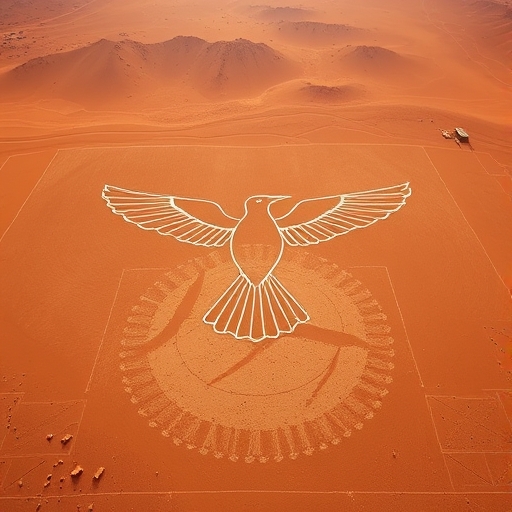
In the midst of the arid Pampa Colorada, a high-altitude desert plateau stretching as far as the eye can see in southern Peru, a mystery has been captivating human imagination for centuries. Here, on the surface of the red-weathered and barren earth, lies an ancient art gallery that is the most extraordinary on the planet: the Nazca Lines (Garis-garis Nazca).
Evolution of Giant Geoglyph Art
These lines are not meaningless scribbles, but a series of geoglyphs or artworks on the ground created on a scale that is breathtaking. Over 70 animal and plant designs known as biomorphic have been identified, including a 50-meter-long hummingbird, intricate spiders, whales, monkeys, and even a dog with a curved tail. In addition, there are hundreds of geometric shapes and straight lines that cut through the sand like giant aircraft runways.
The greatness of this art lies in its creation technique. The Nazca civilization, which flourished between 500 BC and 500 AD, created this work with an innovative yet simple method. They removed a layer of red-brown rock with iron oxide to reveal the pale yellow soil beneath. In the arid and wind-protected area, this artwork has remained intact for over 1,500 years.
Theories of Function: Science, Ritual, or Outer Space?
What makes the Nazca Lines so captivating is the fundamental question:
What was it made for? Scholars and archaeologists have proposed various conflicting theories.
Astronomical Calendar: Mathematician and archaeologist Maria Reiche spent most of her life studying these lines. She argued that they functioned as a large astronomical calendar. According to her, the lines were arranged to align with the positions of the sun, moon, and specific stars, helping Nazca farmers to determine planting cycles and harvest seasons accurately.
Ritual Water and Fertility: A theory now widely accepted by the archaeological community links the lines to water worship. In the extremely dry desert, water is the most vital source of life. Some studies suggest that geometric lines are pathways for Nazca rituals to seek rain or fertility from their gods. Some lines are said to align with underground water sources or puquios, ancient sophisticated irrigation systems.
Alien Runway: It would be incomplete to discuss Nazca without touching on the more controversial theory of alien involvement. Author Erich von Däniken in his book Chariots of the Gods? believes that these lines are a landing strip for spacecraft from an alien civilization. This theory is often linked to human-like designs among the geoglyphs. Although popular in pop culture, it is rejected by most scientists due to a lack of empirical evidence and ignoring the ingenuity of ancient human engineering.
Irreplaceable Heritage
In 1994, UNESCO recognized the Nazca Lines and Pampas de Jumana as a World Heritage Site. However, their existence is now threatened by new challenges due to climate change and modern human activities such as illegal mining and infrastructure encroachment.
Regardless of whether it is a star map, a sacred path for a rain god, or a gift from another civilization, the Nazca Lines remain a testament to the wisdom and creativity of our ancient ancestors. They remind us that even without modern technology, our forebears had a deep understanding of the universe and the ability to transform landscapes in a way that has lasted for over two millennia.
مystery of Nazca Dunes: The Amazing Giant Drawings of the Andes Desert. Exploring the archaeological wonders of the Peruvian desert that holds thousands of giant geoglyphs, the creations of the Nazca civilization that still puzzle experts to this day.. In the midst of the arid Pampa Colorada, a high-altitude desert plateau stretching as far as the eye can see in southern Peru, a mystery has been captivating human imagination for centuries. Here, on the surface of the red-weathered and barren earth, lies an ancient art gallery that is the most extraordinary on the planet: the Nazca Lines Garis-garis Nazca .
Evolution of Giant Geoglyph Art
These lines are not meaningless scribbles, but a series of geoglyphs or artworks on the ground created on a scale that is breathtaking. Over 70 animal and plant designs known as biomorphic have been identified, including a 50-meter-long hummingbird, intricate spiders, whales, monkeys, and even a dog with a curved tail. In addition, there are hundreds of geometric shapes and straight lines that cut through the sand like giant aircraft runways.
The greatness of this art lies in its creation technique. The Nazca civilization, which flourished between 500 BC and 500 AD, created this work with an innovative yet simple method. They removed a layer of red-brown rock with iron oxide to reveal the pale yellow soil beneath. In the arid and wind-protected area, this artwork has remained intact for over 1,500 years.
Theories of Function: Science, Ritual, or Outer Space?
What makes the Nazca Lines so captivating is the fundamental question: What was it made for? Scholars and archaeologists have proposed various conflicting theories.
Astronomical Calendar: Mathematician and archaeologist Maria Reiche spent most of her life studying these lines. She argued that they functioned as a large astronomical calendar. According to her, the lines were arranged to align with the positions of the sun, moon, and specific stars, helping Nazca farmers to determine planting cycles and harvest seasons accurately.
Ritual Water and Fertility: A theory now widely accepted by the archaeological community links the lines to water worship. In the extremely dry desert, water is the most vital source of life. Some studies suggest that geometric lines are pathways for Nazca rituals to seek rain or fertility from their gods. Some lines are said to align with underground water sources or puquios , ancient sophisticated irrigation systems.
Alien Runway: It would be incomplete to discuss Nazca without touching on the more controversial theory of alien involvement. Author Erich von Däniken in his book Chariots of the Gods? believes that these lines are a landing strip for spacecraft from an alien civilization. This theory is often linked to human-like designs among the geoglyphs. Although popular in pop culture, it is rejected by most scientists due to a lack of empirical evidence and ignoring the ingenuity of ancient human engineering.
Irreplaceable Heritage
In 1994, UNESCO recognized the Nazca Lines and Pampas de Jumana as a World Heritage Site. However, their existence is now threatened by new challenges due to climate change and modern human activities such as illegal mining and infrastructure encroachment.
Regardless of whether it is a star map, a sacred path for a rain god, or a gift from another civilization, the Nazca Lines remain a testament to the wisdom and creativity of our ancient ancestors. They remind us that even without modern technology, our forebears had a deep understanding of the universe and the ability to transform landscapes in a way that has lasted for over two millennia.