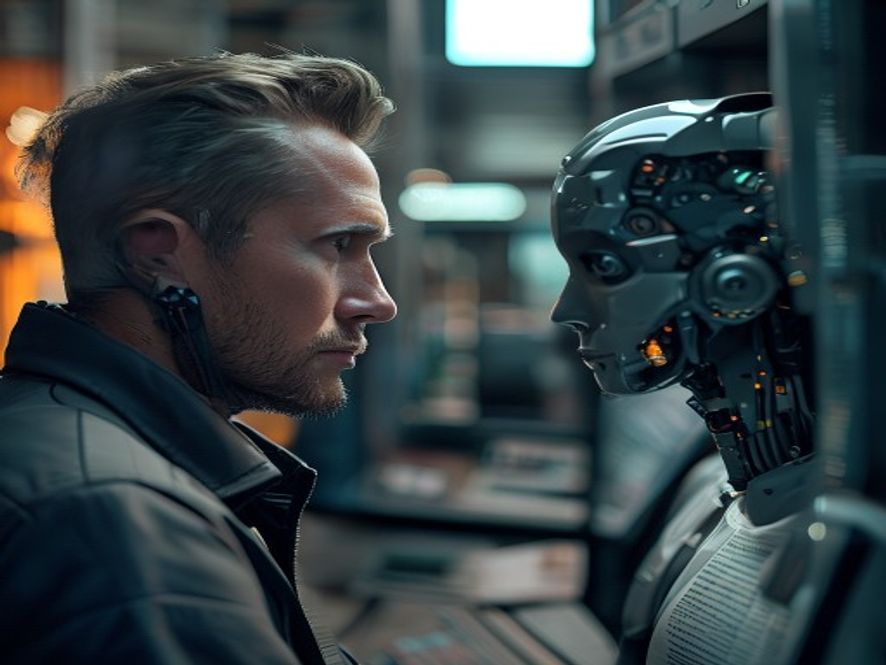
TITLE: AI and Jobs: Not a Human vs Machine Battle, but a Test of Adaptability
SUMMARY: The development of artificial intelligence (AI) is not only changing the way we work—it is challenging education systems, social policies, and the concept of work itself. This article examines the complex reality behind the 'job replacement' narrative: from the risks of task shifts to the opportunities for new roles, from the widening skills gap to the need for smarter policies—based on verified facts and without unfounded speculation.
Imagine machines that not only operate machinery, but also analyze medical images, review legal documents, or help teachers tailor teaching methods. This is not science fiction—it is already happening. However, behind this technical advancement, the main question is no longer *what* AI can do, but *who* will hold power over this change—and who will be left behind.
Cognitive Automation: When Machines Start Thinking Differently
Concerns about automation are not new. Since the Industrial Revolution, technology has replaced physical tasks—but AI brings a qualitative change: it automates cognitive functions. It is not just replacing workers in mines or factories, but also financial analysts, translators, and administrative support officers.
According to data from the Organisation for Economic Co-operation and Development (OECD), approximately 14% of jobs in its member countries are at high risk of being fully automated, while another 32% are likely to experience significant changes in daily tasks. These numbers are not disaster predictions—they indicate that the structure of jobs is changing, not collapsing.
Creation vs Replacement: Numbers Often Misunderstood
Predictions about the number of jobs that will be created or lost are often presented in isolation—without context. A Gartner study states that AI will generate 2.3 million new jobs by 2030, while causing the loss of 1.8 million. The net result is positive, but these numbers do not explain two important factors: first, the time period between job losses and job creation; second, whether workers affected by these changes are suitable for the new roles.
A report from the World Economic Forum (WEF) also notes that automation could replace 85 million jobs by 2025, but create 97 million new roles. The critical question remains the same: can those who lose their jobs as taxi drivers or call center operators truly transition to roles such as algorithm auditors or AI system integration experts—without systematic training, financial support, and access to opportunities?
Education Left Behind by Technology
Education systems in many countries are still built for the industrial era—emphasizing standardization, memorization, and exam-based assessments. They leave little room for skills that are increasingly valuable in the AI ecosystem: critical thinking, solving non-routine problems, cross-cultural communication, and emotional intelligence.
Some countries have taken proactive steps. Singapore launched the *SkillsFuture* program, which provides financial incentives for citizens to take new skill courses. Finland, meanwhile, introduced a national initiative to improve AI literacy among the general public. However, in many developing countries, access to quality training is still limited by digital infrastructure, cost, and lack of targeted supportive policies.
Policies Unprepared for the New Reality
Government responses to AI vary—from a free-market approach to efforts to restructure the social contract. Proposals for a 'robot tax,' for example, although not widely implemented, reflect pressure to ensure that the economic benefits of AI are fairly shared. This concept is not about hindering innovation, but about funding a safety net—such as retraining, career transition support, or temporary income assistance.
Ethical issues also influence the acceptance of AI. Bias in algorithms, transparency of automated decisions, and personal data protection are not just technical issues—they are matters of public trust. The OECD AI Guidelines, which emphasize fairness, transparency, and accountability, are an important reference—but their implementation still depends on political commitment and institutional capacity in each country.
What Is Really Changing?
Not all sectors will be affected equally. Jobs requiring deep emotional interaction—such as chronic patient care, early childhood education, or psychosocial rehabilitation—are still difficult to fully replace. Conversely, repetitive tasks based on patterns and dependent on structured data—such as administrative processes, standard image recognition, or document review—are more vulnerable to change.
The most obvious change is not absolute job loss, but *reclassification* of tasks. A accountant today may spend less time calculating and more analyzing risks. A radiologist doctor may use AI as a diagnostic aid—not be replaced by it.
Concrete Steps, Not Simplistic Narratives
The narrative of 'robots taking our jobs' ignores a basic fact: AI is a tool—not an actor. Its impact depends on human choices: how the technology is designed, regulated, and distributed. For workers, the focus should shift from fear to mastery—basic digital skills, data literacy, and the ability to continuously relearn. For organizations, investment in workforce reskilling is not an additional cost—it is an operational resilience strategy. For governments, policies must move from reactive to anticipatory: strengthening vocational education systems, expanding access to lifelong learning, and ensuring social protection is not tied to traditional employment models.
AI is not a threat or savior—it is a reflection of our choices. Its success or failure in facing this era will be measured not by the speed of technological innovation, but by the fairness of benefit distribution.
---
*References: [Artificial Intelligence — Wikipedia](https://ms.wikipedia.org/wiki/Kecerdasan_buatan)*