Blood on a Frozen Earth: An Exciting Introduction
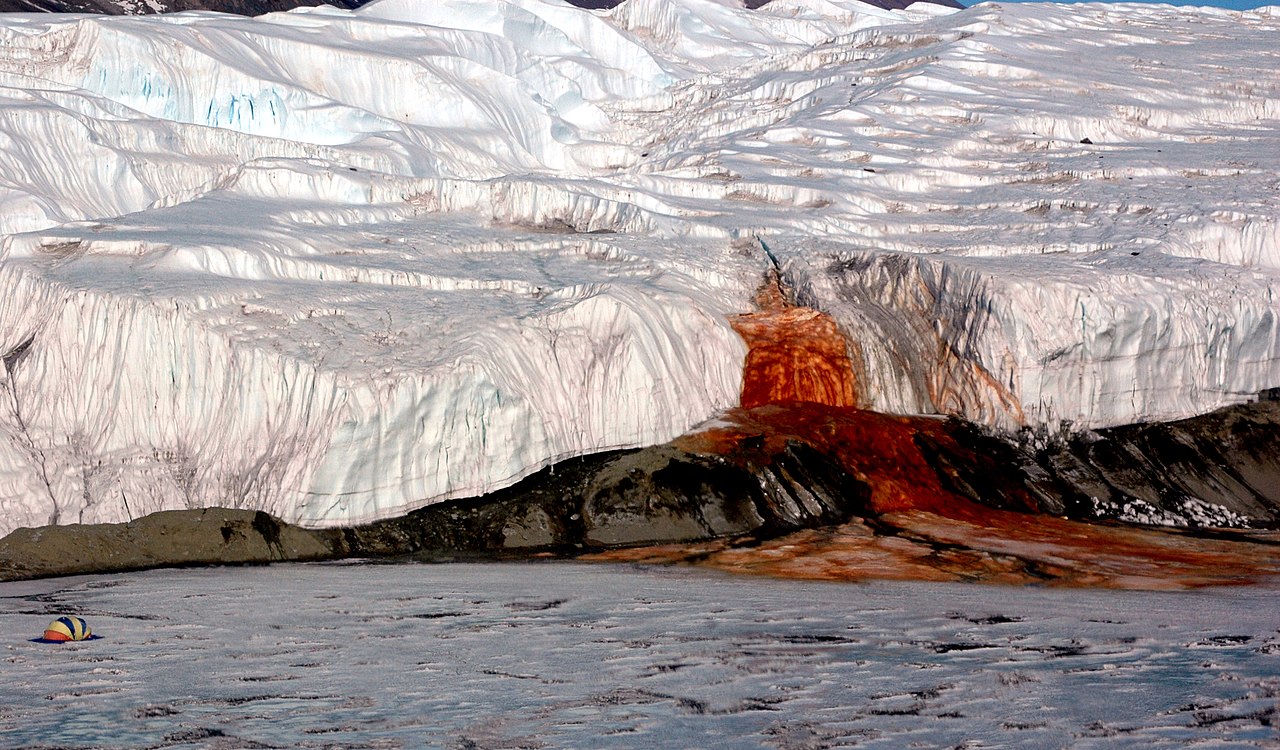
Imagine walking through the silent ice valley in East Antarctica. No sounds other than the howling wind. Suddenly, before your eyes, a small waterfall flows from the glacier—not clear, but dark red like blood. That is Blood Falls, a phenomenon that has fascinated and puzzled the world since 1911. Its discoverer, Australian geologist Thomas Griffith Taylor, initially thought the color came from red algae. However, subsequent analysis proved it was iron(III) oxide. But behind this scientific explanation, there are still unanswered mysteries: what is actually happening beneath the 400-meter thick ice layer?
Facts Behind the Red Color
Blood Falls is located in Taylor Valley, McMurdo Dry Valleys, Victoria Land. It is not an ordinary waterfall, but a spill of hypersaline saltwater rich in iron, emerging from small cracks in the tongue of Taylor Glacier. This water flows into West Lake Bonney—a frozen lake covered with ice. The source of this saltwater is an unknown-sized subglacial pool, trapped under about 400 meters of ice, several kilometers from where it emerges at Blood Falls.
According to studies, the red color is produced when saltwater rich in ferrous (Fe²⁺) is exposed to oxygen at the surface, then oxidized into ferric oxide (Fe³⁺), which gives a rust-like red color. This process is similar to the formation of rust on iron. However, what makes this phenomenon extraordinary is the presence of microorganisms living in this super-salty and cold water, without sunlight and oxygen. They are evidence of extremophilic life that can exist in the most extreme environments on Earth—and perhaps on other planets like Mars.
Hypotheses and Questions
Although the chemical explanation seems sufficient, scientists still wonder: how did this saltwater pool form? One hypothesis suggests that the saltwater was trapped from an ancient ocean that existed millions of years ago, before Antarctica was covered in ice. The process of concentration by ice and glacial pressure may have kept this saltwater in a liquid state at freezing temperatures.
Other questions: is the life under the glacier more complex than known? The discovery of microbes that use iron as a power source (iron metabolism) opens speculation about the possibility of a larger subglacial ecosystem. Perhaps there are new species yet to be discovered? Or is Blood Falls just the surface of something bigger—like a vast subglacial lake like Lake Vostok?
Mystery and Controversy
Since Taylor's discovery, some have tried to link Blood Falls with local myths or paranormal phenomena. However, modern science rejects any supernatural elements. But controversy arises when some researchers question whether the red color is entirely from iron or if there are other factors—such as organic compounds from dead microorganisms. Experiments with samples from Blood Falls show the presence of very small nano-iron particles, which give a darker and more stable red color. This raises new questions: how do these nano-particles form in a cold and oxygen-free environment?
Implications for Life Beyond Earth
Blood Falls is not just a natural wonder—it is an analogy for the possibility of life on other planets. Mars, with its red surface rich in iron oxides, and its polar ice caps, may harbor similar subglacial saltwater. Microbes in Blood Falls could serve as a model for life that might exist beneath the surface of Mars or the moon Europa of Jupiter. Studies on how these microbes survive and use iron as a power source could pave the way for space missions searching for extraterrestrial life.
Conclusion: Between Facts and Questions
Blood Falls is proof that nature still holds secrets beyond imagination. From the explanation about iron oxides to the potential of extremophilic life, this phenomenon teaches us not to be satisfied with easy answers. Questions about the size of the subglacial pool, the origin of the saltwater, and the possibility of complex life beneath the ice remain to be answered. Perhaps one day, further research will reveal more secrets—or maybe this mystery will remain as an unexplained blood waterfall forever.
---
Reference: Blood Falls — Wikipedia
Blood Falls of Antarctica: The Red Mystery of Taylor Glacier. Amidst the quiet expanse of Antarctic ice, a red flow resembling blood adorns Taylor Glacier. Discovered in 1911, Blood Falls continues to confuse scientists with its mysterious red color. Is it merely an iron oxide effect, or does it hide ancient subglacial secrets? This article reveals the facts, hypotheses, and questions behind this anomalous phenomenon.. Blood on a Frozen Earth: An Exciting Introduction
Imagine walking through the silent ice valley in East Antarctica. No sounds other than the howling wind. Suddenly, before your eyes, a small waterfall flows from the glacier—not clear, but dark red like blood. That is Blood Falls, a phenomenon that has fascinated and puzzled the world since 1911. Its discoverer, Australian geologist Thomas Griffith Taylor, initially thought the color came from red algae. However, subsequent analysis proved it was iron III oxide. But behind this scientific explanation, there are still unanswered mysteries: what is actually happening beneath the 400-meter thick ice layer?
Facts Behind the Red Color
Blood Falls is located in Taylor Valley, McMurdo Dry Valleys, Victoria Land. It is not an ordinary waterfall, but a spill of hypersaline saltwater rich in iron, emerging from small cracks in the tongue of Taylor Glacier. This water flows into West Lake Bonney—a frozen lake covered with ice. The source of this saltwater is an unknown-sized subglacial pool, trapped under about 400 meters of ice, several kilometers from where it emerges at Blood Falls.
According to studies, the red color is produced when saltwater rich in ferrous Fe²⁺ is exposed to oxygen at the surface, then oxidized into ferric oxide Fe³⁺ , which gives a rust-like red color. This process is similar to the formation of rust on iron. However, what makes this phenomenon extraordinary is the presence of microorganisms living in this super-salty and cold water, without sunlight and oxygen. They are evidence of extremophilic life that can exist in the most extreme environments on Earth—and perhaps on other planets like Mars.
Hypotheses and Questions
Although the chemical explanation seems sufficient, scientists still wonder: how did this saltwater pool form? One hypothesis suggests that the saltwater was trapped from an ancient ocean that existed millions of years ago, before Antarctica was covered in ice. The process of concentration by ice and glacial pressure may have kept this saltwater in a liquid state at freezing temperatures.
Other questions: is the life under the glacier more complex than known? The discovery of microbes that use iron as a power source iron metabolism opens speculation about the possibility of a larger subglacial ecosystem. Perhaps there are new species yet to be discovered? Or is Blood Falls just the surface of something bigger—like a vast subglacial lake like Lake Vostok?
Mystery and Controversy
Since Taylor's discovery, some have tried to link Blood Falls with local myths or paranormal phenomena. However, modern science rejects any supernatural elements. But controversy arises when some researchers question whether the red color is entirely from iron or if there are other factors—such as organic compounds from dead microorganisms. Experiments with samples from Blood Falls show the presence of very small nano-iron particles, which give a darker and more stable red color. This raises new questions: how do these nano-particles form in a cold and oxygen-free environment?
Implications for Life Beyond Earth
Blood Falls is not just a natural wonder—it is an analogy for the possibility of life on other planets. Mars, with its red surface rich in iron oxides, and its polar ice caps, may harbor similar subglacial saltwater. Microbes in Blood Falls could serve as a model for life that might exist beneath the surface of Mars or the moon Europa of Jupiter. Studies on how these microbes survive and use iron as a power source could pave the way for space missions searching for extraterrestrial life.
Conclusion: Between Facts and Questions
Blood Falls is proof that nature still holds secrets beyond imagination. From the explanation about iron oxides to the potential of extremophilic life, this phenomenon teaches us not to be satisfied with easy answers. Questions about the size of the subglacial pool, the origin of the saltwater, and the possibility of complex life beneath the ice remain to be answered. Perhaps one day, further research will reveal more secrets—or maybe this mystery will remain as an unexplained blood waterfall forever.
---
Reference: Blood Falls — Wikipedia https://en.wikipedia.org/wiki/Blood Falls