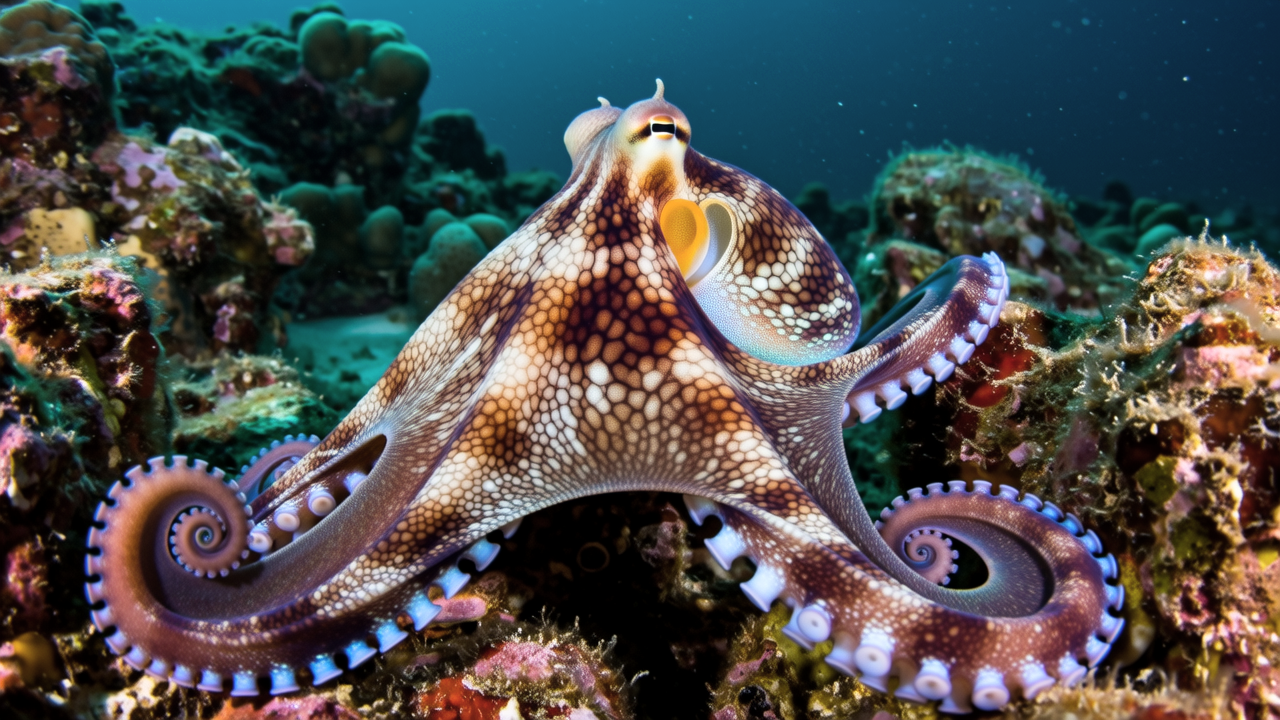
One of the greatest mysteries in evolutionary biology is how octopuses — clinically color blind because they have only one type of photoreceptor in their eyes — can mimic the colors of their surroundings with astonishing accuracy for camouflage.
Octopuses use three types of specialized cells in their skin to change their appearance: chromatophores (pigment-containing membrane-bound cells in elastic sacs that can expand and contract within milliseconds), iridophores (cells containing reflective plates that produce metallic iridescent colors through light interference), and papillae (muscular skin protrusions that can change the surface texture from smooth to spiky within less than a second).
This skin control system is extremely fast and precise — octopuses can change their entire body appearance in 1/10 of a second. This is faster than a human blink. More surprisingly, this control occurs through a nervous system that sends signals directly to the skin cells without going through the central brain — each part of the skin has a degree of autonomous control.
The current theory on how octopuses 'see' colors even though they are color blind suggests that their unusual pupil shape ('W' or 'U'-shaped) allows the use of chromatic aberration — the difference in how different colors are focused on the retina — to provide information about color. Other studies suggest the possibility of photoreceptors in the octopus's own skin that allow 'skin vision' — seeing light directly through the skin without going through the eyes.
🔬 Science Facts #24: Octopuses Can Change Color in 1/10 of a Second Even Though They Are Color Blind. Octopuses, despite being color blind, can perfectly mimic the colors and patterns of their surroundings in less than a tenth of a second — a capability that is still not fully explained by science.. One of the greatest mysteries in evolutionary biology is how octopuses — clinically color blind because they have only one type of photoreceptor in their eyes — can mimic the colors of their surroundings with astonishing accuracy for camouflage.
Octopuses use three types of specialized cells in their skin to change their appearance: chromatophores pigment-containing membrane-bound cells in elastic sacs that can expand and contract within milliseconds , iridophores cells containing reflective plates that produce metallic iridescent colors through light interference , and papillae muscular skin protrusions that can change the surface texture from smooth to spiky within less than a second .
This skin control system is extremely fast and precise — octopuses can change their entire body appearance in 1/10 of a second. This is faster than a human blink. More surprisingly, this control occurs through a nervous system that sends signals directly to the skin cells without going through the central brain — each part of the skin has a degree of autonomous control.
The current theory on how octopuses 'see' colors even though they are color blind suggests that their unusual pupil shape 'W' or 'U'-shaped allows the use of chromatic aberration — the difference in how different colors are focused on the retina — to provide information about color. Other studies suggest the possibility of photoreceptors in the octopus's own skin that allow 'skin vision' — seeing light directly through the skin without going through the eyes.
Tags:
Biologi laut, Kajian sains, Trend sains, Sains Indonesia, Perubahan warna, Sains modern, Hewan laut, Gurita Malaysia, Ilmu pengetahuan, Kemampuan biologis, Penjelasan sains, Mekanisme adaptasi, Sains Malaysia, Gurita, Teknologi sains, Fakta Sains, Buta warna, Sains dan teknologi, Gurita Indonesia, Sains & Teknologi