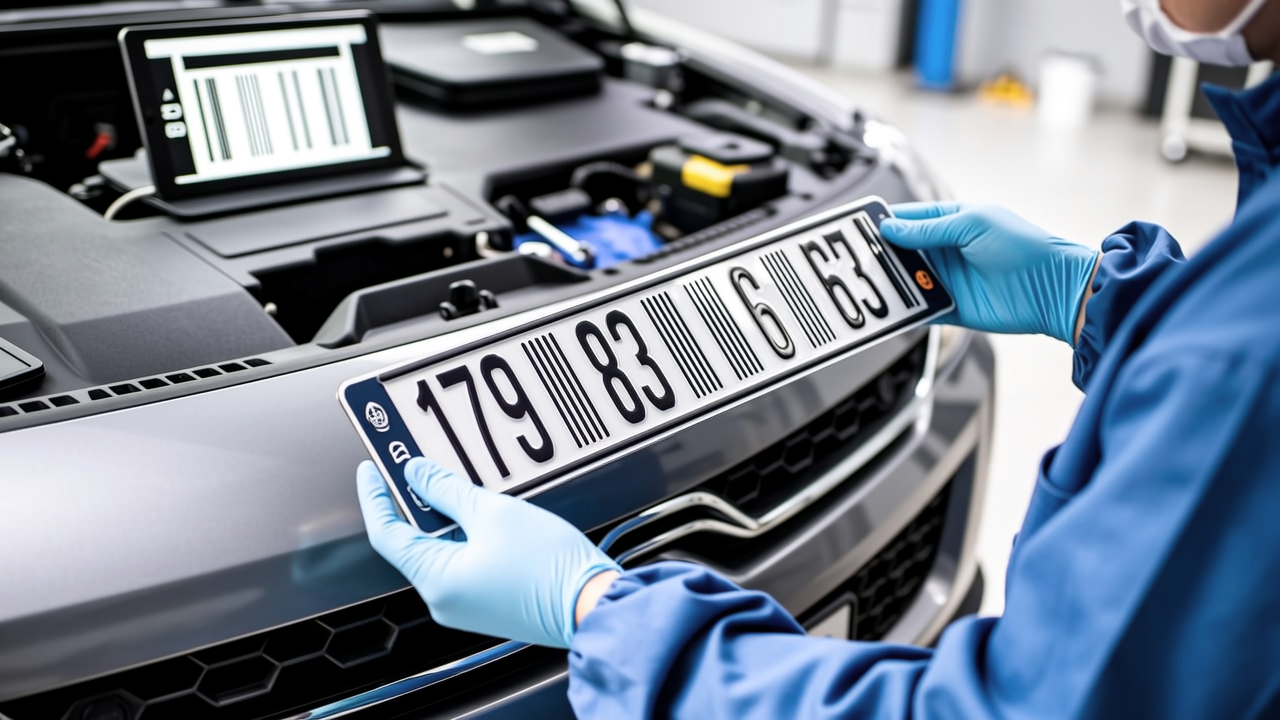
Have you ever wondered what lies behind the sequence of letters and numbers on your vehicle's dashboard or documents? That is the VIN, or Vehicle Identification Number. More than just a unique code, the VIN actually contains various important pieces of information about your car — from the country of manufacture to the engine type.
What is a VIN and where can I find it?
A VIN is a unique 17-character identifier assigned to each vehicle. It is like your car's ID card. Common locations include:
- On the dashboard on the driver's side, visible through the windshield.
- On the driver's door jamb.
- Under the hood, on the engine block or firewall.
- In vehicle documents such as the title or logbook.
How to read a VIN? What does each character mean?
A VIN consists of three main parts: WMI (World Manufacturer Identifier), VDS (Vehicle Descriptor Section), and VIS (Vehicle Identifier Section). Let's break them down one by one.
1. Characters 1–3: WMI – Manufacturer and Country
The first character indicates the country where the vehicle was manufactured. For example:
- J for Japan (e.g., Toyota, Honda)
- 1, 4, 5 for the United States
- W for Germany (e.g., Mercedes-Benz, BMW)
- V for France (e.g., Peugeot, Citroën)
- M for Malaysia (e.g., Proton, Perodua)
The second character represents the manufacturer. The combination of the first two characters is sufficient to identify the brand. For example, JM refers to Mitsubishi.
2. Characters 4–9: VDS – Vehicle Description
This section provides specific information such as model, body type, engine, and safety systems. However, each manufacturer has the freedom to interpret these characters according to their own system. Generally:
- Characters 4–8: Details such as model series, engine type, and transmission.
- Character 9: Check digit used to verify the validity of the VIN.
3. Characters 10–17: VIS – Year and Serial Number
Character 10 indicates the model year of the vehicle. Manufacturers use specific year codes, such as:
- L for 2020
- M for 2021
- N for 2022
- P for 2023
- R for 2024
Character 11 denotes the assembly plant. Characters 12–17 are the unique serial number that distinguishes your vehicle from others of the same model and specifications.
Why is it important to know how to read a VIN?
Understanding the VIN helps in several situations:
- Buying a used car: You can check if the VIN matches the documents and detect possible fraud.
- Knowing original specifications: For example, the original engine or paint color from the factory.
- Checking the vehicle's history: Through online services, you can find out accident records, number of owners, and lien status.
- Ordering the correct replacement parts: With a VIN, you can be sure that the components you purchase are suitable for your vehicle.
Common mistakes when reading a VIN
- Confusing letters with numbers: Characters such as 'I', 'O', and 'Q' are not used in VINs to avoid confusion with numbers 1, 0, and 9. If you see 'I' or 'O', it might be a number or another letter.
- Mixing up the number 0 with the letter O: Remember, there is no letter O in a VIN; therefore, if you see a circle, it is most likely the number 0.
- Reading from the wrong location: Make sure you read the VIN from the correct location and not from another plate that may be inaccurate.
Conclusion
A VIN is not a mysterious code that is difficult to understand. By knowing the meaning of each part, you can obtain a lot of useful information about your vehicle. Whether for purchasing, maintenance, or just curiosity, the skill of reading a VIN is a practical advantage. So, the next time you see a sequence of characters, try reading it yourself — you might be surprised by what you find.
Comprehensive Guide: How to Read Your Car's VIN. The VIN (Vehicle Identification Number) is not just a random sequence of letters and numbers. This article explains how to read and understand the meaning of each character in your car's VIN.. Have you ever wondered what lies behind the sequence of letters and numbers on your vehicle's dashboard or documents? That is the VIN, or Vehicle Identification Number. More than just a unique code, the VIN actually contains various important pieces of information about your car — from the country of manufacture to the engine type.
What is a VIN and where can I find it?
A VIN is a unique 17-character identifier assigned to each vehicle. It is like your car's ID card. Common locations include:
- On the dashboard on the driver's side, visible through the windshield.
- On the driver's door jamb.
- Under the hood, on the engine block or firewall.
- In vehicle documents such as the title or logbook.
How to read a VIN? What does each character mean?
A VIN consists of three main parts: WMI World Manufacturer Identifier , VDS Vehicle Descriptor Section , and VIS Vehicle Identifier Section . Let's break them down one by one.
1. Characters 1–3: WMI – Manufacturer and Country
The first character indicates the country where the vehicle was manufactured. For example:
- J for Japan e.g., Toyota, Honda
- 1, 4, 5 for the United States
- W for Germany e.g., Mercedes-Benz, BMW
- V for France e.g., Peugeot, Citroën
- M for Malaysia e.g., Proton, Perodua
The second character represents the manufacturer. The combination of the first two characters is sufficient to identify the brand. For example, JM refers to Mitsubishi.
2. Characters 4–9: VDS – Vehicle Description
This section provides specific information such as model, body type, engine, and safety systems. However, each manufacturer has the freedom to interpret these characters according to their own system. Generally:
- Characters 4–8: Details such as model series, engine type, and transmission.
- Character 9: Check digit used to verify the validity of the VIN.
3. Characters 10–17: VIS – Year and Serial Number
Character 10 indicates the model year of the vehicle. Manufacturers use specific year codes, such as:
- L for 2020
- M for 2021
- N for 2022
- P for 2023
- R for 2024
Character 11 denotes the assembly plant. Characters 12–17 are the unique serial number that distinguishes your vehicle from others of the same model and specifications.
Why is it important to know how to read a VIN?
Understanding the VIN helps in several situations:
- Buying a used car : You can check if the VIN matches the documents and detect possible fraud.
- Knowing original specifications : For example, the original engine or paint color from the factory.
- Checking the vehicle's history : Through online services, you can find out accident records, number of owners, and lien status.
- Ordering the correct replacement parts : With a VIN, you can be sure that the components you purchase are suitable for your vehicle.
Common mistakes when reading a VIN
- Confusing letters with numbers : Characters such as 'I', 'O', and 'Q' are not used in VINs to avoid confusion with numbers 1, 0, and 9. If you see 'I' or 'O', it might be a number or another letter.
- Mixing up the number 0 with the letter O : Remember, there is no letter O in a VIN; therefore, if you see a circle, it is most likely the number 0.
- Reading from the wrong location : Make sure you read the VIN from the correct location and not from another plate that may be inaccurate.
Conclusion
A VIN is not a mysterious code that is difficult to understand. By knowing the meaning of each part, you can obtain a lot of useful information about your vehicle. Whether for purchasing, maintenance, or just curiosity, the skill of reading a VIN is a practical advantage. So, the next time you see a sequence of characters, try reading it yourself — you might be surprised by what you find.