Mantis Shrimp: The Fastest Striker and the Best Vision in the Ocean
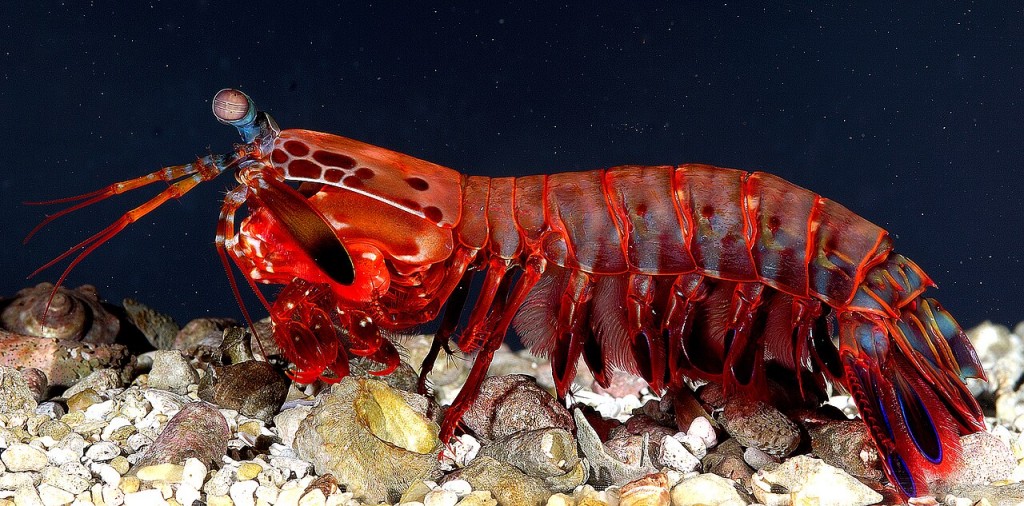
In the vast and mysterious ocean floor, there lies a creature that may not be as popular as sharks or dolphins, yet its capabilities and uniqueness far surpass many other marine animals. In fact, it has inspired various scientific research and modern technological applications. This creature is known as the mantis shrimp, or scientifically as Stomatopoda. Although called 'shrimp', it is actually not part of the regular shrimp family. This marine carnivorous crustacean, which split from Malacostraca around 400 million years ago, now has over 520 known species, all belonging to the suborder Unipeltata, which emerged about 250 million years ago. Known as 'sea locusts' by ancient Assyrians and 'prawn killers' in Australia, mantis shrimp are now also known as 'thumb splitters' due to their ability to cause painful injuries if handled carelessly. The main uniqueness of mantis shrimp lies in two extraordinary features: an aggressive hunting method and a vision system unmatched across the entire animal kingdom.
Biological Engineering: Hypersonic Claw Attack
Mantis shrimp are categorized into two main types based on their attack mechanisms: 'smashers' and 'spearers'. Spearer species have sharp, spiky claws used to pierce soft prey such as fish or shrimp. However, the most astonishing are the smashers. Their front claws have evolved into thick, calcified 'hands', capable of delivering blows with force equivalent to a .22 caliber bullet from a pistol. To understand this strength, imagine a strike powerful enough to easily break the shells of crabs, snails, or clams.
What is even more remarkable is the speed of their attack. A mantis shrimp's strike can reach speeds of up to 23 meters per second (approximately 83 km/h) from a stationary position, producing acceleration faster than a bullet fired from a rifle. This force is not only due to strong muscles but also by a 'latch mechanism' that stores potential energy like a compressed spring. When released, this energy is suddenly unleashed, rapidly accelerating the claw. This extreme speed creates a phenomenon known as supercavitation — a vacuum bubble formed when an object moves through water at high speed. When this bubble collapses, it produces a shockwave that can paralyze or kill the prey, enhancing the physical impact of the blow. This biological engineering has inspired research in the design of new materials that are more impact-resistant and efficient at absorbing energy. Reference: Patek, S. N., & Caldwell, R. L. (2005). Extreme impact and cavitation forces of a biological hammer: a weapon in the mantis shrimp. Journal of Experimental Biology, 208(19), 3655-3664.
The Most Complex Vision System in the Animal Kingdom: Multispectral Vision
If the physical abilities of the mantis shrimp are already impressive, their vision system is on another level. Human eyes have three types of cone cells responsible for color vision (red, green, blue), allowing us to see millions of colors. In contrast, mantis shrimp have between 12 to 16 types of cone cells. This not only allows them to see a broader spectrum of colors, including ultraviolet (UV) light that humans cannot see, but also linearly and circularly polarized light.
This ability to see polarized light is rare in the animal kingdom and gives mantis shrimp a significant advantage in their marine ecosystem. Polarized light is often used in secret communication among mantis shrimp, where patterns on their bodies may only be visible through reflections of polarized light, thus avoiding predators' attention. It also helps them detect transparent or well-camouflaged prey underwater and navigate more accurately.
This advanced visual system has attracted the attention of scientists from various fields, including optics and robotics. Researchers are studying the structure of mantis shrimp eyes to develop more sensitive cameras, medical sensors capable of detecting cancer cells at an early stage (as cancer cells reflect polarized light differently), and better underwater imaging systems. Reference: Cronin, T. W., Marshall, N. J., & Caldwell, R. L. (2002). The unique visual system of the mantis shrimp. Current Opinion in Neurobiology, 12(4), 481-486.
Important Ecological Role and Hidden Life
Although rarely seen by humans, mantis shrimp are important predators in many shallow, tropical, and subtropical marine habitats. They play a crucial role in controlling populations of other species, contributing to the balance of coral reef and seafloor ecosystems. However, their shy nature and tendency to hide in holes and crevices make them difficult to study. Most species spend much of their lives hiding in burrows, only emerging to hunt or find a mate. This behavior, combined with their strength and vision, makes them highly effective ambush hunters.
This hidden life also contributes to the mystery behind their species diversity. Many new species are still being discovered, and each discovery leads to a deeper understanding of the extraordinary evolutionary adaptations in these crustaceans. Studies on the life and physiology of mantis shrimp help us understand how organisms evolve to overcome environmental challenges and how they interact within the complex marine food web.
Scientific Implications and Technological Inspiration
Discoveries in the field of mantis shrimp biology have opened the way for various scientific and technological innovations. From their smashing claw mechanisms, scientists have drawn inspiration to create new composite materials that are lighter and stronger, suitable for applications in aircraft manufacturing, armored vehicles, and even sports helmets. The structure of hydroxyapatite crystals and chitin in the claws of mantis shrimp provides extraordinary strength without sacrificing flexibility, a feature sought after in modern materials engineering.
Meanwhile, their multispectral vision system has provided a blueprint for the development of more advanced cameras and image sensors. Potential applications include medical imaging for early disease diagnosis, detection systems in autonomous vehicles for seeing objects in low-light conditions, and more effective camouflage technology. Moreover, studies on how mantis shrimp process highly complex visual information with a relatively small brain also provide valuable insights in the fields of artificial intelligence and signal processing.
Why Are Mantis Shrimp Important to Study?
In-depth study of mantis shrimp is not just satisfying scientific curiosity, but also offers opportunities to understand the fundamental principles of biological engineering refined by evolution over millions of years. Each extraordinary adaptation, from their hypersonic smashing claws to their eyes capable of seeing light spectra beyond human perception, holds potential for application in various aspects of human life.
By protecting marine habitats and continuing to support research in marine biology, we not only preserve biodiversity but also open the door to discoveries that may change the way we live, work, and interact with our surroundings. Mantis shrimp are proof that the universe is full of inspiration, if we are willing to look deeper and learn from the most unexpected creatures.
---
References: Mantis shrimp — Wikipedia
Mantis Shrimp: The Fastest Striker and the Best Vision in the Ocean. Mantis shrimp, or stomatopods, are marine carnivorous crustaceans renowned for their extraordinary hunting abilities and the most complex vision system in the animal kingdom. This article explores the biological uniqueness, mechanical attack mechanisms, and scientific implications for humans, explaining why these creatures are more than just 'ocean warriors'.. Mantis Shrimp: The Fastest Striker and the Best Vision in the Ocean
In the vast and mysterious ocean floor, there lies a creature that may not be as popular as sharks or dolphins, yet its capabilities and uniqueness far surpass many other marine animals. In fact, it has inspired various scientific research and modern technological applications. This creature is known as the mantis shrimp, or scientifically as Stomatopoda. Although called 'shrimp', it is actually not part of the regular shrimp family. This marine carnivorous crustacean, which split from Malacostraca around 400 million years ago, now has over 520 known species, all belonging to the suborder Unipeltata, which emerged about 250 million years ago. Known as 'sea locusts' by ancient Assyrians and 'prawn killers' in Australia, mantis shrimp are now also known as 'thumb splitters' due to their ability to cause painful injuries if handled carelessly. The main uniqueness of mantis shrimp lies in two extraordinary features: an aggressive hunting method and a vision system unmatched across the entire animal kingdom.
Biological Engineering: Hypersonic Claw Attack
Mantis shrimp are categorized into two main types based on their attack mechanisms: 'smashers' and 'spearers'. Spearer species have sharp, spiky claws used to pierce soft prey such as fish or shrimp. However, the most astonishing are the smashers. Their front claws have evolved into thick, calcified 'hands', capable of delivering blows with force equivalent to a .22 caliber bullet from a pistol. To understand this strength, imagine a strike powerful enough to easily break the shells of crabs, snails, or clams.
What is even more remarkable is the speed of their attack. A mantis shrimp's strike can reach speeds of up to 23 meters per second approximately 83 km/h from a stationary position, producing acceleration faster than a bullet fired from a rifle. This force is not only due to strong muscles but also by a 'latch mechanism' that stores potential energy like a compressed spring. When released, this energy is suddenly unleashed, rapidly accelerating the claw. This extreme speed creates a phenomenon known as supercavitation — a vacuum bubble formed when an object moves through water at high speed. When this bubble collapses, it produces a shockwave that can paralyze or kill the prey, enhancing the physical impact of the blow. This biological engineering has inspired research in the design of new materials that are more impact-resistant and efficient at absorbing energy. Reference: Patek, S. N., & Caldwell, R. L. 2005 . Extreme impact and cavitation forces of a biological hammer: a weapon in the mantis shrimp. Journal of Experimental Biology , 208 19 , 3655-3664. https://journals.biologists.com/jeb/article/208/19/3655/7901/Extreme-impact-and-cavitation-forces-of-a
The Most Complex Vision System in the Animal Kingdom: Multispectral Vision
If the physical abilities of the mantis shrimp are already impressive, their vision system is on another level. Human eyes have three types of cone cells responsible for color vision red, green, blue , allowing us to see millions of colors. In contrast, mantis shrimp have between 12 to 16 types of cone cells. This not only allows them to see a broader spectrum of colors, including ultraviolet UV light that humans cannot see, but also linearly and circularly polarized light.
This ability to see polarized light is rare in the animal kingdom and gives mantis shrimp a significant advantage in their marine ecosystem. Polarized light is often used in secret communication among mantis shrimp, where patterns on their bodies may only be visible through reflections of polarized light, thus avoiding predators' attention. It also helps them detect transparent or well-camouflaged prey underwater and navigate more accurately.
This advanced visual system has attracted the attention of scientists from various fields, including optics and robotics. Researchers are studying the structure of mantis shrimp eyes to develop more sensitive cameras, medical sensors capable of detecting cancer cells at an early stage as cancer cells reflect polarized light differently , and better underwater imaging systems. Reference: Cronin, T. W., Marshall, N. J., & Caldwell, R. L. 2002 . The unique visual system of the mantis shrimp. Current Opinion in Neurobiology , 12 4 , 481-486. https://www.sciencedirect.com/science/article/pii/S095943880200343X
Important Ecological Role and Hidden Life
Although rarely seen by humans, mantis shrimp are important predators in many shallow, tropical, and subtropical marine habitats. They play a crucial role in controlling populations of other species, contributing to the balance of coral reef and seafloor ecosystems. However, their shy nature and tendency to hide in holes and crevices make them difficult to study. Most species spend much of their lives hiding in burrows, only emerging to hunt or find a mate. This behavior, combined with their strength and vision, makes them highly effective ambush hunters.
This hidden life also contributes to the mystery behind their species diversity. Many new species are still being discovered, and each discovery leads to a deeper understanding of the extraordinary evolutionary adaptations in these crustaceans. Studies on the life and physiology of mantis shrimp help us understand how organisms evolve to overcome environmental challenges and how they interact within the complex marine food web.
Scientific Implications and Technological Inspiration
Discoveries in the field of mantis shrimp biology have opened the way for various scientific and technological innovations. From their smashing claw mechanisms, scientists have drawn inspiration to create new composite materials that are lighter and stronger, suitable for applications in aircraft manufacturing, armored vehicles, and even sports helmets. The structure of hydroxyapatite crystals and chitin in the claws of mantis shrimp provides extraordinary strength without sacrificing flexibility, a feature sought after in modern materials engineering.
Meanwhile, their multispectral vision system has provided a blueprint for the development of more advanced cameras and image sensors. Potential applications include medical imaging for early disease diagnosis, detection systems in autonomous vehicles for seeing objects in low-light conditions, and more effective camouflage technology. Moreover, studies on how mantis shrimp process highly complex visual information with a relatively small brain also provide valuable insights in the fields of artificial intelligence and signal processing.
Why Are Mantis Shrimp Important to Study?
In-depth study of mantis shrimp is not just satisfying scientific curiosity, but also offers opportunities to understand the fundamental principles of biological engineering refined by evolution over millions of years. Each extraordinary adaptation, from their hypersonic smashing claws to their eyes capable of seeing light spectra beyond human perception, holds potential for application in various aspects of human life.
By protecting marine habitats and continuing to support research in marine biology, we not only preserve biodiversity but also open the door to discoveries that may change the way we live, work, and interact with our surroundings. Mantis shrimp are proof that the universe is full of inspiration, if we are willing to look deeper and learn from the most unexpected creatures.
---
References: Mantis shrimp — Wikipedia https://en.wikipedia.org/wiki/Mantis shrimp