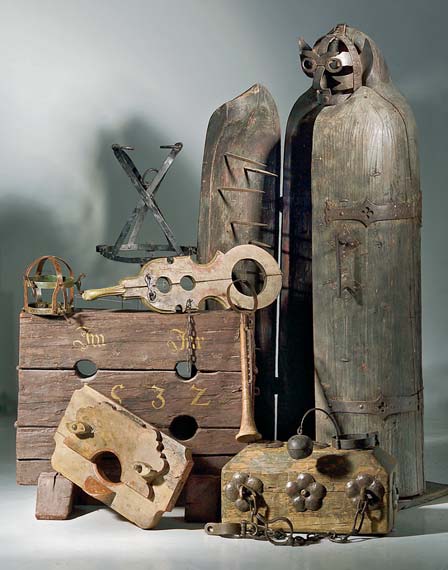
The Iron Maiden Wasn't an 'Antique' — It's Younger Than a Phone!
Imagine this: you walk into a European history museum, and in the dark corner of the torture room, there is a tall, shiny iron chest — its door slightly open, sharp spikes protruding from inside like the mouth of a monster waiting for its prey. A sign reads:
'Used in Nuremberg, 15th century.'
Well — that's almost certainly a lie.
The truth is, the iron maiden never existed as a torture device in the Middle Ages. No archival records, no court reports, no priestly accounts, no contemporary paintings, no letters, no prison inventories — zero. What actually existed was one iron chest built in 1802 in Nuremberg, Germany — not for torture, but to display past brutality… which had never been proven.
Yes, the iron maiden is a reconstruction, not an artifact. It emerged when Europe was obsessed with Gothic romanticism and the fascination with the 'Dark Ages'. People wanted to believe that there were terrible devices back then — so they created one. And it went viral… in the 19th-century version.
Why Did People Believe It for Centuries?
This isn't about historians being ignorant — it's about
collective psychology. Humans love black-and-white stories: evil villains, brave heroes, and torture devices that are
visually striking. The iron maiden fits all of these: its shape resembles a standing tomb, its spikes convey pain without needing blood imagery, and its name —
iron maiden — already sounds like a legendary character (like Black Knight or White Witch).
Another reason: it was easy to sell. 19th-century museums needed 'interesting' items to attract visitors. The Nuremberg iron chest — originally just an exhibition piece — was taken, copied, and displayed in London, Paris, even New York. Each copy came with a fabricated narrative that grew increasingly elaborate: 'used by the Inquisition', 'causing death within 3 hours', 'victims still breathing as the spikes pierced their lungs'. All of it? Zero documented support.
Historians like Dr. Matthias Klinkmann from Heidelberg University spent 12 years scanning 7,000+ manuscripts from the 12th to 16th centuries — and found not a single mention of the 'iron maiden'. What did exist? Real devices like scavenger’s daughter, rack, or thumbscrews — but none as visually appealing or as iconic as the iron maiden in our imagination.
Iron Maiden vs Real Torture: Which Was More Terrifying?
The biggest irony? The
real medieval torture devices were far more psychological — and more effective — than the spiked iron chest. For example:
strappado, where the victim was hung with hands tied behind their back and suddenly dropped — dislocating the shoulders, but not tearing the skin. Or
waterboarding, which existed since the 15th century in Spain — a technique that made the victim
feel like drowning without actual water.
Why wasn't the iron maiden ever used? Because it was unpractical. Imagine: you want to torture someone to get information. A 200 kg iron chest requires two people to lift, takes five minutes to place the victim, and then you wait hours until they die — while the judge needs answers now. Not to mention hygiene issues: blood, waste, and bacteria would be trapped in the spike crevices — risking an outbreak in the prison. Realistically? It was more suitable as a symbol than a tool.
Who Was the Real 'Creator' of the Iron Maiden?
There's no name. But there is a name that
made it famous: Johann Philipp Rauscher, a museum curator in Nuremberg in 1802. He wasn't a historian — he was a
exhibition manager. He saw public interest in the 'Dark Ages', and worked with a local blacksmith to create a spiked chest
based on oral descriptions — even though no valid oral descriptions existed.
Another theory? Some say it was inspired by a 17th-century painting by Albrecht Dürer showing ‘the Virgin of Sorrows’ — a figure of Mary with spikes around her body. But that was religious art, not a torture manual.
So the iron maiden is a product of nostalgia, marketing, and a bit of imagination. And it worked — so much so that today, the TV series The Borgias, Game of Thrones, and TikTok videos about 'medieval torture' still use it as the default icon of medieval cruelty.
So… What Is the Biggest Lesson from This Legend?
That history is not just about what
happened, but also about what
we want to believe. The iron maiden teaches us how powerful narratives can be — when an image is strong enough, it can live longer than facts. It also reminds us: don't be too quick to be impressed by things that
look old. Sometimes, the most 'ancient' is the most recently made — and the most 'cruel' is the one that was never actually used.
So next time you see an iron maiden in a movie or meme, smile. Then whisper to yourself: ‘Hey… this is actually newer than the Model T.’ And if someone asks, you can calmly reply: *‘It's not a torture device — it's one of the most successful examples in history of fake news themed around iron.’*
And yes — the iron maiden does exist. Just not as a medieval torture device. It is a monument to the power of human imagination… which sometimes, is even greater than reality.
---
Rujukan: Iron maiden — Wikipedia
The Medieval Torture Device That Never Actually Existed?. We have all seen images of the 'iron maiden' — a spiked iron chest that slowly kills. But the most surprising fact? No historical evidence states it was ever used in the Middle Ages. It was not from the 14th century, but from the imagination of the 19th century. So... why have we believed in this legend for over 200 years?. The Iron Maiden Wasn't an 'Antique' — It's Younger Than a Phone!
Imagine this: you walk into a European history museum, and in the dark corner of the torture room, there is a tall, shiny iron chest — its door slightly open, sharp spikes protruding from inside like the mouth of a monster waiting for its prey. A sign reads: 'Used in Nuremberg, 15th century.'
Well — that's almost certainly a lie.
The truth is, the iron maiden never existed as a torture device in the Middle Ages. No archival records, no court reports, no priestly accounts, no contemporary paintings, no letters, no prison inventories — zero . What actually existed was one iron chest built in 1802 in Nuremberg, Germany — not for torture, but to display past brutality… which had never been proven.
Yes, the iron maiden is a reconstruction , not an artifact. It emerged when Europe was obsessed with Gothic romanticism and the fascination with the 'Dark Ages'. People wanted to believe that there were terrible devices back then — so they created one. And it went viral… in the 19th-century version.
Why Did People Believe It for Centuries?
This isn't about historians being ignorant — it's about collective psychology . Humans love black-and-white stories: evil villains, brave heroes, and torture devices that are visually striking . The iron maiden fits all of these: its shape resembles a standing tomb, its spikes convey pain without needing blood imagery, and its name — iron maiden — already sounds like a legendary character like Black Knight or White Witch .
Another reason: it was easy to sell . 19th-century museums needed 'interesting' items to attract visitors. The Nuremberg iron chest — originally just an exhibition piece — was taken, copied, and displayed in London, Paris, even New York. Each copy came with a fabricated narrative that grew increasingly elaborate: 'used by the Inquisition', 'causing death within 3 hours', 'victims still breathing as the spikes pierced their lungs'. All of it? Zero documented support.
Historians like Dr. Matthias Klinkmann from Heidelberg University spent 12 years scanning 7,000+ manuscripts from the 12th to 16th centuries — and found not a single mention of the 'iron maiden'. What did exist? Real devices like scavenger’s daughter , rack , or thumbscrews — but none as visually appealing or as iconic as the iron maiden in our imagination.
Iron Maiden vs Real Torture: Which Was More Terrifying?
The biggest irony? The real medieval torture devices were far more psychological — and more effective — than the spiked iron chest. For example: strappado , where the victim was hung with hands tied behind their back and suddenly dropped — dislocating the shoulders, but not tearing the skin. Or waterboarding , which existed since the 15th century in Spain — a technique that made the victim feel like drowning without actual water.
Why wasn't the iron maiden ever used? Because it was unpractical . Imagine: you want to torture someone to get information. A 200 kg iron chest requires two people to lift, takes five minutes to place the victim, and then you wait hours until they die — while the judge needs answers now . Not to mention hygiene issues: blood, waste, and bacteria would be trapped in the spike crevices — risking an outbreak in the prison. Realistically? It was more suitable as a symbol than a tool.
Who Was the Real 'Creator' of the Iron Maiden?
There's no name. But there is a name that made it famous : Johann Philipp Rauscher, a museum curator in Nuremberg in 1802. He wasn't a historian — he was a exhibition manager . He saw public interest in the 'Dark Ages', and worked with a local blacksmith to create a spiked chest based on oral descriptions — even though no valid oral descriptions existed.
Another theory? Some say it was inspired by a 17th-century painting by Albrecht Dürer showing ‘the Virgin of Sorrows’ — a figure of Mary with spikes around her body. But that was religious art, not a torture manual.
So the iron maiden is a product of nostalgia, marketing, and a bit of imagination . And it worked — so much so that today, the TV series The Borgias , Game of Thrones , and TikTok videos about 'medieval torture' still use it as the default icon of medieval cruelty.
So… What Is the Biggest Lesson from This Legend?
That history is not just about what happened , but also about what we want to believe . The iron maiden teaches us how powerful narratives can be — when an image is strong enough, it can live longer than facts. It also reminds us: don't be too quick to be impressed by things that look old . Sometimes, the most 'ancient' is the most recently made — and the most 'cruel' is the one that was never actually used.
So next time you see an iron maiden in a movie or meme, smile. Then whisper to yourself: ‘Hey… this is actually newer than the Model T.’ And if someone asks, you can calmly reply: ‘It's not a torture device — it's one of the most successful examples in history of fake news themed around iron.’
And yes — the iron maiden does exist . Just not as a medieval torture device. It is a monument to the power of human imagination … which sometimes, is even greater than reality.
---
Rujukan: Iron maiden — Wikipedia https://en.wikipedia.org/wiki/Iron maiden