Every breath you take contains about 21% oxygen — a gas you consider essential to life. However, 2.4 billion years ago, oxygen was a deadly poison that triggered one of the largest mass extinctions in Earth's history, killing almost all life at that time. This paradox, known as the "Great Oxidation Event," is one of the most dramatic chapters in the history of life on our planet.
For the first 2 billion years of Earth's history, the atmosphere contained no free oxygen. Life at that time consisted entirely of single-celled organisms — bacteria and archaea — which evolved in an anaerobic (without oxygen) environment. For these ancient organisms, oxygen was a deadly toxin. They had no mechanisms to handle "oxidative stress" — damage caused by oxygen to biological molecules.
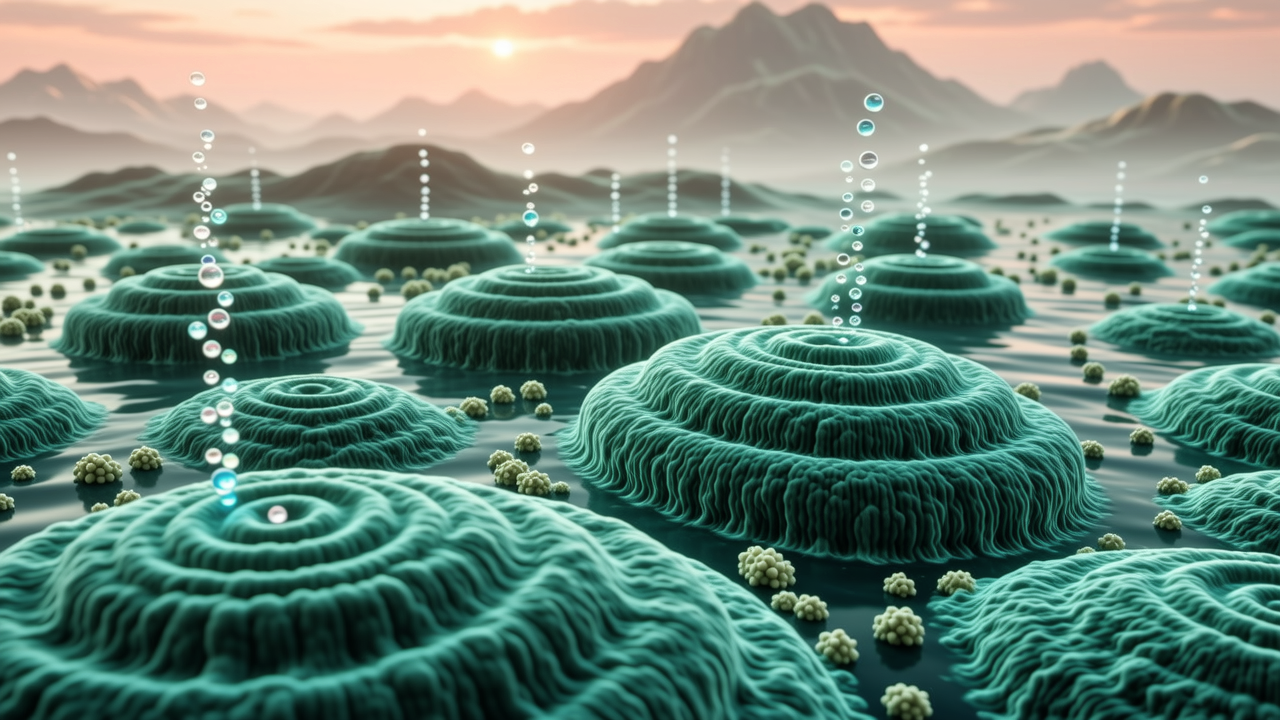
Then cyanobacteria emerged — the first organisms to develop oxygenic photosynthesis, a process that uses sunlight to convert carbon dioxide and water into sugar, with oxygen as a byproduct. For hundreds of millions of years, cyanobacteria produced oxygen that was absorbed by dissolved iron in the oceans and minerals in rocks. However, eventually, these "sinks" became saturated, and oxygen began to accumulate in the atmosphere.
For most of the ancient anaerobic organisms, this was apocalyptic. Oxygen bound to molecules in their cells, producing free radicals that destroyed them. The Great Oxidation Event may have been the first mass extinction in Earth's history — a massive killing not caused by a meteorite or volcano, but by the waste product of other organisms.
Yet from this disaster arose more complex life. Some organisms developed mitochondria — cell organelles that can use oxygen in a controlled way to produce energy far more efficiently than anaerobic fermentation. Oxygen-consuming cells were able to produce 18 times more energy from the same glucose compared to anaerobic cells. This energy surge enabled the evolution of complex multicellular life — and ultimately, you.
Today, your own cells use antioxidants — vitamins C, E, and the enzyme catalase — to protect themselves from the toxic oxygen you breathe every moment. Modern life is an adaptation to a poison that once nearly destroyed all life.
## Science Facts #62: Oxygen — The Poison That Saved Modern Life. The oxygen we breathe every moment is actually a toxic gas that almost destroyed all life on Earth 2.4 billion years ago — yet this oxygen disaster paved the way for the evolution of complex life.. Every breath you take contains about 21% oxygen — a gas you consider essential to life. However, 2.4 billion years ago, oxygen was a deadly poison that triggered one of the largest mass extinctions in Earth's history, killing almost all life at that time. This paradox, known as the "Great Oxidation Event," is one of the most dramatic chapters in the history of life on our planet.
For the first 2 billion years of Earth's history, the atmosphere contained no free oxygen. Life at that time consisted entirely of single-celled organisms — bacteria and archaea — which evolved in an anaerobic without oxygen environment. For these ancient organisms, oxygen was a deadly toxin. They had no mechanisms to handle "oxidative stress" — damage caused by oxygen to biological molecules.
Then cyanobacteria emerged — the first organisms to develop oxygenic photosynthesis, a process that uses sunlight to convert carbon dioxide and water into sugar, with oxygen as a byproduct. For hundreds of millions of years, cyanobacteria produced oxygen that was absorbed by dissolved iron in the oceans and minerals in rocks. However, eventually, these "sinks" became saturated, and oxygen began to accumulate in the atmosphere.
For most of the ancient anaerobic organisms, this was apocalyptic. Oxygen bound to molecules in their cells, producing free radicals that destroyed them. The Great Oxidation Event may have been the first mass extinction in Earth's history — a massive killing not caused by a meteorite or volcano, but by the waste product of other organisms.
Yet from this disaster arose more complex life. Some organisms developed mitochondria — cell organelles that can use oxygen in a controlled way to produce energy far more efficiently than anaerobic fermentation. Oxygen-consuming cells were able to produce 18 times more energy from the same glucose compared to anaerobic cells. This energy surge enabled the evolution of complex multicellular life — and ultimately, you.
Today, your own cells use antioxidants — vitamins C, E, and the enzyme catalase — to protect themselves from the toxic oxygen you breathe every moment. Modern life is an adaptation to a poison that once nearly destroyed all life.