Background
The War of Saint Sabas (1256–1270) between the two Italian maritime republics, Venice and Genoa, erupted due to competition for control of ports and markets in the Eastern Mediterranean. In previous battles such as the Battle of Acre (1258) and the Battle of Settepozzi (1263), the Venetian fleet had shown tactical superiority over Genoa. As a result, Genoa avoided direct confrontation and shifted to attacking Venetian merchant convoys. This strategy proved successful in the Battle of Saseno in August 1264, when the annual Venetian convoy to the Levant was captured by Genoa.
At the same time, Venice's diplomatic position improved when the Byzantine Emperor, Michael VIII Palaiologos, decided to form an alliance with Genoa due to Genoa's poor performance against Venice. In 1264, he expelled Genoa from Constantinople and approached Venice, culminating in a temporary truce agreement in 1265.
Opening Moves
For the 1266 campaign, Genoa prepared a fleet consisting of 18 galleys and a
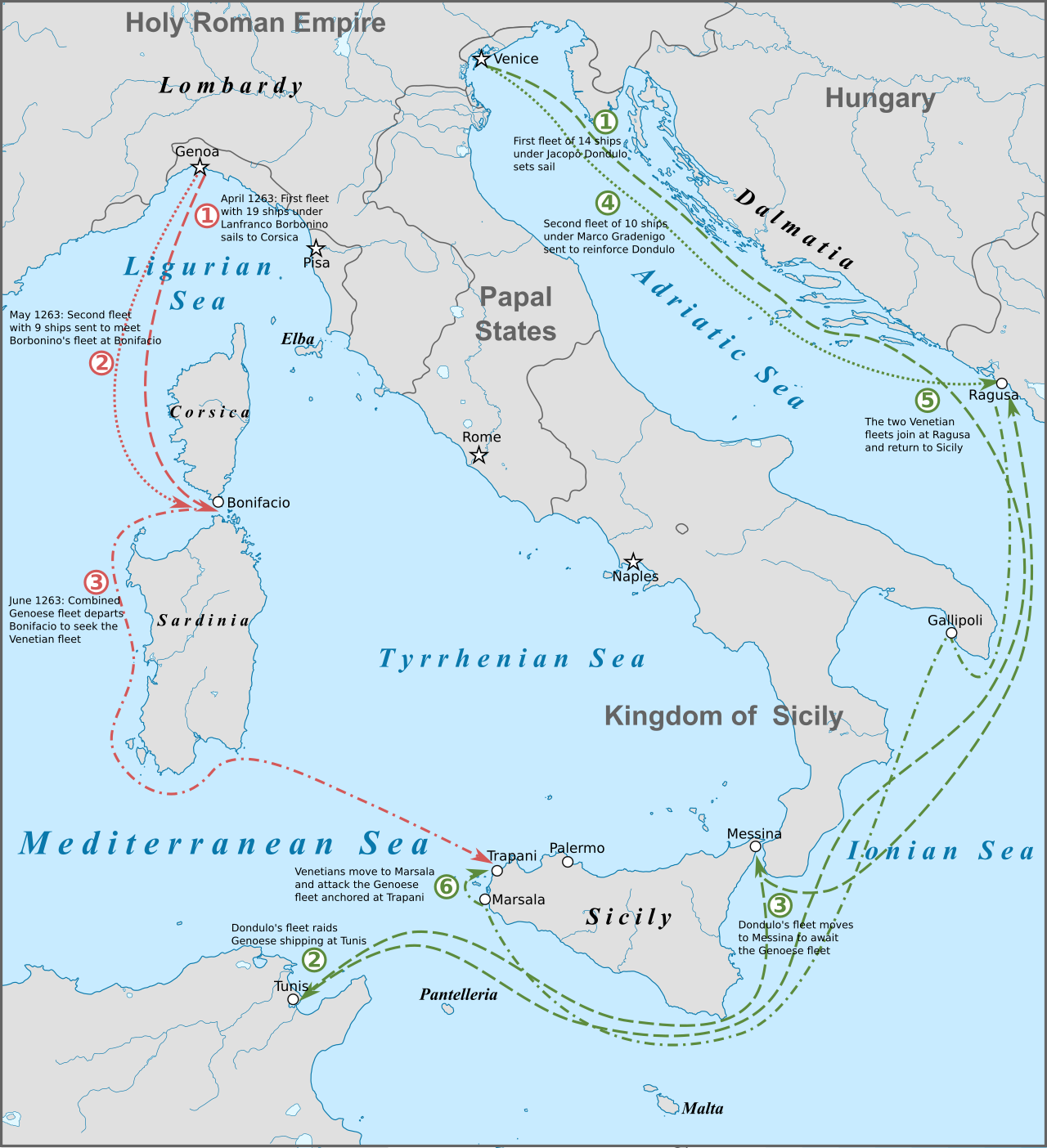
nave (a large cargo ship) under the command of Lanfranco Borbonino. When the fleet set sail for Corsica at the end of April, news of the increased strength of the Venetian fleet arrived, and nine additional galleys were sent to join them in Bonifacio in May. In fact, the Venetian fleet only had 15 galleys, far smaller than what Genoa had anticipated.
Jacopo Dondulo, an experienced sailor known for 'knowing the harbors and hiding places of Genoa,' was appointed commander of the Venetian fleet. Due to financial constraints, most of the fleet was supplied by Venetian territories: four galleys from Crete, three from Zara, and three galleys and a galiot from Negroponte, while only four galleys were equipped in Venice itself.
Dondulo led his fleet to Tunis, where they captured a Genoese ship in a night attack, expelling the crew and cargo, then burning it. The next day, a small merchant ship from Savona was also captured. On their way back to Messina, Venice met and defeated a squadron of pirates consisting of two galleys and a saetta (light galley) from the Genoese port of Porto Venere, capturing one of the galleys along with most of its crew.
The Battle
After receiving reports that Venice had gathered 30 or more galleys, Borbonino decided to leave the
nave behind and distribute his men among other ships to increase combat strength. In early June, Borbonino led his fleet out of Bonifacio to confront Venice.
On June 22, Genoa was in Trapani when they received intelligence that the Venetian fleet was near Marsala, and its size was smaller than what Borbonino had feared. Borbonino held a war council with three advisors and all the galley captains. The Genoese captains did not trust their own crews, who were mostly Lombards and foreign mercenaries hired by Genoese citizens unwilling to face the hardship and danger of rowing in war galleys. Therefore, the war council decided to attack Venice from the open sea so that the crews would not be tempted to abandon their positions and swim to shore.
However, shortly after, Borbonino changed his decision. Perhaps influenced by Venice's previous victories in open battles, he chose to take a defensive position by chaining his ships together, sterns facing the shore and prows facing the sea. This tactic offered many advantages to the defenders, especially in facing a more skilled and aggressive opponent: it ensured the fleet could not be surrounded or split, and aid could be quickly moved to any threatened ship. However, it required discipline and steadfastness from the defenders.
To strengthen his crews, Borbonino hired many local residents of Trapani by offering one gold agostaro per day. Borbonino's orders were carried out throughout the night, and when the Venetian fleet arrived in Trapani the next day, they found the Genoese galleys tied together and chained.
Taking this as a sign of low morale on the enemy side, and despite the opposing wind, Venice advanced enthusiastically toward Genoa, shouting to weaken their spirits. Two attempts by Venice to break the Genoese line failed, but on the third attempt, they managed to separate three Genoese galleys from the main group. Genoa tried to counter the Venetian attack by sending fire rafts toward enemy ships, but when they saw the success of Venice, panic began to spread among the Genoese crews.
Already losing morale due to a lack of confidence in their commanders, the Genoese crews began abandoning their ships and swimming to shore to save themselves. Finally, Venice succeeded in capturing all 27 Genoese galleys, as well as the remaining crew. Venice towed 24 of the captured galleys, while three were burned on the spot. Many Genoese soldiers were killed, including approximately 1,200 drowning; 600 were captured.
Aftermath
Borbonino and his officers managed to escape, but as news of the battle reached Genoa, they were tried for cowardice and incompetence. On July 25, all except five galley captains were found guilty and sentenced to confiscation of property and exile, which could only be revoked after paying heavy fines. Borbonino was fined 10,000 Genoese lire to reclaim his exile, his advisors—Rinaldo Cebà and Bonavia Conte da Noli—were fined 3,000 lire, and the galley captain—only one, Ogerio Vacca—was fined 1,000 lire. They were also required to pay compensation to the republic for the expenses of outfitting the fleet.
In Venice, Dondulo was welcomed as a hero upon his return in July, towing the captured ships, and was appointed Captain General of the Sea, the highest naval military government position in Venice. However, he soon had a conflict with Doge Reniero Zeno: the Doge urged the fleet to only escort merchant convoys, while Dondulo strongly supported the idea that the fleet should remain at sea to search for and attack Genoese vessels. As a result of this disagreement, Dondulo resigned and was replaced by his lieutenant, Marco Zeno.
Venice's victory at Trapani did not immediately change the course of the war. Genoa was still able to recover quickly from its losses; in August, another Genoese fleet consisting of 25 ships under Oberto D'Oria, a member of the powerful Doria family and future ruler of Genoa, sailed toward the Adriatic. Furthermore, since the cause and objective of the conflict were trade, neither side considered attacking each other's core territories for a final blow. The stalemate between the two powers continued until King Louis IX of France, who wanted to use the Venetian and Genoese fleets in the Eighth Crusade, forced both sides to sign a five-year truce in the Treaty of Cremona in 1270.
---
Original source: en.wikipedia.org
The Battle of Trapani: A Glorious Victory of Venice over Genoa in 1266. On June 23, 1266, the Venetian Republic's fleet under the command of Jacopo Dondulo successfully destroyed the entire Genoese fleet in the Battle of Trapani, a significant battle in the War of Saint Sabas that demonstrated the superiority of Venetian tactics and military spirit.. Background
The War of Saint Sabas 1256–1270 between the two Italian maritime republics, Venice and Genoa, erupted due to competition for control of ports and markets in the Eastern Mediterranean. In previous battles such as the Battle of Acre 1258 and the Battle of Settepozzi 1263 , the Venetian fleet had shown tactical superiority over Genoa. As a result, Genoa avoided direct confrontation and shifted to attacking Venetian merchant convoys. This strategy proved successful in the Battle of Saseno in August 1264, when the annual Venetian convoy to the Levant was captured by Genoa.
At the same time, Venice's diplomatic position improved when the Byzantine Emperor, Michael VIII Palaiologos, decided to form an alliance with Genoa due to Genoa's poor performance against Venice. In 1264, he expelled Genoa from Constantinople and approached Venice, culminating in a temporary truce agreement in 1265.
Opening Moves
For the 1266 campaign, Genoa prepared a fleet consisting of 18 galleys and a nave a large cargo ship under the command of Lanfranco Borbonino. When the fleet set sail for Corsica at the end of April, news of the increased strength of the Venetian fleet arrived, and nine additional galleys were sent to join them in Bonifacio in May. In fact, the Venetian fleet only had 15 galleys, far smaller than what Genoa had anticipated.
Jacopo Dondulo, an experienced sailor known for 'knowing the harbors and hiding places of Genoa,' was appointed commander of the Venetian fleet. Due to financial constraints, most of the fleet was supplied by Venetian territories: four galleys from Crete, three from Zara, and three galleys and a galiot from Negroponte, while only four galleys were equipped in Venice itself.
Dondulo led his fleet to Tunis, where they captured a Genoese ship in a night attack, expelling the crew and cargo, then burning it. The next day, a small merchant ship from Savona was also captured. On their way back to Messina, Venice met and defeated a squadron of pirates consisting of two galleys and a saetta light galley from the Genoese port of Porto Venere, capturing one of the galleys along with most of its crew.
The Battle
After receiving reports that Venice had gathered 30 or more galleys, Borbonino decided to leave the nave behind and distribute his men among other ships to increase combat strength. In early June, Borbonino led his fleet out of Bonifacio to confront Venice.
On June 22, Genoa was in Trapani when they received intelligence that the Venetian fleet was near Marsala, and its size was smaller than what Borbonino had feared. Borbonino held a war council with three advisors and all the galley captains. The Genoese captains did not trust their own crews, who were mostly Lombards and foreign mercenaries hired by Genoese citizens unwilling to face the hardship and danger of rowing in war galleys. Therefore, the war council decided to attack Venice from the open sea so that the crews would not be tempted to abandon their positions and swim to shore.
However, shortly after, Borbonino changed his decision. Perhaps influenced by Venice's previous victories in open battles, he chose to take a defensive position by chaining his ships together, sterns facing the shore and prows facing the sea. This tactic offered many advantages to the defenders, especially in facing a more skilled and aggressive opponent: it ensured the fleet could not be surrounded or split, and aid could be quickly moved to any threatened ship. However, it required discipline and steadfastness from the defenders.
To strengthen his crews, Borbonino hired many local residents of Trapani by offering one gold agostaro per day. Borbonino's orders were carried out throughout the night, and when the Venetian fleet arrived in Trapani the next day, they found the Genoese galleys tied together and chained.
Taking this as a sign of low morale on the enemy side, and despite the opposing wind, Venice advanced enthusiastically toward Genoa, shouting to weaken their spirits. Two attempts by Venice to break the Genoese line failed, but on the third attempt, they managed to separate three Genoese galleys from the main group. Genoa tried to counter the Venetian attack by sending fire rafts toward enemy ships, but when they saw the success of Venice, panic began to spread among the Genoese crews.
Already losing morale due to a lack of confidence in their commanders, the Genoese crews began abandoning their ships and swimming to shore to save themselves. Finally, Venice succeeded in capturing all 27 Genoese galleys, as well as the remaining crew. Venice towed 24 of the captured galleys, while three were burned on the spot. Many Genoese soldiers were killed, including approximately 1,200 drowning; 600 were captured.
Aftermath
Borbonino and his officers managed to escape, but as news of the battle reached Genoa, they were tried for cowardice and incompetence. On July 25, all except five galley captains were found guilty and sentenced to confiscation of property and exile, which could only be revoked after paying heavy fines. Borbonino was fined 10,000 Genoese lire to reclaim his exile, his advisors—Rinaldo Cebà and Bonavia Conte da Noli—were fined 3,000 lire, and the galley captain—only one, Ogerio Vacca—was fined 1,000 lire. They were also required to pay compensation to the republic for the expenses of outfitting the fleet.
In Venice, Dondulo was welcomed as a hero upon his return in July, towing the captured ships, and was appointed Captain General of the Sea, the highest naval military government position in Venice. However, he soon had a conflict with Doge Reniero Zeno: the Doge urged the fleet to only escort merchant convoys, while Dondulo strongly supported the idea that the fleet should remain at sea to search for and attack Genoese vessels. As a result of this disagreement, Dondulo resigned and was replaced by his lieutenant, Marco Zeno.
Venice's victory at Trapani did not immediately change the course of the war. Genoa was still able to recover quickly from its losses; in August, another Genoese fleet consisting of 25 ships under Oberto D'Oria, a member of the powerful Doria family and future ruler of Genoa, sailed toward the Adriatic. Furthermore, since the cause and objective of the conflict were trade, neither side considered attacking each other's core territories for a final blow. The stalemate between the two powers continued until King Louis IX of France, who wanted to use the Venetian and Genoese fleets in the Eighth Crusade, forced both sides to sign a five-year truce in the Treaty of Cremona in 1270.
---
Original source: en.wikipedia.org https://en.wikipedia.org/wiki/Battle of Trapani