First Shock: 860 Volts in Water
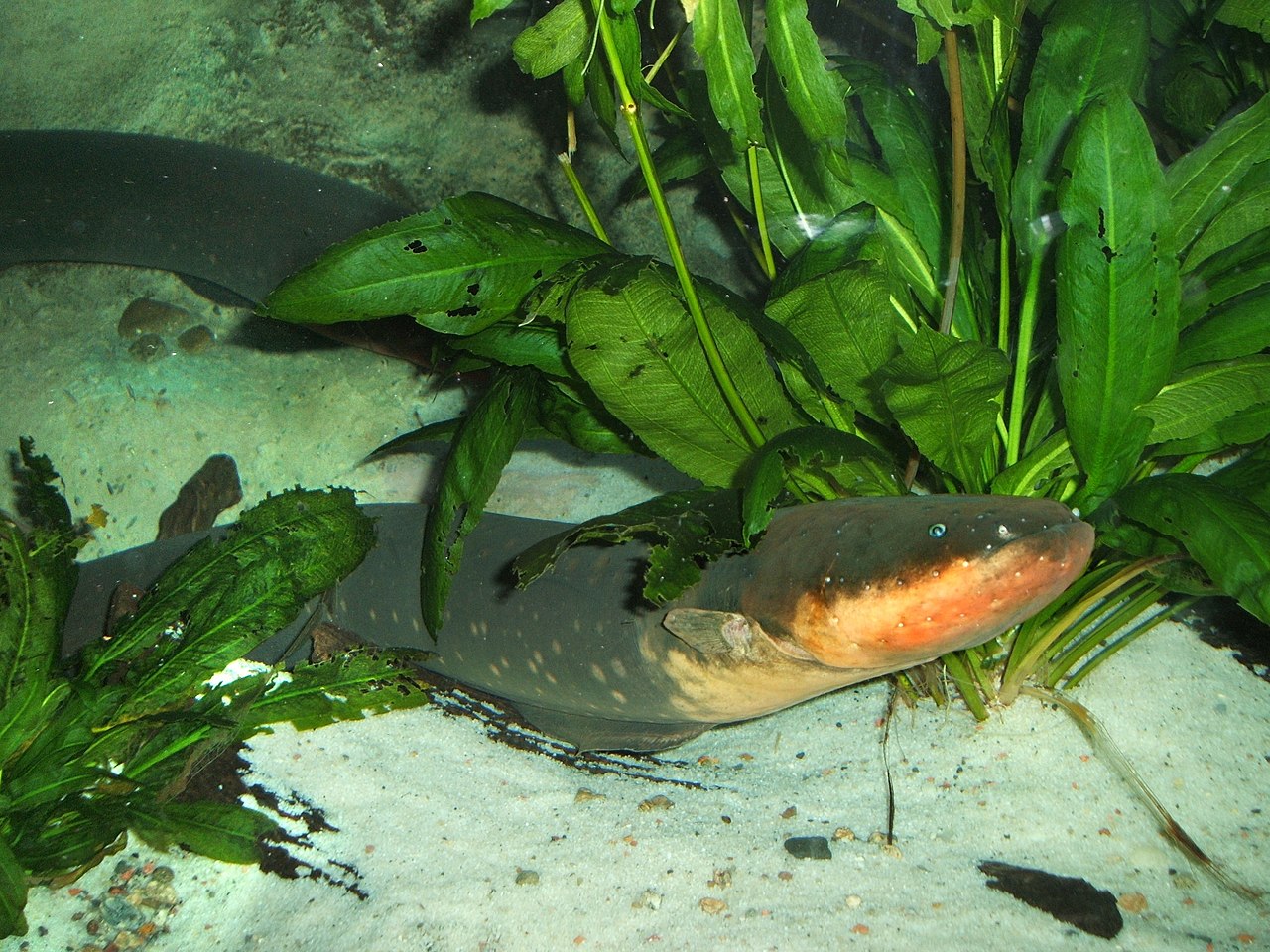
Imagine you're wading through a river in the Amazon, suddenly your legs are struck by an electric shock strong enough to knock down an adult horse. This is the reality faced by locals and explorers when encountering the electric eel (
Electrophorus). With voltages reaching 860 volts—almost seven times the household socket usage in Malaysia—this creature is not just a biological oddity, but proof of nature surpassing human imagination.
In 1775, scientists began studying this ability, and the results later inspired Alessandro Volta to create the first electric battery in 1800. Yes, humans borrowed ideas from eels to power the modern world. But how can a fish that looks like a snake generate such power? The answer lies in evolution that took millions of years.
Not Actually an Eel: Knife Fish Relatives
Although its name is 'eel,' don't be deceived.
Electrophorus is not related to true eels (Anguilliformes). It belongs to the order Gymnotiformes, a group of 'knife fish' more closely related to catfish. This distinction is important because it shows how unique the evolutionary adaptation is. Other knife fish also have weak electrical abilities for navigation, but the electric eel takes it to an extreme.
Three species are now recognized in this genus: Electrophorus electricus, E. voltai, and E. varii. Before 2019, scientists believed only one species existed. This discovery emphasizes that nature still holds secrets, even for animals studied for over two centuries.
Electric Organs: Layered Living Batteries
Electric eels have three pairs of electric organs: the main organ, Hunter's organ, and Sach's organ. These organs consist of specialized cells called electrocytes, arranged like a battery in series. When the brain sends a signal, thousands of electrocytes discharge simultaneously, generating high voltage. The main and Hunter's organs produce strong charges to shock prey, while Sach's organ generates a weak electric field to detect surroundings—like a living radar.
Interestingly, these eels can control their voltage output. For small prey, they use low shocks. For larger threats like humans or horses, they release maximum bursts. This is not just a weapon, but a sophisticated defense and hunting system.
Mandatory Air Breathing: Living in Water, Breathing in Air
Another quirk of the electric eel: it is an obligate air-breather. Although living in muddy, oxygen-poor waters of the Amazon, it must rise to the surface every 10 minutes to inhale air through its mouth. Oxygen is absorbed through vascular tissue in the mouth cavity. Without this, it would suffocate. This is an adaptation to an extreme habitat—and shows that nature is not bound by 'normal' rules.
Unending Growth: Additional Vertebrae
Electric eels grow throughout their lives, adding new vertebrae to their spine. Males can reach lengths of 2.5 meters, larger than females. In captivity, some live over 20 years. This unlimited growth is rare among vertebrates and raises questions about its genetic mechanisms.
From Eel to Battery: Inspiration for Technology
The electric eel's ability has inspired research in bioelectricity and robotics. Scientists are now trying to mimic its electrocytes to create flexible batteries that can be implanted in the human body. Imagine a heart pacemaker powered by natural mechanisms—this is a direct legacy from the Amazon creature.
Conclusion: Nature Is Greater Than Fiction
The electric eel is not just a biological oddity. It is a reminder that nature can create systems more complex and effective than anything humans can invent. When we create batteries, we imitate the eel. When we build underwater robots, we are still lagging in performance. In the race to understand life, we are merely students reading the first page.
Thousands of species remain undiscovered, and each may hold secrets that could revolutionize science. The electric eel is just one example—but a remarkable one to remind us: nature is the most innovative creator, and we are simply watching in awe.
---
Reference: Electric eel — Wikipedia
Electric Eel: The 860 Volt Weapon Far Greater Than Science Fiction. Electric eels, freshwater creatures from South America, are capable of producing electric shocks up to 860 volts—enough to paralyze humans or horses. Studied since 1775, their electrical abilities helped the creation of modern batteries. Although called 'eels,' they are actually closer to knife fish, and prove that nature is far more bizarre than human inventions.. First Shock: 860 Volts in Water
Imagine you're wading through a river in the Amazon, suddenly your legs are struck by an electric shock strong enough to knock down an adult horse. This is the reality faced by locals and explorers when encountering the electric eel Electrophorus . With voltages reaching 860 volts—almost seven times the household socket usage in Malaysia—this creature is not just a biological oddity, but proof of nature surpassing human imagination.
In 1775, scientists began studying this ability, and the results later inspired Alessandro Volta to create the first electric battery in 1800. Yes, humans borrowed ideas from eels to power the modern world. But how can a fish that looks like a snake generate such power? The answer lies in evolution that took millions of years.
Not Actually an Eel: Knife Fish Relatives
Although its name is 'eel,' don't be deceived. Electrophorus is not related to true eels Anguilliformes . It belongs to the order Gymnotiformes, a group of 'knife fish' more closely related to catfish. This distinction is important because it shows how unique the evolutionary adaptation is. Other knife fish also have weak electrical abilities for navigation, but the electric eel takes it to an extreme.
Three species are now recognized in this genus: Electrophorus electricus , E. voltai , and E. varii . Before 2019, scientists believed only one species existed. This discovery emphasizes that nature still holds secrets, even for animals studied for over two centuries.
Electric Organs: Layered Living Batteries
Electric eels have three pairs of electric organs: the main organ, Hunter's organ, and Sach's organ. These organs consist of specialized cells called electrocytes, arranged like a battery in series. When the brain sends a signal, thousands of electrocytes discharge simultaneously, generating high voltage. The main and Hunter's organs produce strong charges to shock prey, while Sach's organ generates a weak electric field to detect surroundings—like a living radar.
Interestingly, these eels can control their voltage output. For small prey, they use low shocks. For larger threats like humans or horses, they release maximum bursts. This is not just a weapon, but a sophisticated defense and hunting system.
Mandatory Air Breathing: Living in Water, Breathing in Air
Another quirk of the electric eel: it is an obligate air-breather. Although living in muddy, oxygen-poor waters of the Amazon, it must rise to the surface every 10 minutes to inhale air through its mouth. Oxygen is absorbed through vascular tissue in the mouth cavity. Without this, it would suffocate. This is an adaptation to an extreme habitat—and shows that nature is not bound by 'normal' rules.
Unending Growth: Additional Vertebrae
Electric eels grow throughout their lives, adding new vertebrae to their spine. Males can reach lengths of 2.5 meters, larger than females. In captivity, some live over 20 years. This unlimited growth is rare among vertebrates and raises questions about its genetic mechanisms.
From Eel to Battery: Inspiration for Technology
The electric eel's ability has inspired research in bioelectricity and robotics. Scientists are now trying to mimic its electrocytes to create flexible batteries that can be implanted in the human body. Imagine a heart pacemaker powered by natural mechanisms—this is a direct legacy from the Amazon creature.
Conclusion: Nature Is Greater Than Fiction
The electric eel is not just a biological oddity. It is a reminder that nature can create systems more complex and effective than anything humans can invent. When we create batteries, we imitate the eel. When we build underwater robots, we are still lagging in performance. In the race to understand life, we are merely students reading the first page.
Thousands of species remain undiscovered, and each may hold secrets that could revolutionize science. The electric eel is just one example—but a remarkable one to remind us: nature is the most innovative creator, and we are simply watching in awe.
---
Reference: Electric eel — Wikipedia https://en.wikipedia.org/wiki/Electric eel