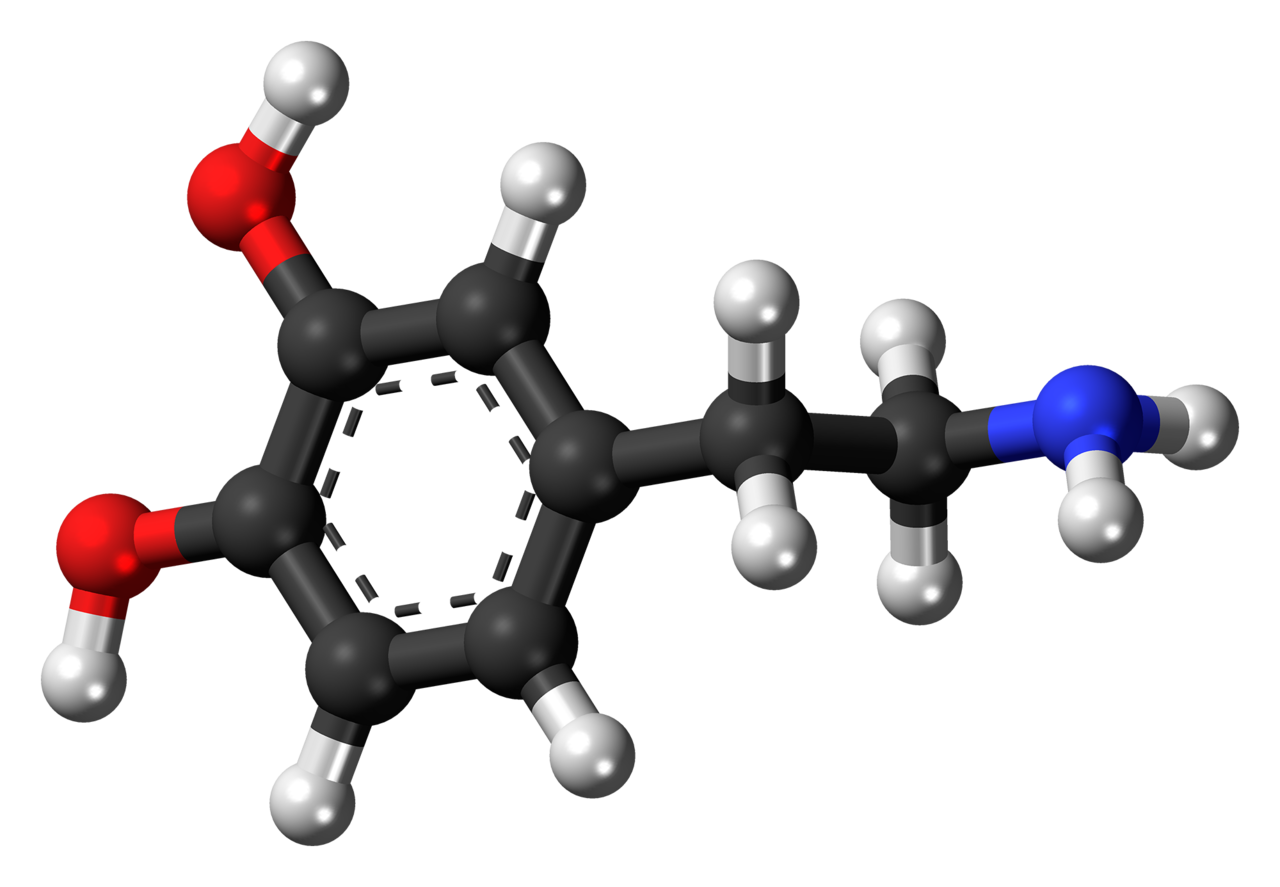
What Is Dopamine? More Than Just the 'Happiness Chemical'
Dopamine (DA) is an organic neuromodulator from the catecholamine and phenethylamine family. It is not a hormone produced by endocrine glands, but a chemical molecule produced locally by specific neurons in the brain—primarily in the substantia nigra and ventral tegmental area (VTA). Its synthesis begins with the amino acid L-tyrosine, which is converted into L-DOPA through the enzyme tyrosine hydroxylase, then further converted into dopamine by the enzyme dopa decarboxylase. It is important to emphasize: dopamine does not directly cause a feeling of 'happiness'. Instead, it functions as a
prediction signal—it increases when we
anticipate a reward, not when we actually experience it. This was demonstrated in a classic neuroscience experiment by Wolfram Schultz (1997), where monkeys showed a dopamine spike when they saw a signal light that preceded juice delivery—not when the juice actually entered their mouths.
Four Main Dopamine Pathways in the Brain and Their Specific Functions
The human dopamine system is not a single entity, but consists of four main anatomically and functionally distinct pathways. First, the
mesolimbic pathway, connecting the VTA to the nucleus accumbens and amygdala—this is the main center for motivation and response to rewards. Second, the
mesocortical pathway, from the VTA to the prefrontal cortex—responsible for decision-making, planning, and impulse control. Third, the
nigrostriatal pathway, from the substantia nigra to the striatum—critical for fine motor coordination; its deterioration becomes the main cause of motor symptoms in Parkinson's disease. Fourth, the
tuberoinfundibular pathway, from the hypothalamus to the pituitary gland—blocking the release of prolactin, a hormone related to lactation and reproductive function. Each pathway uses dopamine differently: disruption in one pathway does not necessarily interfere with others—explaining why Parkinson's patients can experience tremors without mood disturbances, or why individuals with schizophrenia may have hallucinations (hyperdopaminergic in the mesolimbic pathway) but lose motivation (hypodopaminergic in the mesocortical pathway).
Dopamine in Daily Life: Between Technology, Food, and Sleep
Our daily activities often unconsciously manipulate the dopamine system. Phone notifications, social media algorithms, and video games are designed to create a 'variable ratio reinforcement'—unpredictable rewards—which result in stronger dopamine release than fixed rewards. A study at the University of California (2021) showed that every time a person checks their phone without a clear purpose, dopamine levels in the nucleus accumbens increase by 35–40%—equivalent to the initial response to nicotine or sugar. Similarly, high-fat and high-sugar foods stimulate dopamine release twice as much as regular food, making repeated consumption easier to become a habit. On the other hand, lack of sleep for 24 hours reduces D2 receptor sensitivity in the striatum by 25%, reducing the brain's ability to normally perceive rewards—and explaining why we tend to seek external stimulation (like sweet food or endless scrolling) after staying up late.
Dopamine System Disorders: When the 'Motivation Driver' Is Impaired
Dopamine imbalance is not just about 'too much' or 'too little', but about
location,
timing, and
receptor sensitivity. In Parkinson's disease, the death of dopaminergic neurons in the substantia nigra causes a dopamine deficiency in the striatum—resulting in rigidity, bradykinesia, and resting tremors. Conversely, in schizophrenia, hyperactivity of dopamine in the mesolimbic pathway is associated with positive symptoms (hallucinations, delusions), while hypofunction in the mesocortical pathway is linked to negative symptoms (avolition, alogia). Substance use disorders—such as cocaine or methamphetamine—work differently: cocaine blocks dopamine reuptake (reuptake inhibition), while methamphetamine forces excessive dopamine release from presynaptic terminals. Both result in long-term adjustments in D2 receptor expression, slowing down the recovery of motivational function after cessation of use.
How to Build a Healthy 'Dopamine Ecosystem'?
There is no magic pill to 'increase dopamine', but there are evidence-based interventions that support dopamine system homeostasis. Simple physical exercise—such as walking 30 minutes a day—increases the biogenesis of dopaminergic neurons in the VTA and increases D2 receptor density. A diet rich in tyrosine (found in bananas, almonds, and oat grains) provides the raw material for dopamine synthesis, but is only effective if the tyrosine hydroxylase enzyme functions optimally—which requires sufficient vitamin B6, iron, and folate. Exposure to morning sunlight also stimulates the VTA through the retina-hypothalamus, increasing dopamine tone physiologically. An important reflective question for readers:
What are the three daily activities I most frequently trigger a 'false dopamine spike'—and what sustainable alternative can provide real rewards without long-term cognitive costs?
Conclusion: Dopamine Is Not the Enemy, But a Companion to Be Understood
Viewing dopamine as 'the enemy'—as in the viral 'dopamine detox' narrative—is a conceptual mistake. It is an evolutionary system that allows humans to learn, survive, and adapt. What we need to change is not dopamine itself, but the
context in which it is activated: algorithms designed for addiction, overly processed food environments, or a productivity culture that neglects neurological recovery. As neuroscientist Dr. Anna Lembke said in her book
Dopamine Nation: 'We don't need to eliminate dopamine—we need to restore the power to choose how and when it is used.' Balance is not about avoidance, but about awareness, structure, and daily neurological wisdom.
---
References: Dopamine — Wikipedia
Dopamine: The Brain's Motivation Chemical That Drives Desire, Movement, and Emotional Balance. Dopamine is not just the 'happiness hormone' as often misunderstood—it is a complex neuromodulator that regulates motivation, reward-based learning, motor control, and hormone regulation. Dopamine's function depends on the location of its neural pathways in the brain, not just the overall quantity. Disruptions in the dopamine system are linked to Parkinson's disease, schizophrenia, depression, and substance use disorders. Understanding its mechanisms helps us make wiser daily choices regarding food, technology, sleep, and physical activity.. What Is Dopamine? More Than Just the 'Happiness Chemical'
Dopamine DA is an organic neuromodulator from the catecholamine and phenethylamine family. It is not a hormone produced by endocrine glands, but a chemical molecule produced locally by specific neurons in the brain—primarily in the substantia nigra and ventral tegmental area VTA . Its synthesis begins with the amino acid L-tyrosine, which is converted into L-DOPA through the enzyme tyrosine hydroxylase, then further converted into dopamine by the enzyme dopa decarboxylase. It is important to emphasize: dopamine does not directly cause a feeling of 'happiness'. Instead, it functions as a prediction signal —it increases when we anticipate a reward, not when we actually experience it. This was demonstrated in a classic neuroscience experiment by Wolfram Schultz 1997 , where monkeys showed a dopamine spike when they saw a signal light that preceded juice delivery—not when the juice actually entered their mouths.
Four Main Dopamine Pathways in the Brain and Their Specific Functions
The human dopamine system is not a single entity, but consists of four main anatomically and functionally distinct pathways. First, the mesolimbic pathway , connecting the VTA to the nucleus accumbens and amygdala—this is the main center for motivation and response to rewards. Second, the mesocortical pathway , from the VTA to the prefrontal cortex—responsible for decision-making, planning, and impulse control. Third, the nigrostriatal pathway , from the substantia nigra to the striatum—critical for fine motor coordination; its deterioration becomes the main cause of motor symptoms in Parkinson's disease. Fourth, the tuberoinfundibular pathway , from the hypothalamus to the pituitary gland—blocking the release of prolactin, a hormone related to lactation and reproductive function. Each pathway uses dopamine differently: disruption in one pathway does not necessarily interfere with others—explaining why Parkinson's patients can experience tremors without mood disturbances, or why individuals with schizophrenia may have hallucinations hyperdopaminergic in the mesolimbic pathway but lose motivation hypodopaminergic in the mesocortical pathway .
Dopamine in Daily Life: Between Technology, Food, and Sleep
Our daily activities often unconsciously manipulate the dopamine system. Phone notifications, social media algorithms, and video games are designed to create a 'variable ratio reinforcement'—unpredictable rewards—which result in stronger dopamine release than fixed rewards. A study at the University of California 2021 showed that every time a person checks their phone without a clear purpose, dopamine levels in the nucleus accumbens increase by 35–40%—equivalent to the initial response to nicotine or sugar. Similarly, high-fat and high-sugar foods stimulate dopamine release twice as much as regular food, making repeated consumption easier to become a habit. On the other hand, lack of sleep for 24 hours reduces D2 receptor sensitivity in the striatum by 25%, reducing the brain's ability to normally perceive rewards—and explaining why we tend to seek external stimulation like sweet food or endless scrolling after staying up late.
Dopamine System Disorders: When the 'Motivation Driver' Is Impaired
Dopamine imbalance is not just about 'too much' or 'too little', but about location , timing , and receptor sensitivity . In Parkinson's disease, the death of dopaminergic neurons in the substantia nigra causes a dopamine deficiency in the striatum—resulting in rigidity, bradykinesia, and resting tremors. Conversely, in schizophrenia, hyperactivity of dopamine in the mesolimbic pathway is associated with positive symptoms hallucinations, delusions , while hypofunction in the mesocortical pathway is linked to negative symptoms avolition, alogia . Substance use disorders—such as cocaine or methamphetamine—work differently: cocaine blocks dopamine reuptake reuptake inhibition , while methamphetamine forces excessive dopamine release from presynaptic terminals. Both result in long-term adjustments in D2 receptor expression, slowing down the recovery of motivational function after cessation of use.
How to Build a Healthy 'Dopamine Ecosystem'?
There is no magic pill to 'increase dopamine', but there are evidence-based interventions that support dopamine system homeostasis. Simple physical exercise—such as walking 30 minutes a day—increases the biogenesis of dopaminergic neurons in the VTA and increases D2 receptor density. A diet rich in tyrosine found in bananas, almonds, and oat grains provides the raw material for dopamine synthesis, but is only effective if the tyrosine hydroxylase enzyme functions optimally—which requires sufficient vitamin B6, iron, and folate. Exposure to morning sunlight also stimulates the VTA through the retina-hypothalamus, increasing dopamine tone physiologically. An important reflective question for readers: What are the three daily activities I most frequently trigger a 'false dopamine spike'—and what sustainable alternative can provide real rewards without long-term cognitive costs?
Conclusion: Dopamine Is Not the Enemy, But a Companion to Be Understood
Viewing dopamine as 'the enemy'—as in the viral 'dopamine detox' narrative—is a conceptual mistake. It is an evolutionary system that allows humans to learn, survive, and adapt. What we need to change is not dopamine itself, but the context in which it is activated: algorithms designed for addiction, overly processed food environments, or a productivity culture that neglects neurological recovery. As neuroscientist Dr. Anna Lembke said in her book Dopamine Nation : 'We don't need to eliminate dopamine—we need to restore the power to choose how and when it is used.' Balance is not about avoidance, but about awareness, structure, and daily neurological wisdom.
---
References: Dopamine — Wikipedia https://en.wikipedia.org/wiki/Dopamine