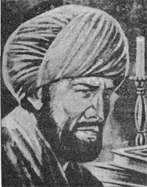
Introduction: A Doctor Who Changed the World's View on Children's Health
In the 10th century, when Europe was still struggling with the darkness of the Middle Ages, in the city of Qayrawan, Tunisia, a doctor named Abu Ja'far Ahmad ibn Ibrahim ibn Abi Khalid ibn al-Jazzar al-Qayrawani began writing a medical guide that would influence the world for centuries. Ibn al-Jazzar, known in Europe by the Latin name Algizar, was not just an ordinary doctor. He was a prolific writer who produced over 30 medical works, including the first book specifically discussing nutrition and childhood diseases. His works were translated into Latin, Hebrew, and Greek, becoming required texts at European universities such as Salerno and Montpellier. This article will take you through the life and extraordinary contributions of this figure, proving that the Islamic civilization not only preserved ancient medical knowledge but also expanded it with a revolutionary scientific approach.
Historical Background: Qayrawan, the Intellectual Center in North Africa
In the 10th century, the city of Qayrawan in Tunisia was one of the most important intellectual centers in the Islamic world. Founded in 670 CE, Qayrawan developed into a center of trade, religion, and science. It was here that great figures such as Imam Sahnun (a jurist) and Ibn al-Jazzar himself were born. When the Fatimid dynasty (909–1171) ruled, Qayrawan became home to large libraries and modern hospitals (bimaristan) for its time. Ibn al-Jazzar received his early education in this city, studying medicine from his father and renowned teachers such as Ishak bin Imran (a famous doctor). The fertile intellectual environment allowed him to access the works of Galen, Hippocrates, and Dioscorides, which formed the basis of his medical writings.
Main Figure: Ibn al-Jazzar, Doctor and Prolific Writer
Ibn al-Jazzar was born in 895 CE in Qayrawan and died in 979 CE. He was known as 'al-Jazzar' (meat seller) because his family was involved in the meat trade, but this title did not prevent him from becoming a leading scholar. Ibn al-Jazzar was not only an expert in medicine, but also in pharmacy, botany, and nutrition. His most famous work is 'Zad al-Musafir wa Qut al-Hadir' (The Traveler's Provision and the Home-Dweller's Food), a medical guide covering various diseases and treatments. This book was translated into Latin by Constantine the African in the 11th century under the title 'Viaticum peregrinantis', and became a standard text in European medical schools. In addition, Ibn al-Jazzar also wrote 'Kitab al-Tibb al-Muluki' (Medicine for Kings) and 'Kitab al-Mujarrabat' (Book of Experiences), which contained recipes for medicines based on his clinical experiences.
Achievements and Contributions: Nutrition and Childhood Diseases
One of Ibn al-Jazzar's greatest contributions was his emphasis on nutrition and children's health. In his works, he wrote in detail about the diseases that often affected children, such as fever, cough, diarrhea, and digestive problems. He emphasized the importance of balanced nutrition to prevent disease and provided advice on suitable foods for children based on their age and health conditions. Ibn al-Jazzar also discussed breastfeeding, hygiene, and infant care. This holistic approach was far ahead of its time, as at that time, medicine in Europe was still speculative and based on superstition. The book 'Zad al-Musafir' contains a specific chapter on childhood diseases, which became the main reference for doctors throughout the Islamic world and Europe. In addition, he also wrote about the nutrition of adult patients, including diets for diabetic patients, liver problems, and digestive disorders. Ibn al-Jazzar believed that food was the most basic medicine, and he encouraged the use of herbs and spices as additional treatments.
Important Events: Translation of Works into Latin
In the 11th century, a Benedictine monk named Constantine the African (1020–1087) visited Qayrawan and discovered the works of Ibn al-Jazzar. Constantine, who later became a teacher at the School of Medicine in Salerno, Italy, translated 'Zad al-Musafir' into Latin under the title 'Viaticum peregrinantis'. This translation became a required text at European universities such as Salerno, Montpellier, and Paris. 'Viaticum' was used as a practical medical guide for doctors treating patients at home or during travel. The work was also translated into Hebrew and Greek, proving its widespread influence. This translation became an important milestone in the history of European medicine, as it introduced the scientific methods of Islam based on observation and experience, rather than the speculative theories of Galen, which dominated at the time.
Implications for the World: The Legacy of Ibn al-Jazzar in Modern Medicine
Ibn al-Jazzar left a deep legacy in the field of medicine, especially in nutrition and pediatrics. His approach to childhood diseases and diet became the foundation for the development of modern medicine. His works continued to be studied until the 17th century, and many herbal medicine recipes recorded by Ibn al-Jazzar are still used in traditional medicine in North Africa and the Middle East. In addition, his emphasis on hygiene and disease prevention through a balanced diet is a principle accepted in modern preventive medicine. Ibn al-Jazzar is also recognized as a pioneer in the field of pharmacology, as he wrote about how to safely prepare and use herbal medicines. His legacy proves that the Islamic civilization not only preserved ancient medical knowledge, but also expanded it with practical and innovative scientific approaches.
Conclusion: Honoring a Great Figure
Ibn al-Jazzar died in 979 CE in Qayrawan, but his name and contributions continue to live on. He is the best example of how an Islamic doctor could change the world through writing and research. His works not only served as medical references for centuries, but also paved the way for the development of modern medicine. In an era where we often overlook the contributions of Islamic civilization, the story of Ibn al-Jazzar reminds us that knowledge knows no boundaries. He is proof that a doctor from Tunisia could influence medicine in Europe and around the world. May this article inspire us to continue appreciating and learning from the great heritage of Islamic civilization.
---
*Reference: [Ibn al-Jazzar — Wikipedia](https://en.wikipedia.org/wiki/Ibn_al-Jazzar)*