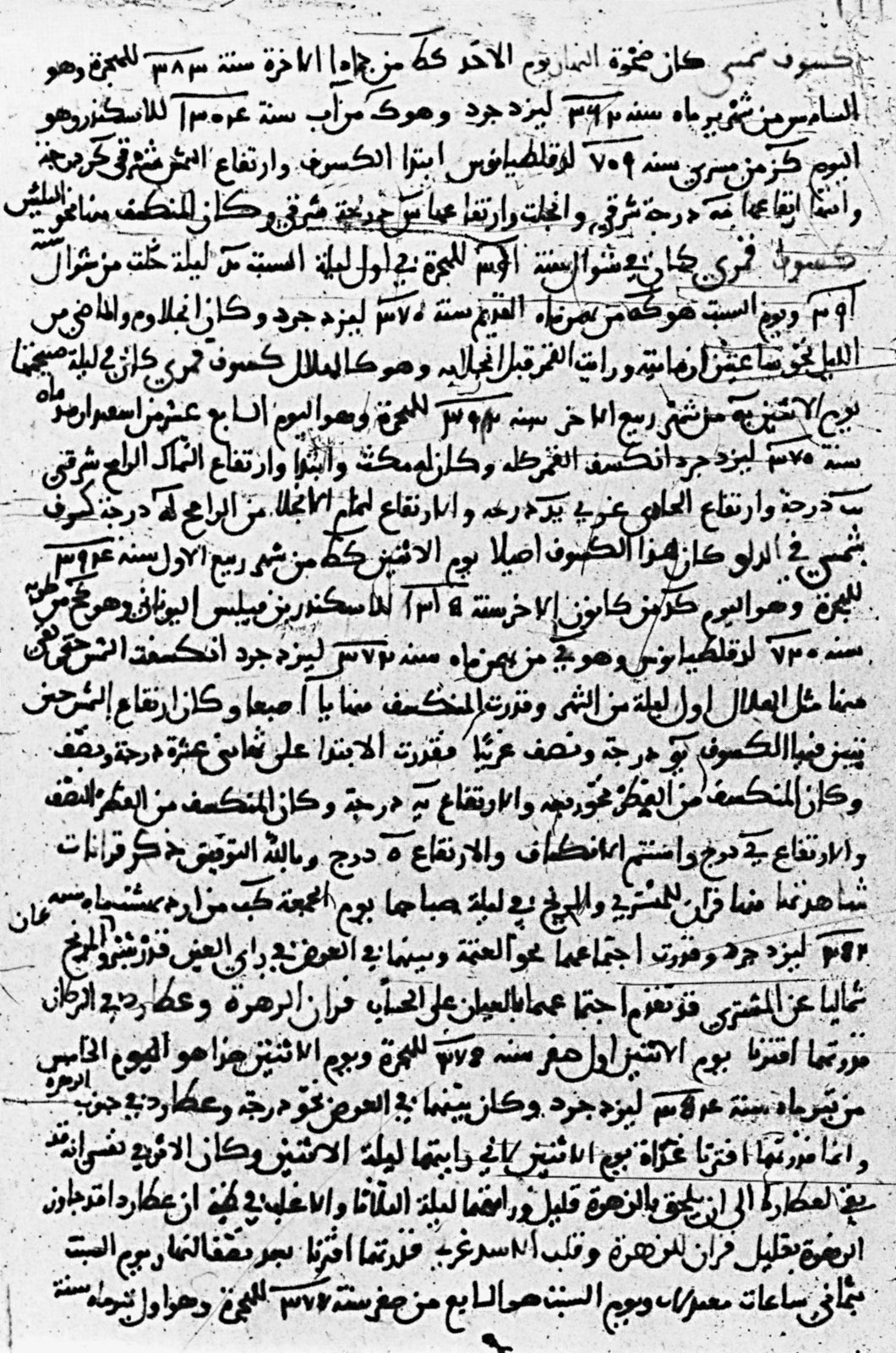
On the Summit of Mokattam Hill, An Astronomer Gazed at the Sky
On a quiet night at the end of the 10th century, on top of Mokattam Hill overlooking the city of Fustat, a man with a simple build and white beard meticulously recorded the position of the moon and the planets. His name was Abu al-Hasan Ali ibn Yunus, and what he did that night—and thousands of nights before—would change the way humans understood the sky. He was not just an ordinary astronomer; he was the architect of the most accurate astronomical table ever created in his time, a achievement that could only be accomplished through a combination of perseverance, genius, and full support from the Fatimid caliph.
From Youth to Adulthood: The Journey of a Science Lover
Born around the year 950 CE in the city of Fustat (now part of Cairo), Ibn Yunus came from an esteemed family. His father, Abu al-Said, was a renowned scholar and historian. From a young age, Ibn Yunus showed a deep interest in mathematics and astronomy. He studied the works of great predecessors such as Al-Battani and Abu al-Wafa’ al-Buzjani, but he did not merely imitate. With sharp intellect, he began to critique and refine existing methods.
When Caliph Al-Aziz Billah of the Fatimid Dynasty heard about his intelligence, he immediately invited Ibn Yunus to the palace. The caliph was not only impressed but also gave him abundant gifts. More importantly, he ordered the construction of an observatory on Mokattam Hill—a major recognition of Ibn Yunus's potential. It was here, under the clear Egyptian sky, that Ibn Yunus began the work that would become a landmark of Islamic science.
Al-Zij al-Kabir al-Hakimi: A Table That Changed Everything
Under the order of Caliph Al-Aziz, Ibn Yunus began compiling an astronomical table that later became known as *al-Zij al-Kabir al-Hakimi* in honor of Caliph Al-Hakim bi-Amr Allah, the successor of Al-Aziz. This table was not just a list of star positions. It was an astronomical encyclopedia covering more than 100 years of observations, including calculations of eclipses, planetary movements, and the positions of the sun and moon.
What made this table extraordinary was its accuracy. Ibn Yunus used advanced trigonometric methods and tools such as astrolabes and large quadrants built specifically for this purpose. He recorded prayer times, the direction of the qibla, and other astronomical phenomena with a very low margin of error. In fact, some of his records on lunar and solar eclipses are still used by modern astronomers to study changes in the Earth's rotation. A well-known example is his record of the eclipses that occurred in 978 and 979 CE, which serve as important scientific evidence in historical studies.
More Than Just a Table: Mathematical Contributions and Innovations
Ibn Yunus was not only an astronomer; he was also a brilliant mathematician. In his works, he introduced several previously unknown trigonometric solutions, including the use of more precise trigonometric functions to calculate the distance between stars. He also improved methods for calculating time using the shadow of the sun, a technique extremely important for Islamic worship.
Another major contribution of his was in the field of prayer times. Using his astronomical table, Ibn Yunus could accurately determine the times of Dhuhr and Asr based on the shadow of objects. This not only simplified daily life but also demonstrated how science and religion could coexist in the Islamic civilization.
A Legacy That Lives On: From Mokattam Hill to the Moon
Ibn Yunus died in 1009 CE, but his legacy never faded. *Al-Zij al-Kabir al-Hakimi* continued to be used by astronomers across the Islamic world for centuries. Even when Europe began to rise in science, copies of these tables were translated and studied in universities such as those in Toledo and Cordova.
In the 20th century, when NASA and international scientists began mapping the surface of the moon, they named one of the craters on the southern side of the moon 'Ibn Yunus'—a lasting tribute to a man who once gazed at the sky from Mokattam Hill. The Ibn Yunus crater, located at coordinates 14.6°S, 91.1°E, now stands as a silent witness to the immense contribution of a Muslim astronomer to the treasure of human knowledge.
Inspiration for the Modern Age
The story of Ibn Yunus reminds us that scientific excellence does not emerge in a vacuum. It requires government support, personal dedication, and the courage to question what is already known. In the midst of a world often plagued by conflict, Ibn Yunus proved that the Islamic civilization was capable of producing knowledge that was not only accurate but also beneficial to all of humanity.
So, when you look up at the night sky and are captivated by the beauty of the stars, remember that a man from Egypt over 1,000 years ago meticulously recorded every movement of them with love and precision. For him, each star was a verse of God to be read, understood, and shared.
---
*Rujukan: [Ibn Yunus — Wikipedia](https://en.wikipedia.org/wiki/Ibn_Yunus)*