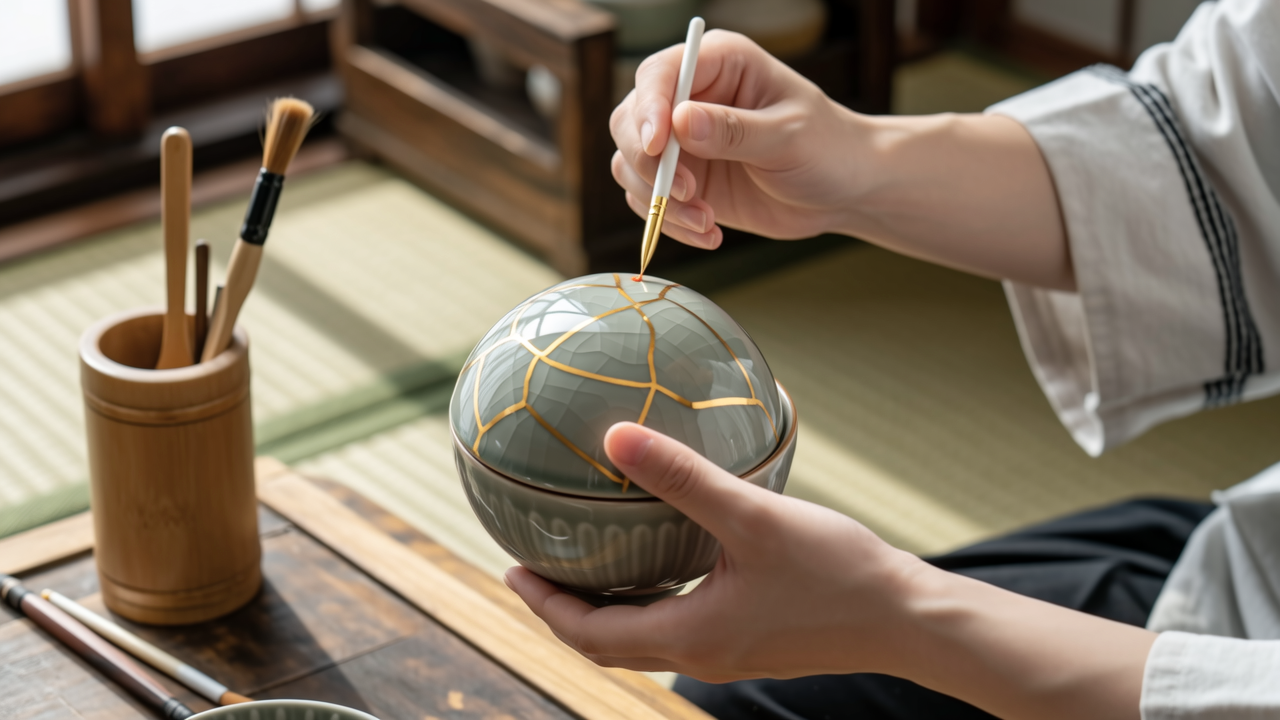
KYOTO — Amid the hustle of modern life often driven by digital perfection, a unique cultural movement is rapidly growing among the youth in Japan. The traditional art of 'Kintsugi,' a technique that repairs broken ceramics or pottery using lacquer mixed with gold, silver, or platinum, is experiencing an extraordinary revival. What is intriguing is how this centuries-old art is no longer just seen as a method for restoring antique items, but has evolved into a profound philosophy of life for today's youth.
Literally meaning 'golden joinery,' Kintsugi is rooted in the Wabi-Sabi philosophy that values the beauty in imperfection, transience, and incompleteness. In ancient times, when a valuable tea bowl cracked or broke, it was not discarded; instead, it was carefully repaired, and the cracks were highlighted with precious metals. This made the object more beautiful and valuable than its original state. The golden lines tell the story and trauma of the object, transforming flaws into a proud feature of strength and uniqueness.
For today's Japanese youth, the message conveyed by Kintsugi is highly relevant and provides therapeutic relief. Facing high academic pressure, fierce competition in the job market, and the effects of social isolation due to recent pandemics, many young people feel burdened by societal expectations to be 'perfect.' Kintsugi workshops are now sprouting like mushrooms after rain in major cities such as Tokyo and Kyoto. Through a process requiring patience, meticulous attention, and inner calm, participants find that it acts as a form of healing meditation.
A renowned Kintsugi art instructor, Haruka Sato, explains that the process of repairing a broken bowl is a reflection of the process of self-healing. 'Many of my students come to class feeling broken or stressed about life. When they see how the broken pieces can be reassembled into something more beautiful and valuable, it gives them a new perspective on their own weaknesses,' she says. This philosophy emphasizes that wounds and scars, whether physical or emotional, are not something to be hidden, but should be accepted as part of one's identity that strengthens character.
This phenomenon has also gained widespread attention through social media platforms like Instagram and TikTok, where art enthusiasts proudly display their Kintsugi works. It has indirectly sparked global interest in this art, attracting international tourists to travel to Japan solely to learn the skill. The revival of Kintsugi proves that even though Japan continues to drive rapid technological innovation, the spirit and wisdom of its traditional culture are still capable of offering deep answers to modern human existential crises.
The Revival of Kintsugi Art: How Japanese Youth Embrace the Philosophy of Imperfection. The traditional Japanese art of repairing broken pottery using lacquer mixed with gold, known as Kintsugi, is now gaining popularity among the younger generation as a symbol of mental resilience and beauty.. KYOTO — Amid the hustle of modern life often driven by digital perfection, a unique cultural movement is rapidly growing among the youth in Japan. The traditional art of 'Kintsugi,' a technique that repairs broken ceramics or pottery using lacquer mixed with gold, silver, or platinum, is experiencing an extraordinary revival. What is intriguing is how this centuries-old art is no longer just seen as a method for restoring antique items, but has evolved into a profound philosophy of life for today's youth.
Literally meaning 'golden joinery,' Kintsugi is rooted in the Wabi-Sabi philosophy that values the beauty in imperfection, transience, and incompleteness. In ancient times, when a valuable tea bowl cracked or broke, it was not discarded; instead, it was carefully repaired, and the cracks were highlighted with precious metals. This made the object more beautiful and valuable than its original state. The golden lines tell the story and trauma of the object, transforming flaws into a proud feature of strength and uniqueness.
For today's Japanese youth, the message conveyed by Kintsugi is highly relevant and provides therapeutic relief. Facing high academic pressure, fierce competition in the job market, and the effects of social isolation due to recent pandemics, many young people feel burdened by societal expectations to be 'perfect.' Kintsugi workshops are now sprouting like mushrooms after rain in major cities such as Tokyo and Kyoto. Through a process requiring patience, meticulous attention, and inner calm, participants find that it acts as a form of healing meditation.
A renowned Kintsugi art instructor, Haruka Sato, explains that the process of repairing a broken bowl is a reflection of the process of self-healing. 'Many of my students come to class feeling broken or stressed about life. When they see how the broken pieces can be reassembled into something more beautiful and valuable, it gives them a new perspective on their own weaknesses,' she says. This philosophy emphasizes that wounds and scars, whether physical or emotional, are not something to be hidden, but should be accepted as part of one's identity that strengthens character.
This phenomenon has also gained widespread attention through social media platforms like Instagram and TikTok, where art enthusiasts proudly display their Kintsugi works. It has indirectly sparked global interest in this art, attracting international tourists to travel to Japan solely to learn the skill. The revival of Kintsugi proves that even though Japan continues to drive rapid technological innovation, the spirit and wisdom of its traditional culture are still capable of offering deep answers to modern human existential crises.