Historical Roots: From Kampung Kapit to Keppel Road
Laksa is not a single dish that emerged from one point in time or location. It is the result of years of evolution in between spaces—especially in the Peranakan communities in Malacca and Singapore from the 15th to the 19th century. The term 'laksa' itself may originate from the Sanskrit word
laksha, meaning 'thousands,' referring to the complexity of spices and layers of flavor in its broth. However, in the context of Nusantara linguistics, it is also closely related to the Malay words
laksan (like) or
laksa-laksa (repeated), indicating the layered and repeated nature of its preparation. Early historical documents such as Portuguese traveler records from the 16th century mention 'spiced rice soup' in the port of Malacca—which is now known as the precursor to Laksa Lemak. In Sarawak, the local version of laksa—with its thick yellow broth and different spices—has been found in records from the University Malaysia Sarawak (UNIMAS) since the early 20th century, showing that laksa is not only rooted in the Peninsula but also thrived in West Kalimantan through exchanges with Iban and Sambas Malay communities.
Three Main Faces: Lemak, Asam, and Sarawak
In general, laksa in Nusantara can be categorized into three main forms based on their flavor profile and broth structure.
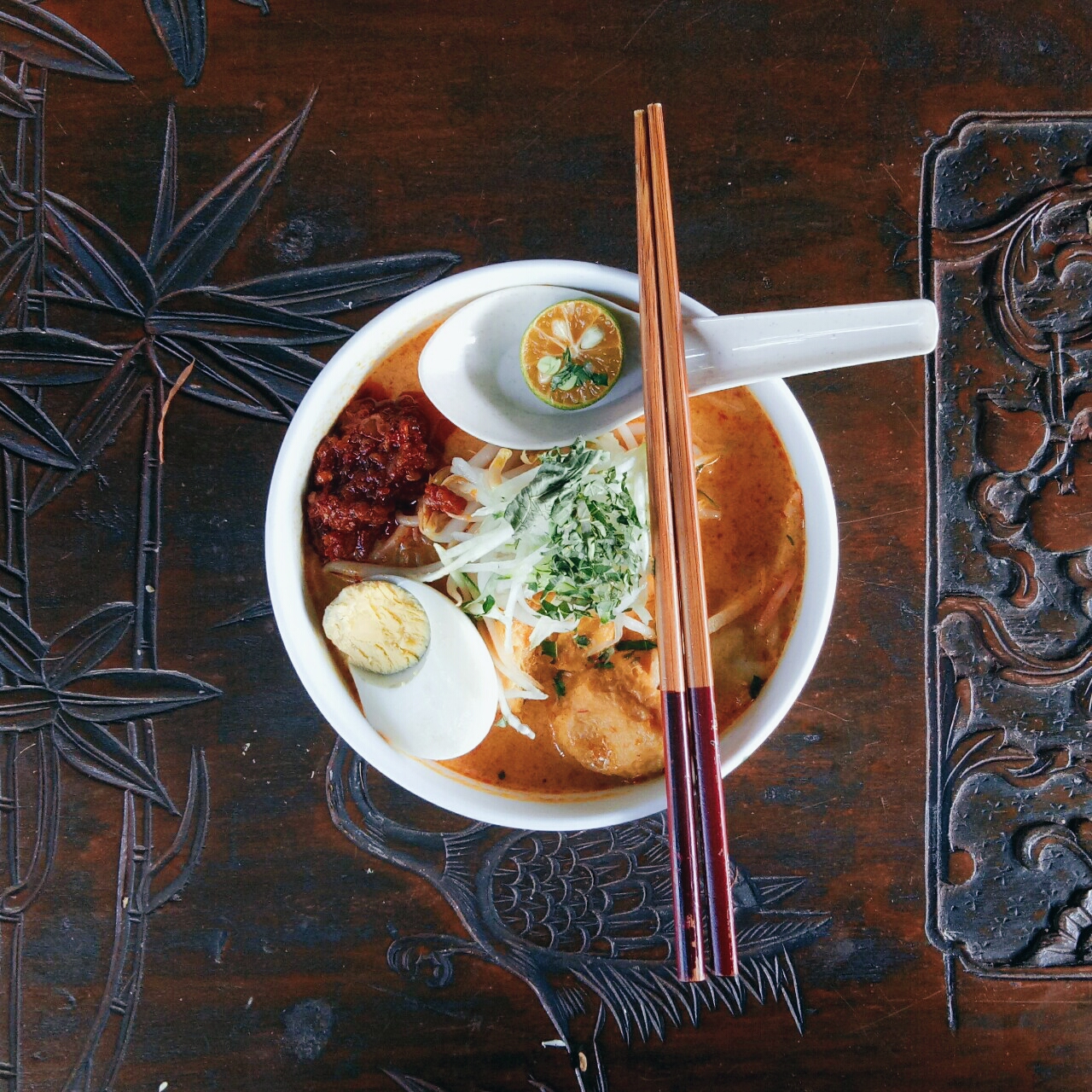
Laksa Lemak, most common in Selangor and Johor, uses rich coconut milk as a base, combined with fried dried shrimp, lemongrass, and kaffir lime leaves. Its broth is rich, oily, and golden-colored—often served with boiled chicken or eggs.
Laksa Asam, popular in Penang and North Sumatra, relies on tamarind or sour mango as a balancing agent for spiciness and sweetness; its broth is thinner, brownish, and has a sharp sour note—usually accompanied by mackerel or anchovies. Meanwhile,
Laksa Sarawak, recognized by UNESCO as part of Malaysia's Intangible Cultural Heritage in 2022, uses a unique blend of spices such as cumin, cinnamon, and fresh galangal roots—without coconut milk—and is served with prawns, grilled chicken, and blanched bean sprouts. These differences are not just about taste, but reflect ecosystems: the abundance of coconut milk in lowlands versus the availability of wild tamarind in hilly and river areas.
Local Ingredients as Drivers of Culinary Identity
The quality of laksa is not determined by the fineness of imported spices, but by the presence of irreplaceable local ingredients. For example,
tamarind on the west coast of the Peninsula—which cannot be replaced by sour mango without drastically changing the flavor profile—or
prawns from the Rajang River in Sarawak, which provide a natural umami not found in regular sea prawns. In Palembang, laksa uses
catfish that is grilled before being cooked in the broth—technique that produces a smoky and deep fatty flavor. This fact emphasizes the Nusantara culinary principle: authenticity does not lie in recipe consistency, but in loyalty to ingredients and geographical context. A study by the Malaysian Agricultural Research and Development Institute (MARDI) in 2021 showed that 78% of traditional laksa makers in Kelantan and Terengganu still prioritize local ingredients despite higher prices—not because of economics, but because of awareness that taste is a collective memory.
Laksa in Social Spaces: From Family Kitchens to Digital Platforms
Laksa is not only served on dining tables—it becomes a medium for social interaction. In villages in Penang, making Laksa Asam is a group activity before Hari Raya, where adult women manually grind spices using mortar and pestle while sharing family stories. In Kuching City, Sarawak laksa stalls on Carpenter Street still use the 'two-pot' cooking method—one for the broth, one for the spice stir-fry—a practice passed down through generations. In the digital era, laksa has also become a main subject on platforms like TikTok and YouTube, where food creators like
Rasa Nusantara and
Makanan Warisan receive millions of views for videos comparing Medan laksa vs. Johor laksa. This phenomenon shows that laksa is not just food, but an object of reflection: when we choose a specific laksa, we are choosing a narrative—about home, roots, and who we are in the map of Nusantara flavors.
Reflective Question: Who Still Owns Laksa?
Amid the popularity of laksa on halal restaurant menus in Tokyo and fast food shops in Sydney, an important question arises: when laksa is adapted without tamarind, without prawns, or without a mortar—does it still count as laksa? The answer lies not in absolute authenticity, but in the awareness of the process. As stated by food anthropologist Dr. Noraini Mohamed in her book
Flavor and Roots (2020), 'Laksa is a dialogue—not a monologue. It changes when it moves, but it does not lose its identity as long as the dialogue still respects its roots.' Therefore, every spoonful of laksa is not just a fulfillment of taste, but an invitation to ask: Do the ingredients I eat today tell me about the land they grew in? Does the way it is cooked still remind me of the hands that first ground the spices? And most importantly—am I still hearing the voice of the village in every sip of its broth?
Laksa, in all its forms, is proof that food culture is never static. It is a river—flowing, branching, settling, but always keeping the original silt at its bottom. And this river, as said by a spice farmer in Tanjung Malim, 'never forgets where it started, even though it has already reached the sea.'
---
Reference: Laksa — Wikipedia
Laksa: The Taste of Peranakan Heritage Connecting the Islands and Mainland of Nusantara. Laksa is not just a spicy noodle soup—it is a taste document built from the cultural mix of Malay, Chinese, and Indian in the Nusantara region. As a Peranakan culinary heritage, laksa shows geographical diversity through varieties such as Laksa Lemak, Laksa Asam, and Laksa Sarawak—each reflecting local ingredients, cooking techniques, and local social history. Its presence in family spaces, night markets, and modern restaurants illustrates the resilience of food culture amidst globalization.. Historical Roots: From Kampung Kapit to Keppel Road
Laksa is not a single dish that emerged from one point in time or location. It is the result of years of evolution in between spaces—especially in the Peranakan communities in Malacca and Singapore from the 15th to the 19th century. The term 'laksa' itself may originate from the Sanskrit word laksha , meaning 'thousands,' referring to the complexity of spices and layers of flavor in its broth. However, in the context of Nusantara linguistics, it is also closely related to the Malay words laksan like or laksa-laksa repeated , indicating the layered and repeated nature of its preparation. Early historical documents such as Portuguese traveler records from the 16th century mention 'spiced rice soup' in the port of Malacca—which is now known as the precursor to Laksa Lemak. In Sarawak, the local version of laksa—with its thick yellow broth and different spices—has been found in records from the University Malaysia Sarawak UNIMAS since the early 20th century, showing that laksa is not only rooted in the Peninsula but also thrived in West Kalimantan through exchanges with Iban and Sambas Malay communities.
Three Main Faces: Lemak, Asam, and Sarawak
In general, laksa in Nusantara can be categorized into three main forms based on their flavor profile and broth structure. Laksa Lemak , most common in Selangor and Johor, uses rich coconut milk as a base, combined with fried dried shrimp, lemongrass, and kaffir lime leaves. Its broth is rich, oily, and golden-colored—often served with boiled chicken or eggs. Laksa Asam , popular in Penang and North Sumatra, relies on tamarind or sour mango as a balancing agent for spiciness and sweetness; its broth is thinner, brownish, and has a sharp sour note—usually accompanied by mackerel or anchovies. Meanwhile, Laksa Sarawak , recognized by UNESCO as part of Malaysia's Intangible Cultural Heritage in 2022, uses a unique blend of spices such as cumin, cinnamon, and fresh galangal roots—without coconut milk—and is served with prawns, grilled chicken, and blanched bean sprouts. These differences are not just about taste, but reflect ecosystems: the abundance of coconut milk in lowlands versus the availability of wild tamarind in hilly and river areas.
Local Ingredients as Drivers of Culinary Identity
The quality of laksa is not determined by the fineness of imported spices, but by the presence of irreplaceable local ingredients. For example, tamarind on the west coast of the Peninsula—which cannot be replaced by sour mango without drastically changing the flavor profile—or prawns from the Rajang River in Sarawak, which provide a natural umami not found in regular sea prawns. In Palembang, laksa uses catfish that is grilled before being cooked in the broth—technique that produces a smoky and deep fatty flavor. This fact emphasizes the Nusantara culinary principle: authenticity does not lie in recipe consistency, but in loyalty to ingredients and geographical context. A study by the Malaysian Agricultural Research and Development Institute MARDI in 2021 showed that 78% of traditional laksa makers in Kelantan and Terengganu still prioritize local ingredients despite higher prices—not because of economics, but because of awareness that taste is a collective memory.
Laksa in Social Spaces: From Family Kitchens to Digital Platforms
Laksa is not only served on dining tables—it becomes a medium for social interaction. In villages in Penang, making Laksa Asam is a group activity before Hari Raya, where adult women manually grind spices using mortar and pestle while sharing family stories. In Kuching City, Sarawak laksa stalls on Carpenter Street still use the 'two-pot' cooking method—one for the broth, one for the spice stir-fry—a practice passed down through generations. In the digital era, laksa has also become a main subject on platforms like TikTok and YouTube, where food creators like Rasa Nusantara and Makanan Warisan receive millions of views for videos comparing Medan laksa vs. Johor laksa. This phenomenon shows that laksa is not just food, but an object of reflection: when we choose a specific laksa, we are choosing a narrative—about home, roots, and who we are in the map of Nusantara flavors.
Reflective Question: Who Still Owns Laksa?
Amid the popularity of laksa on halal restaurant menus in Tokyo and fast food shops in Sydney, an important question arises: when laksa is adapted without tamarind, without prawns, or without a mortar—does it still count as laksa? The answer lies not in absolute authenticity, but in the awareness of the process. As stated by food anthropologist Dr. Noraini Mohamed in her book Flavor and Roots 2020 , 'Laksa is a dialogue—not a monologue. It changes when it moves, but it does not lose its identity as long as the dialogue still respects its roots.' Therefore, every spoonful of laksa is not just a fulfillment of taste, but an invitation to ask: Do the ingredients I eat today tell me about the land they grew in? Does the way it is cooked still remind me of the hands that first ground the spices? And most importantly—am I still hearing the voice of the village in every sip of its broth?
Laksa, in all its forms, is proof that food culture is never static. It is a river—flowing, branching, settling, but always keeping the original silt at its bottom. And this river, as said by a spice farmer in Tanjung Malim, 'never forgets where it started, even though it has already reached the sea.'
---
Reference: Laksa — Wikipedia https://en.wikipedia.org/wiki/Laksa