Gamma-Ray Bursts: The Most Powerful Cosmic Explosions Since the Big Bang
In the vast expanse of the universe, there exist phenomena so powerful that the human mind struggles to comprehend them. Gamma-ray bursts, or GRBs, are the most energetic and luminous cosmic explosions ever recorded, second only to the Big Bang itself. Imagine an event that releases energy equivalent to the entire lifetime of the Sun over 10 billion years, but in just a few seconds. That is the scale of a GRB, a stunning and mysterious expression of the universe's violence.
The Death of Giant Stars and the Birth of Exotic Objects
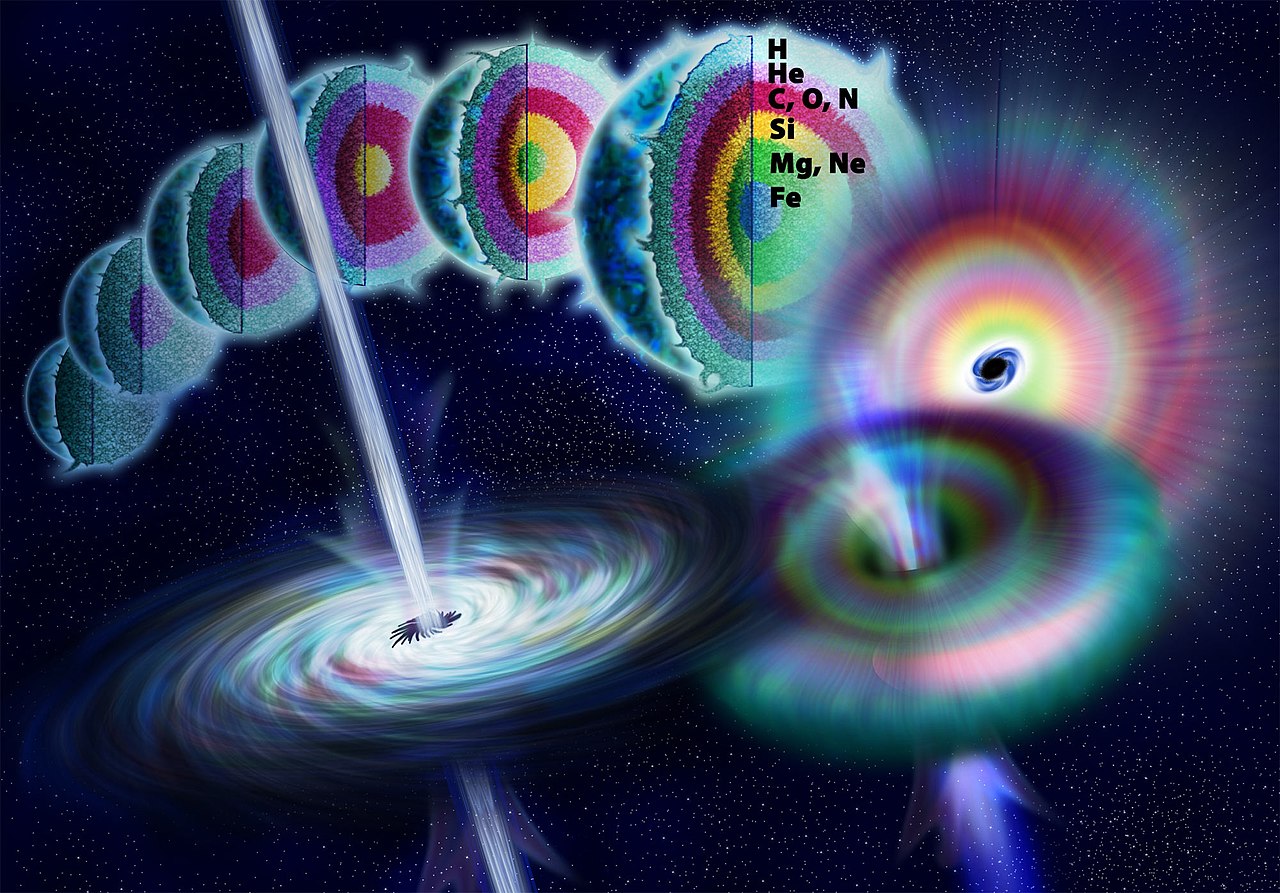
Fundamentally, GRBs can be divided into two main categories based on their duration: long GRBs and short GRBs. Long GRBs, which can last from a few seconds to several minutes, are believed to originate from the collapse of the core of a very massive star, known as a hypernova or superluminous supernova. When a star with more than 20 times the mass of the Sun exhausts the nuclear fuel in its core, it can no longer withstand the immense gravitational force. The star's core collapses rapidly, forming either an extremely dense neutron star or a black hole. This collapse process emits jets of material moving at nearly the speed of light, piercing through the star's outer layers and emitting powerful gamma rays.
A notable example of a long GRB is GRB 080319B, known as the 'Naked-Eye Burst' because its light was so bright that it could be seen with the naked eye through a small telescope from a distance of 7.5 billion light-years. The jets produced by this event are believed to contain extraordinary kinetic energy, emitting an electromagnetic spectrum from gamma rays to radio waves after the initial gamma-ray flash fades. This leaves an 'afterglow' that can be observed for days or even weeks, allowing scientists to gather more information about the nature of the event.
The Cosmic Merger of Neutron Stars: Source of Short GRBs
In contrast to long GRBs, short GRBs last only milliseconds to a few seconds. Recent studies reveal that short GRBs originate from the merger of two neutron stars in a binary system. Neutron stars are extremely dense remnants of stars, where a teaspoon of their material could weigh as much as Mount Everest. When two neutron stars orbit each other at increasingly close distances, they gradually lose energy through the emission of gravitational waves. Eventually, they collide and merge into a larger object, either a black hole or a more massive neutron star, releasing a tremendous amount of energy in the form of gamma rays and gravitational waves.
These neutron star merger events are also the primary source of kilonovae, which are explosions brighter than a typical nova but not as bright as a supernova. Kilonovae play a crucial role in the formation of heavy elements such as gold, platinum, and uranium through the rapid neutron capture process (r-process). The discovery of gravitational waves associated with GRB 170817A in 2017, through the collaboration of the LIGO and Virgo detectors, confirmed this theory. This marked the first time humans observed a cosmic event using both electromagnetic waves and gravitational waves, opening a new era in multi-messenger astronomy.
Why Are GRBs So Important to Us?
Although GRBs occur in very distant galaxies, their implications for our understanding of the universe are immense. First, GRBs serve as cosmic beacons that illuminate the most primitive parts of the universe. Since most GRBs occur billions of light-years from Earth, the light we see today comes from events that happened when the universe was young. This allows astronomers to study the conditions of early galaxies, star formation rates, and the evolution of heavy elements in the early universe. They act as 'diagnostic tools' to test cosmological models and understand how the structure of the universe formed.
Second, GRBs are major engines in the formation of heavy elements. As mentioned, neutron star mergers not only produce short GRBs but are also responsible for synthesizing many heavy elements essential for life, including those that form planets and living organisms. Without these violent events, these elements might not exist in sufficient quantities.
Third, the study of GRBs helps us understand the nature of extreme physics. The conditions under which GRBs occur—extreme density, high temperatures, and strong magnetic fields—cannot be replicated in Earth laboratories. By studying GRBs, scientists can test physical theories at their limits, including Einstein's general theory of relativity and high-energy particle physics. They also provide clues about the nature of black holes and neutron stars, two of the most mysterious objects in the universe.
A Rare Cosmic Threat
A common question is whether GRBs could threaten life on Earth. Theoretically, yes. If a GRB occurred in our own galaxy, the Milky Way, and its jet was aimed directly at Earth, it could cause massive destruction. Gamma rays could thin the atmospheric ozone layer, exposing Earth's surface to harmful ultraviolet radiation from the Sun. This could trigger a mass extinction event. However, this risk is very low. Our galaxy has a lower star formation rate compared to other galaxies, and GRBs are extremely rare phenomena—only a few per galaxy over billions of years. Furthermore, GRB jets are very narrow, making it unlikely for Earth to be in the direct path of such a jet. Therefore, practically, the threat of GRBs to life on Earth is nearly zero.
Future Prospects in GRB Research
With advances in telescope and detector technology, such as the Swift and Fermi satellites, as well as gravitational wave observatories like LIGO and Virgo, our understanding of GRBs continues to grow. Future missions, such as next-generation X-ray observatories and more sensitive radio telescopes, will provide deeper insights into the physical processes occurring during GRBs. The study of GRBs not only expands the boundaries of our knowledge about the universe but also challenges our understanding of the most fundamental laws of physics. Each burst is a 'natural laboratory' offering new clues about how the universe works and how we, as a small part of it, exist here.
---
---
Reference: Gamma-ray burst — Wikipedia
Gamma-Ray Bursts: The Most Powerful Cosmic Explosions Since the Big Bang. Gamma-ray bursts (GRBs) are the most energetic and luminous astrophysical phenomena in the universe, second only to the Big Bang. They result from the collapse of massive stars or the merger of neutron stars, releasing energy equivalent to the entire lifetime of the Sun in just a few seconds. Understanding GRBs allows us to study stellar evolution, the formation of heavy elements, and the early structure of the universe.. Gamma-Ray Bursts: The Most Powerful Cosmic Explosions Since the Big Bang
In the vast expanse of the universe, there exist phenomena so powerful that the human mind struggles to comprehend them. Gamma-ray bursts, or GRBs, are the most energetic and luminous cosmic explosions ever recorded, second only to the Big Bang itself. Imagine an event that releases energy equivalent to the entire lifetime of the Sun over 10 billion years, but in just a few seconds. That is the scale of a GRB, a stunning and mysterious expression of the universe's violence.
The Death of Giant Stars and the Birth of Exotic Objects
Fundamentally, GRBs can be divided into two main categories based on their duration: long GRBs and short GRBs. Long GRBs, which can last from a few seconds to several minutes, are believed to originate from the collapse of the core of a very massive star, known as a hypernova or superluminous supernova. When a star with more than 20 times the mass of the Sun exhausts the nuclear fuel in its core, it can no longer withstand the immense gravitational force. The star's core collapses rapidly, forming either an extremely dense neutron star or a black hole. This collapse process emits jets of material moving at nearly the speed of light, piercing through the star's outer layers and emitting powerful gamma rays.
A notable example of a long GRB is GRB 080319B, known as the 'Naked-Eye Burst' because its light was so bright that it could be seen with the naked eye through a small telescope from a distance of 7.5 billion light-years. The jets produced by this event are believed to contain extraordinary kinetic energy, emitting an electromagnetic spectrum from gamma rays to radio waves after the initial gamma-ray flash fades. This leaves an 'afterglow' that can be observed for days or even weeks, allowing scientists to gather more information about the nature of the event.
The Cosmic Merger of Neutron Stars: Source of Short GRBs
In contrast to long GRBs, short GRBs last only milliseconds to a few seconds. Recent studies reveal that short GRBs originate from the merger of two neutron stars in a binary system. Neutron stars are extremely dense remnants of stars, where a teaspoon of their material could weigh as much as Mount Everest. When two neutron stars orbit each other at increasingly close distances, they gradually lose energy through the emission of gravitational waves. Eventually, they collide and merge into a larger object, either a black hole or a more massive neutron star, releasing a tremendous amount of energy in the form of gamma rays and gravitational waves.
These neutron star merger events are also the primary source of kilonovae, which are explosions brighter than a typical nova but not as bright as a supernova. Kilonovae play a crucial role in the formation of heavy elements such as gold, platinum, and uranium through the rapid neutron capture process r-process . The discovery of gravitational waves associated with GRB 170817A in 2017, through the collaboration of the LIGO and Virgo detectors, confirmed this theory. This marked the first time humans observed a cosmic event using both electromagnetic waves and gravitational waves, opening a new era in multi-messenger astronomy.
Why Are GRBs So Important to Us?
Although GRBs occur in very distant galaxies, their implications for our understanding of the universe are immense. First, GRBs serve as cosmic beacons that illuminate the most primitive parts of the universe. Since most GRBs occur billions of light-years from Earth, the light we see today comes from events that happened when the universe was young. This allows astronomers to study the conditions of early galaxies, star formation rates, and the evolution of heavy elements in the early universe. They act as 'diagnostic tools' to test cosmological models and understand how the structure of the universe formed.
Second, GRBs are major engines in the formation of heavy elements. As mentioned, neutron star mergers not only produce short GRBs but are also responsible for synthesizing many heavy elements essential for life, including those that form planets and living organisms. Without these violent events, these elements might not exist in sufficient quantities.
Third, the study of GRBs helps us understand the nature of extreme physics. The conditions under which GRBs occur—extreme density, high temperatures, and strong magnetic fields—cannot be replicated in Earth laboratories. By studying GRBs, scientists can test physical theories at their limits, including Einstein's general theory of relativity and high-energy particle physics. They also provide clues about the nature of black holes and neutron stars, two of the most mysterious objects in the universe.
A Rare Cosmic Threat
A common question is whether GRBs could threaten life on Earth. Theoretically, yes. If a GRB occurred in our own galaxy, the Milky Way, and its jet was aimed directly at Earth, it could cause massive destruction. Gamma rays could thin the atmospheric ozone layer, exposing Earth's surface to harmful ultraviolet radiation from the Sun. This could trigger a mass extinction event. However, this risk is very low. Our galaxy has a lower star formation rate compared to other galaxies, and GRBs are extremely rare phenomena—only a few per galaxy over billions of years. Furthermore, GRB jets are very narrow, making it unlikely for Earth to be in the direct path of such a jet. Therefore, practically, the threat of GRBs to life on Earth is nearly zero.
Future Prospects in GRB Research
With advances in telescope and detector technology, such as the Swift and Fermi satellites, as well as gravitational wave observatories like LIGO and Virgo, our understanding of GRBs continues to grow. Future missions, such as next-generation X-ray observatories and more sensitive radio telescopes, will provide deeper insights into the physical processes occurring during GRBs. The study of GRBs not only expands the boundaries of our knowledge about the universe but also challenges our understanding of the most fundamental laws of physics. Each burst is a 'natural laboratory' offering new clues about how the universe works and how we, as a small part of it, exist here.
---
---
Reference: Gamma-ray burst — Wikipedia https://en.wikipedia.org/wiki/Gamma-ray burst