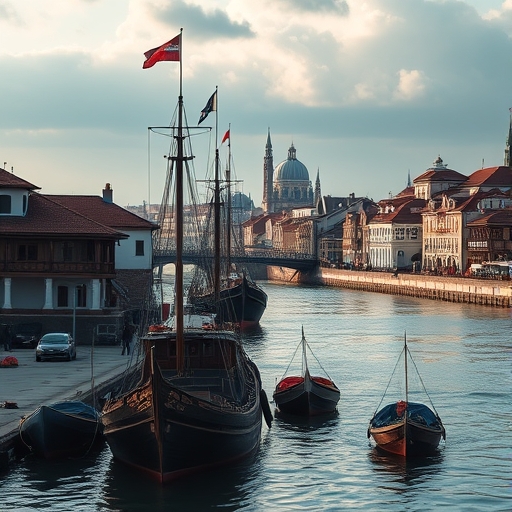
Pre-Portuguese Malacca: A Strategic Trading Hub that Shaped Southeast Asia
When the Portuguese armada breached the Strait of Malacca in 1511, they found a town that had been over a century old.
Malacca's presence as a major port in the 14th and 15th centuries was not coincidental, but rather the result of its unique geographical position and the local government's policy of promoting free trade.
The Focus of Maritime Trade
This port was located in the southern part of the Strait of Malacca, the main maritime route that connected the South China Sea with the Indian Ocean. Merchants from
China,
India,
Arabia, and
Java would stop their ships here to load and unload goods. As noted in the source
Malacca and the Spread of Islam, "Java had to put in at Malacca before proceeding onwards to India". This indicates that Malacca functioned as a logistics hub, forcing ships to wait for a schedule that synchronized with the flow of trade.
Political and Security Dynamics
Before the arrival of the Portuguese, Malacca was under the rule of the
Sultanate of Malacca, founded by Parameswara (also known as Parameswara Singh) at the end of the 14th century. This government practiced a low-tariff policy and ensured security for all merchants, regardless of their religion or ethnicity. This policy attracted Muslim merchants who later played a significant role in the spread of Islam in Nusantara. This openness made Malacca not only a trading center, but also a
center for the spread of Islamic culture that extended to the surrounding regions.
Port Infrastructure and Technology
Malacca was not just an open port; it had protected docks, storage warehouses, and an open market called the
Malacca Market. This infrastructure was supported by traditional Malay building techniques and foreign influences, such as Chinese building techniques on wooden warehouses. According to archaeological studies, these structures were built using driven piles that penetrated the riverbank, ensuring stability even during extreme high tides.
Cross-Cultural Economic Connections
The presence of this port resulted in a complex network of trade. From the east, merchants brought
silk, porcelain, and tea; from the west, they brought
spices, woven fabrics, and gold. The value of this trade was not only measured in goods, but also in the exchange of knowledge. For example, Arab navigation skills and Chinese astronomical knowledge were disseminated through the exchange of goods, enriching the local sailors' knowledge.
The Spread of Islam Through Trade Routes
The presence of Muslim merchants from Gujarat, Persia, and Arabia at this port played a significant role in the process of Islamizing the Malay archipelago. Several mosques were built, including the Kampong Sungai Batu Mosque, established in the early 15th century. This process was not forced; rather, it was through marriage, trade networks, and the dissemination of inclusive social values.
The Impact of Portuguese Arrival
The arrival of the Portuguese in 1511 marked a drastic change. Although they successfully captured the city, the Malacca trade network continued to operate through underground networks and alternative colonies in Pahang and Johor. However, Portuguese dominance marked the beginning of a colonial era that shifted control of trade to European powers.
Historical Significance for Contemporary Southeast Asia
The success of pre-Portuguese Malacca demonstrates the importance of
cross-cultural cooperation in promoting economic and cultural development. The Sultanate of Malacca's open trade policy can serve as a reference for ASEAN countries in building a integrated maritime logistics network. Additionally, Malacca's role in the spread of Islam emphasizes how trade can be a positive agent of social change.
Conclusion, pre-Portuguese Malacca was not just a trading port; it was a critical node in the global trade network that connected three continents. Its ability to integrate various cultures, strengthen the economy, and disseminate religion shows that Malacca's history is a dynamic reflection of ongoing global interactions to this day.
Rujukan: Malacca and the Spread of Islam — Google Scholar
Pre-Portuguese Malacca: A Strategic Trading Hub that Shaped Southeast Asia. Before the arrival of the Portuguese in the early 16th century, Malacca had become a major port that connected China, India, and the Nusantara region, driving the spread of Islam and cultural exchange in the area.. Pre-Portuguese Malacca: A Strategic Trading Hub that Shaped Southeast Asia
When the Portuguese armada breached the Strait of Malacca in 1511, they found a town that had been over a century old. Malacca's presence as a major port in the 14th and 15th centuries was not coincidental, but rather the result of its unique geographical position and the local government's policy of promoting free trade.
The Focus of Maritime Trade
This port was located in the southern part of the Strait of Malacca, the main maritime route that connected the South China Sea with the Indian Ocean. Merchants from China , India , Arabia , and Java would stop their ships here to load and unload goods. As noted in the source Malacca and the Spread of Islam , "Java had to put in at Malacca before proceeding onwards to India". This indicates that Malacca functioned as a logistics hub, forcing ships to wait for a schedule that synchronized with the flow of trade.
Political and Security Dynamics
Before the arrival of the Portuguese, Malacca was under the rule of the Sultanate of Malacca , founded by Parameswara also known as Parameswara Singh at the end of the 14th century. This government practiced a low-tariff policy and ensured security for all merchants, regardless of their religion or ethnicity. This policy attracted Muslim merchants who later played a significant role in the spread of Islam in Nusantara. This openness made Malacca not only a trading center, but also a center for the spread of Islamic culture that extended to the surrounding regions.
Port Infrastructure and Technology
Malacca was not just an open port; it had protected docks, storage warehouses, and an open market called the Malacca Market . This infrastructure was supported by traditional Malay building techniques and foreign influences, such as Chinese building techniques on wooden warehouses. According to archaeological studies, these structures were built using driven piles that penetrated the riverbank, ensuring stability even during extreme high tides.
Cross-Cultural Economic Connections
The presence of this port resulted in a complex network of trade. From the east, merchants brought silk, porcelain, and tea ; from the west, they brought spices, woven fabrics, and gold . The value of this trade was not only measured in goods, but also in the exchange of knowledge. For example, Arab navigation skills and Chinese astronomical knowledge were disseminated through the exchange of goods, enriching the local sailors' knowledge.
The Spread of Islam Through Trade Routes
The presence of Muslim merchants from Gujarat, Persia, and Arabia at this port played a significant role in the process of Islamizing the Malay archipelago. Several mosques were built, including the Kampong Sungai Batu Mosque, established in the early 15th century. This process was not forced; rather, it was through marriage, trade networks, and the dissemination of inclusive social values.
The Impact of Portuguese Arrival
The arrival of the Portuguese in 1511 marked a drastic change. Although they successfully captured the city, the Malacca trade network continued to operate through underground networks and alternative colonies in Pahang and Johor. However, Portuguese dominance marked the beginning of a colonial era that shifted control of trade to European powers.
Historical Significance for Contemporary Southeast Asia
The success of pre-Portuguese Malacca demonstrates the importance of cross-cultural cooperation in promoting economic and cultural development. The Sultanate of Malacca's open trade policy can serve as a reference for ASEAN countries in building a integrated maritime logistics network. Additionally, Malacca's role in the spread of Islam emphasizes how trade can be a positive agent of social change.
Conclusion , pre-Portuguese Malacca was not just a trading port; it was a critical node in the global trade network that connected three continents. Its ability to integrate various cultures, strengthen the economy, and disseminate religion shows that Malacca's history is a dynamic reflection of ongoing global interactions to this day.
Rujukan: Malacca and the Spread of Islam — Google Scholar https://link.springer.com/content/pdf/10.1007/978-1-349-16521-6 10?pdf=chapter%20toc