Abiotic Origin: Not from Flesh, But from Water and Stone
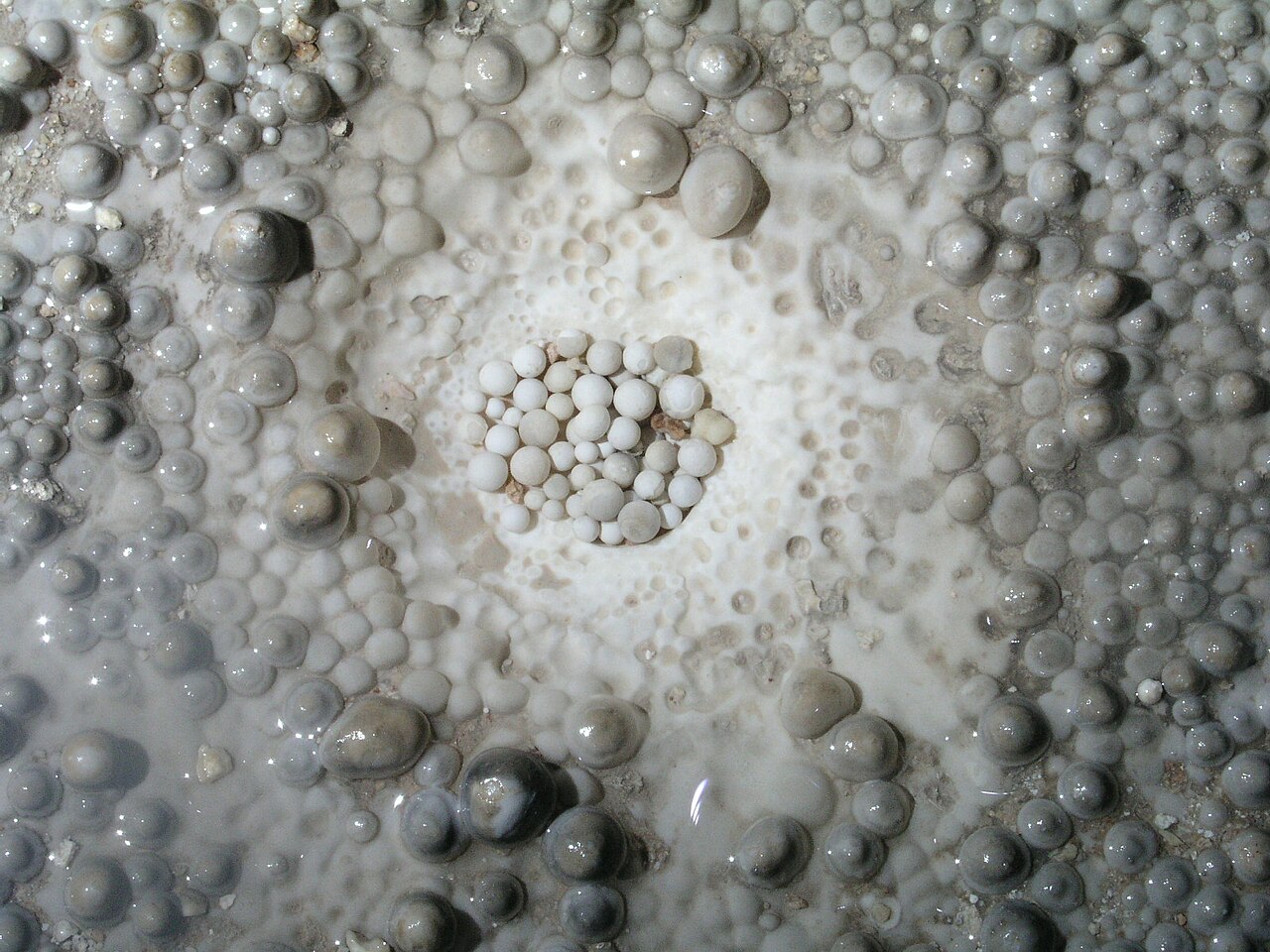
Unlike sea pearls produced by oysters or clams as a response to foreign irritants—such as sand or parasites—cave pearls are born entirely without the intervention of living organisms. They are a pure product of physical chemistry: the dissolution of carbon dioxide (CO₂) in rainwater forms weak carbonic acid (H₂CO₃), which then dissolves calcium carbonate (CaCO₃) from the limestone above the cave. This water seeps into rock crevices and drips onto the cave ceiling. When the drops fall into shallow pools on the cave floor, CO₂ is released into the air, causing calcium carbonate to precipitate again—but not as stalactites or stalagmites, rather as round grains that rotate slowly at the bottom of the pool due to gentle water flow. Each rotation allows a new layer of calcium carbonate to uniformly attach around a nucleus—which can be a dust grain, rock fragment, or even a microscopic quartz crystal. This makes cave pearls one of the clearest examples on Earth of the formation of highly symmetrical spherical structures without a biological template.
Natural Polishing Mechanism: Water as the Creator of Luster
The luster of a cave pearl's surface is not the result of human polishing or biological processes, but a direct mechanical effect of water movement. In stable cave pools—with depths between 1–5 cm and flow velocities less than 0.3 cm/s—the calcium grains rotate continuously like balls in a bowl of water. Each gentle contact between the grain and the pool bottom, or between grains, erodes microscopic irregularities on the surface. This process is known as
hydrodynamic abrasion, and it requires tens to hundreds of years to produce an optical luster that reflects light like a small mirror. Conversely, if the pool dries out or the pearl is exposed to air for more than a few weeks, the outer layer will undergo dehydration, micro-cracking, and surface oxidation—changing the color from ivory white or cream to dull gray and the texture from smooth to rough like fine sand. In Cacahuamilpa Cave in Mexico, oxygen isotope (δ¹⁸O) studies on cave pearls show that variations in layer thickness correlate with rainfall fluctuations over 2,400 years—proving that each layer is a sheet of microclimate archive.
Size and Composition: Between Micro and Macro
Cave pearls typically range from 0.5–5 mm in diameter, although extreme specimens in Carlsbad Cavern (New Mexico) reach 12 mm—large enough to be seen with the naked eye without lens assistance. Their composition is predominantly calcium carbonate in the form of aragonite or calcite, depending on temperature, pH, and magnesium content in the water. Micro-XRD (X-ray diffraction) analysis shows that the layers are not amorphous but radially oriented crystals—a structure very difficult to synthesize in the laboratory without precise control of temperature and flow. An interesting comparison can be made with oyster pearls: both have concentric layer structures, but oyster pearls consist of nacre (vertically oriented aragonite in a protein matrix), while cave pearls consist of polycrystalline calcite without organic material—thus, they are more brittle and do not reflect light with the 'play-of-color' like opal.
Global Locations and Scientific Value: Not Treasure, But Time Maps
Cave pearls are found in more than 200 caves worldwide—especially in tropical and subtropical karst cave systems such as in Yucatán (Mexico), Gunung Mulu (Malaysia), and Krka (Croatia). In Niah Cave, Sarawak, cave pearls were found alongside archaeological deposits dating back 40,000 years, providing additional data on local hydrological stability during the late Pleistocene. Their scientific value far exceeds their aesthetic value: each pearl is a 'geochemical clock'—its layers record changes in carbon isotopes (δ¹³C) reflecting plant photosynthesis activity on the surface, as well as δ¹⁸O sensitive to temperature and rainwater source. A single pearl 3 mm in diameter with 100 layers could represent a climate record of 300–800 years, depending on the daily deposition rate—measured using secondary ion mass spectrometry (SIMS) techniques.
Reflection Questions: What Does Symmetry Without Purpose Mean?
If a perfect structure—round, lustrous, layered—forms without design, without genetic selection, and without functional purpose, does that diminish its wonder? Cave pearls remind us that order is not exclusive to the domain of life; it is also an intrinsic expression of the laws of physics and chemistry operating in absolute darkness, without sunlight, without free oxygen, and without a single cell. They raise profound questions: is 'beauty' merely human perception—or is it a sign of the existence of universal organizing principles that we have yet to fully understand? In remote Malaysian caves, where cave pearls glimmer dimly under the headlamps of geologists, we witness not just rock formations—but the presence of time itself, which has deposited, rotated, and polished, in silence, for centuries.
---
Reference: Cave pearl — Wikipedia
Cave Pearls: Calcium Crystals Formed in Darkness Without Living Organisms. Cave pearls are microscopic calcium carbonate formations that form abiotically in limestone caves, not as secretions of organisms. Their formation requires low-velocity water flow, non-living nuclei, and tens to thousands of years of layered deposition. Although they resemble oyster pearls in appearance, they have no commercial value—yet they serve as unique geochemical indicators of groundwater history and local climate change.. Abiotic Origin: Not from Flesh, But from Water and Stone
Unlike sea pearls produced by oysters or clams as a response to foreign irritants—such as sand or parasites—cave pearls are born entirely without the intervention of living organisms. They are a pure product of physical chemistry: the dissolution of carbon dioxide CO₂ in rainwater forms weak carbonic acid H₂CO₃ , which then dissolves calcium carbonate CaCO₃ from the limestone above the cave. This water seeps into rock crevices and drips onto the cave ceiling. When the drops fall into shallow pools on the cave floor, CO₂ is released into the air, causing calcium carbonate to precipitate again—but not as stalactites or stalagmites, rather as round grains that rotate slowly at the bottom of the pool due to gentle water flow. Each rotation allows a new layer of calcium carbonate to uniformly attach around a nucleus—which can be a dust grain, rock fragment, or even a microscopic quartz crystal. This makes cave pearls one of the clearest examples on Earth of the formation of highly symmetrical spherical structures without a biological template.
Natural Polishing Mechanism: Water as the Creator of Luster
The luster of a cave pearl's surface is not the result of human polishing or biological processes, but a direct mechanical effect of water movement. In stable cave pools—with depths between 1–5 cm and flow velocities less than 0.3 cm/s—the calcium grains rotate continuously like balls in a bowl of water. Each gentle contact between the grain and the pool bottom, or between grains, erodes microscopic irregularities on the surface. This process is known as hydrodynamic abrasion , and it requires tens to hundreds of years to produce an optical luster that reflects light like a small mirror. Conversely, if the pool dries out or the pearl is exposed to air for more than a few weeks, the outer layer will undergo dehydration, micro-cracking, and surface oxidation—changing the color from ivory white or cream to dull gray and the texture from smooth to rough like fine sand. In Cacahuamilpa Cave in Mexico, oxygen isotope δ¹⁸O studies on cave pearls show that variations in layer thickness correlate with rainfall fluctuations over 2,400 years—proving that each layer is a sheet of microclimate archive.
Size and Composition: Between Micro and Macro
Cave pearls typically range from 0.5–5 mm in diameter, although extreme specimens in Carlsbad Cavern New Mexico reach 12 mm—large enough to be seen with the naked eye without lens assistance. Their composition is predominantly calcium carbonate in the form of aragonite or calcite, depending on temperature, pH, and magnesium content in the water. Micro-XRD X-ray diffraction analysis shows that the layers are not amorphous but radially oriented crystals—a structure very difficult to synthesize in the laboratory without precise control of temperature and flow. An interesting comparison can be made with oyster pearls: both have concentric layer structures, but oyster pearls consist of nacre vertically oriented aragonite in a protein matrix , while cave pearls consist of polycrystalline calcite without organic material—thus, they are more brittle and do not reflect light with the 'play-of-color' like opal.
Global Locations and Scientific Value: Not Treasure, But Time Maps
Cave pearls are found in more than 200 caves worldwide—especially in tropical and subtropical karst cave systems such as in Yucatán Mexico , Gunung Mulu Malaysia , and Krka Croatia . In Niah Cave, Sarawak, cave pearls were found alongside archaeological deposits dating back 40,000 years, providing additional data on local hydrological stability during the late Pleistocene. Their scientific value far exceeds their aesthetic value: each pearl is a 'geochemical clock'—its layers record changes in carbon isotopes δ¹³C reflecting plant photosynthesis activity on the surface, as well as δ¹⁸O sensitive to temperature and rainwater source. A single pearl 3 mm in diameter with 100 layers could represent a climate record of 300–800 years, depending on the daily deposition rate—measured using secondary ion mass spectrometry SIMS techniques.
Reflection Questions: What Does Symmetry Without Purpose Mean?
If a perfect structure—round, lustrous, layered—forms without design, without genetic selection, and without functional purpose, does that diminish its wonder? Cave pearls remind us that order is not exclusive to the domain of life; it is also an intrinsic expression of the laws of physics and chemistry operating in absolute darkness, without sunlight, without free oxygen, and without a single cell. They raise profound questions: is 'beauty' merely human perception—or is it a sign of the existence of universal organizing principles that we have yet to fully understand? In remote Malaysian caves, where cave pearls glimmer dimly under the headlamps of geologists, we witness not just rock formations—but the presence of time itself, which has deposited, rotated, and polished, in silence, for centuries.
---
Reference: Cave pearl — Wikipedia https://en.wikipedia.org/wiki/Cave pearl