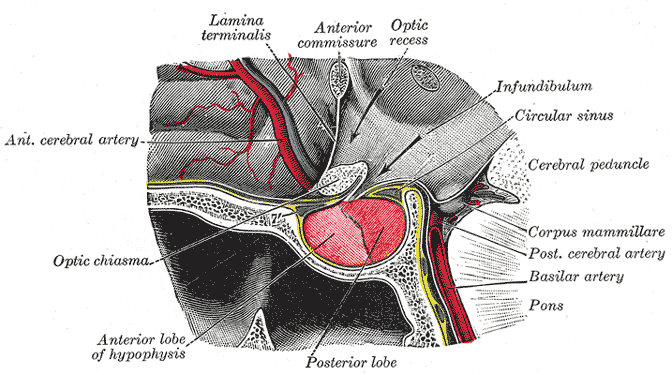
A Gland the Size of a Pea That Governs the Entire Kingdom of the Body
Deep within the human brain lies a structure that never appears in school anatomy drawings — not the heart, not the lungs, not even the majestic cerebral cortex. It measures only about 1 cm in length and weighs less than a gram. Yet, within that microscopic space resides the
hormonal council: the pituitary gland. It is not merely a hormone producer — it is the
director of the endocrine orchestra, the absolute conductor that signals the thyroid, adrenals, ovaries, testes, kidneys, even bones and muscles. Every morning, it awakens cortisol to greet the dawn; during adolescence, it triggers growth through GH; in moments of budding love, it releases oxytocin like a gentle breeze. Without its voice, the body is not just weak — it loses the
narrative of its life.
When the Conductor Starts Whispering — Then Goes Silent
Hypopituitarism is not a dramatic attack like a stroke or a large tumor destroying the brain. It is more subtle: like stage lights dimming one by one — not extinguishing all at once, but slowly, so the audience doesn't realize the curtain has half-fallen. A 32-year-old woman begins to experience endless fatigue despite sleeping 10 hours; a 45-year-old man suddenly loses interest in sex, gains weight inexplicably, develops dry skin like old paper, and loses hair in places he never imagined. No fever. No severe headache. No 'classic' screaming symptoms. What exists is a
whispering imbalance — illogical fatigue, easily shattered moods, low blood pressure that causes fainting upon standing, and menstruation that disappears for 18 months without pregnancy.
And behind all this? A small area at the base of the brain — sometimes caused by a benign tumor (adenoma), sometimes by birth trauma or a car accident years ago, sometimes due to autoimmune inflammation that silently attacks the gland like an elite, flagless unit. In fact, recent studies show: nearly 25% of patients with mild traumatic brain injury — such as those who have fallen off a motorcycle and only complain of 'prolonged headaches' — have undetected pituitary hormone deficits.
Eye-Opening Numbers: 7 Hormones, 1 Gland, 0 Clear Signs
The pituitary produces eight major hormones — but seven of them are
regulatory hormones: TSH (regulates thyroid), ACTH (activates adrenals), FSH/LH (regulates fertility), GH (growth & metabolism), Prolactin (milk & emotional bonding), and Oxytocin/Vasopressin (love & fluid balance). In hypopituitarism, not all are lost at once. Some lose only ACTH — then the body cannot cope with stress, leading to collapse one day when their child falls off a bicycle. Some lose adult GH — it's no longer about height, but about softening muscles, accumulating abdominal fat, and memory blurring like dew-covered glass. And most tragically: many patients wait an
average of 5.7 years before a correct diagnosis — not because doctors are incompetent, but because the symptoms mimic depression, chronic fatigue syndrome, or 'just stress'.
Invisible Diagnostics: Blood, Images, and Stories That Must Be Heard
There is no X-ray that shows hormone loss. No stethoscope can hear the silence of the pituitary. Diagnosis begins with a
story: when did the fatigue start? Is hair loss on the eyebrows or eyelashes? Does blood pressure drop drastically when standing? Then comes blood tests — not once, but in a
dynamic profile: morning cortisol, insulin-induced hypoglycemia test for GH, CRH stimulation for ACTH. Only then is a head MRI performed — not to find a large tumor, but to detect lesions as small as 2 mm in the
pituitary stalk, or atrophy of the gland that has shrunk like a dried fruit. This is where the art of medicine meets science: an endocrinologist not only reads numbers but reads the
void between symptoms — like an archaeologist reading history from dust.
Replacement, Not Cure — But the Return of Life's Narrative
There is no medicine that restores the function of a dead pituitary. But humans can now
replace the lost voice. Cortisol is given in the form of hydrocortisone — not a potent steroid, but a subtle mimic that replicates the natural daily rhythm. Testosterone or estrogen is given transdermally or by injection — not to 'rejuvenate', but so the brain can recognize desire again, and bones can feel secure. GH is given by daily injection — not to build bodybuilding muscles, but so the heart beats with strength, and the mind shines again. Most importantly: there is no 'standard' dose. Each patient is a unique world — doses are adjusted not by body weight, but by
how their body hears again. One patient said: 'After two months of treatment, I wasn't just 'less tired'. I could *remember the color of the sky at dusk.'
The Lost Voice Can Be Replaced — But Not Forgotten
Hypopituitarism teaches a painful and beautiful truth: humans are not just a sum of organs, but a
symphony of connections. A pea-sized gland can change the meaning of 'hunger', 'love', 'anger', and 'sleep'. It reminds us: health is not the absence of disease, but the presence of an
intact narrative. And for those living with the silence of the pituitary — every morning when they take their cortisol pill, every night when they inject growth hormone — they are not fixing their bodies. They are rewriting the chapters of life that were almost erased, one hormone, one breath, one sunset at a time.
Its Brain Is Still Alive — But Its Body Has 'Turned Off' Hormones One by One. Imagine: every second, your brain sends secret messages throughout your body — messages that regulate breathing, heart rate, growth, desire, even tears. Now imagine: a small pea-sized area at the base of that brain suddenly stops talking. Not all of it — just parts. And the body begins to forget how to be itself. This is hypopituitarism: not a disease that attacks from the outside, but an internal loss of voice from within.. A Gland the Size of a Pea That Governs the Entire Kingdom of the Body
Deep within the human brain lies a structure that never appears in school anatomy drawings — not the heart, not the lungs, not even the majestic cerebral cortex. It measures only about 1 cm in length and weighs less than a gram. Yet, within that microscopic space resides the hormonal council : the pituitary gland. It is not merely a hormone producer — it is the director of the endocrine orchestra , the absolute conductor that signals the thyroid, adrenals, ovaries, testes, kidneys, even bones and muscles. Every morning, it awakens cortisol to greet the dawn; during adolescence, it triggers growth through GH; in moments of budding love, it releases oxytocin like a gentle breeze. Without its voice, the body is not just weak — it loses the narrative of its life.
When the Conductor Starts Whispering — Then Goes Silent
Hypopituitarism is not a dramatic attack like a stroke or a large tumor destroying the brain. It is more subtle: like stage lights dimming one by one — not extinguishing all at once, but slowly, so the audience doesn't realize the curtain has half-fallen. A 32-year-old woman begins to experience endless fatigue despite sleeping 10 hours; a 45-year-old man suddenly loses interest in sex, gains weight inexplicably, develops dry skin like old paper, and loses hair in places he never imagined. No fever. No severe headache. No 'classic' screaming symptoms. What exists is a whispering imbalance — illogical fatigue, easily shattered moods, low blood pressure that causes fainting upon standing, and menstruation that disappears for 18 months without pregnancy.
And behind all this? A small area at the base of the brain — sometimes caused by a benign tumor adenoma , sometimes by birth trauma or a car accident years ago, sometimes due to autoimmune inflammation that silently attacks the gland like an elite, flagless unit. In fact, recent studies show: nearly 25% of patients with mild traumatic brain injury — such as those who have fallen off a motorcycle and only complain of 'prolonged headaches' — have undetected pituitary hormone deficits.
Eye-Opening Numbers: 7 Hormones, 1 Gland, 0 Clear Signs
The pituitary produces eight major hormones — but seven of them are regulatory hormones : TSH regulates thyroid , ACTH activates adrenals , FSH/LH regulates fertility , GH growth & metabolism , Prolactin milk & emotional bonding , and Oxytocin/Vasopressin love & fluid balance . In hypopituitarism, not all are lost at once. Some lose only ACTH — then the body cannot cope with stress, leading to collapse one day when their child falls off a bicycle. Some lose adult GH — it's no longer about height, but about softening muscles, accumulating abdominal fat, and memory blurring like dew-covered glass. And most tragically: many patients wait an average of 5.7 years before a correct diagnosis — not because doctors are incompetent, but because the symptoms mimic depression, chronic fatigue syndrome, or 'just stress'.
Invisible Diagnostics: Blood, Images, and Stories That Must Be Heard
There is no X-ray that shows hormone loss. No stethoscope can hear the silence of the pituitary. Diagnosis begins with a story : when did the fatigue start? Is hair loss on the eyebrows or eyelashes? Does blood pressure drop drastically when standing? Then comes blood tests — not once, but in a dynamic profile : morning cortisol, insulin-induced hypoglycemia test for GH, CRH stimulation for ACTH. Only then is a head MRI performed — not to find a large tumor, but to detect lesions as small as 2 mm in the pituitary stalk , or atrophy of the gland that has shrunk like a dried fruit. This is where the art of medicine meets science: an endocrinologist not only reads numbers but reads the void between symptoms — like an archaeologist reading history from dust.
Replacement, Not Cure — But the Return of Life's Narrative
There is no medicine that restores the function of a dead pituitary. But humans can now replace the lost voice . Cortisol is given in the form of hydrocortisone — not a potent steroid, but a subtle mimic that replicates the natural daily rhythm. Testosterone or estrogen is given transdermally or by injection — not to 'rejuvenate', but so the brain can recognize desire again, and bones can feel secure. GH is given by daily injection — not to build bodybuilding muscles, but so the heart beats with strength, and the mind shines again. Most importantly: there is no 'standard' dose. Each patient is a unique world — doses are adjusted not by body weight, but by how their body hears again . One patient said: 'After two months of treatment, I wasn't just 'less tired'. I could remember the color of the sky at dusk.'
The Lost Voice Can Be Replaced — But Not Forgotten
Hypopituitarism teaches a painful and beautiful truth: humans are not just a sum of organs, but a symphony of connections . A pea-sized gland can change the meaning of 'hunger', 'love', 'anger', and 'sleep'. It reminds us: health is not the absence of disease, but the presence of an intact narrative . And for those living with the silence of the pituitary — every morning when they take their cortisol pill, every night when they inject growth hormone — they are not fixing their bodies. They are rewriting the chapters of life that were almost erased, one hormone, one breath, one sunset at a time.