What Is Nuclear Fission? Not Just 'Splitting,' But Energy Transformation
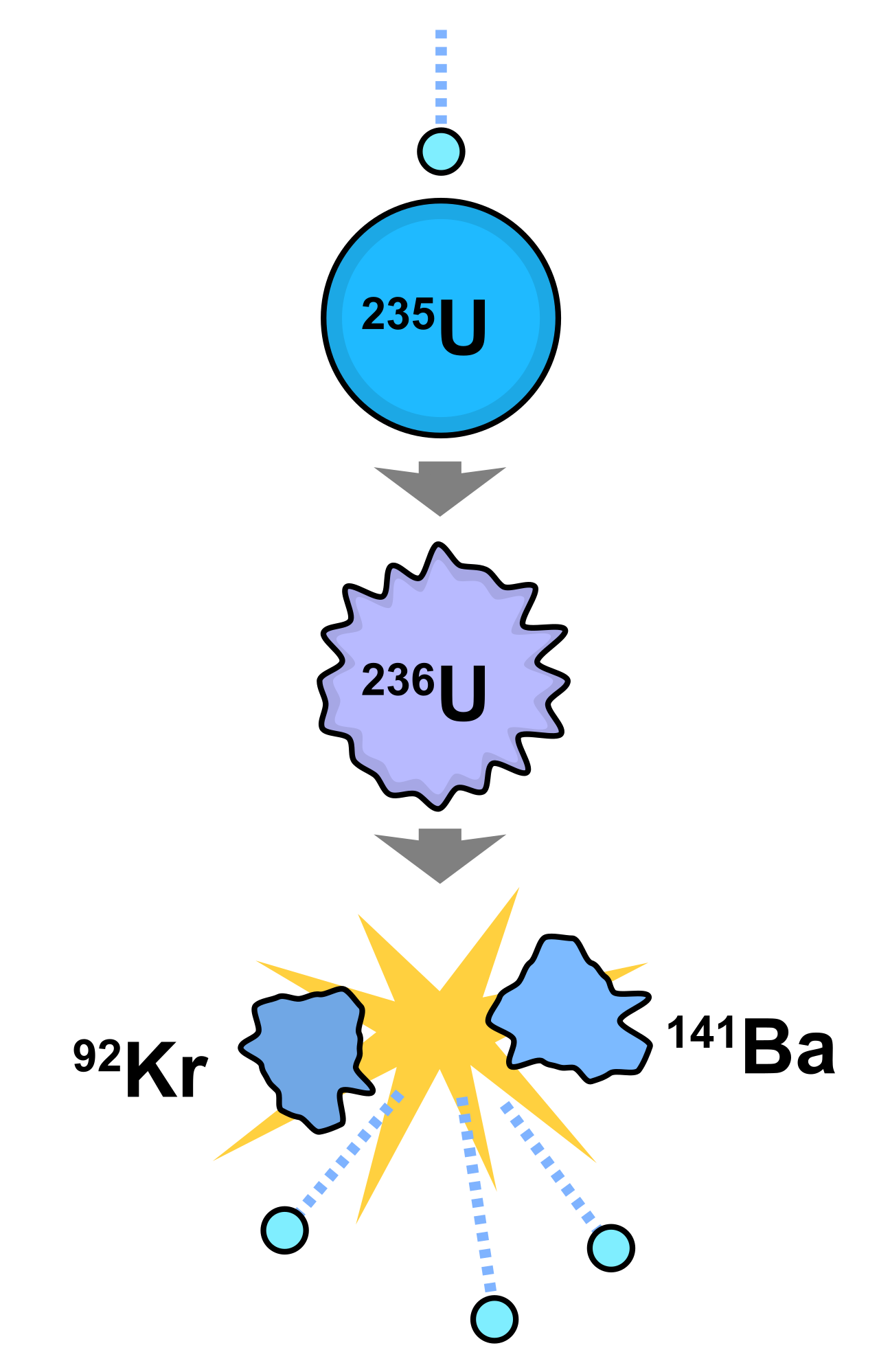
Nuclear fission is not a normal decay process like alpha or beta. It is a nuclear reaction in which heavy atomic nuclei — such as uranium-235 or plutonium-239 — absorb a free neutron, become unstable, and then split into two lighter daughter nuclei (for example, barium-144 and krypton-89), accompanied by the release of two to three free neutrons, gamma rays, and high kinetic energy. The main difference from other radioactive processes is the magnitude of energy: a single fission reaction releases about 200 MeV (mega-electron volts), which is ten million times the energy released in a chemical reaction such as carbon combustion. Compared to biological cell division — an analogy used by Otto Robert Frisch when he named 'fission' — nuclear fission is like a cell dividing, but each daughter cell explodes with the power equivalent to several kilograms of TNT.
Discovery Arising from Cross-Disciplinary Collaboration
The discovery of nuclear fission was not the result of one genius's work, but the synergy between meticulous analytical chemistry and visionary theoretical physics. In 1938, Otto Hahn and Fritz Strassmann in Berlin conducted experiments firing neutrons into uranium. Using precision chemical methods — including selective precipitation and spectral analysis — they confirmed the presence of barium, a much lighter element than uranium. This contradicted the expectations of the time, which anticipated only heavier elements 'almost similar' (such as radium) would form. However, Hahn and Strassmann, as chemists, could not explain the mechanism behind it. They shared their data with Lise Meitner — a long-time collaborator who had to flee Nazi Germany due to her Jewish heritage — who, together with her nephew Otto Robert Frisch, used the liquid-drop model to calculate binding energy. They found that the distorted shape of the uranium nucleus after absorbing a neutron could 'split' like an over-stretched droplet — and calculations showed the release of approximately 200 MeV of energy, consistent with experimental data. The term 'fission' was first used by Frisch in a letter to
Nature in January 1939.
Chain Reaction: From Single Fission to Continuous Power
The real surprise came in the second publication by Hahn and Strassmann in February 1939: they predicted that fission not only produced daughter nuclei and energy, but also additional free neutrons. This opened the door to the concept of a
self-sustaining chain reaction: if each fission produces an average of more than one neutron capable of causing another fission, the reaction can develop exponentially. In modern nuclear reactors, this condition is controlled using neutron-absorbing materials such as boron or cadmium rods, as well as moderators like heavy water or graphite to slow down neutrons so they are more easily absorbed by uranium-235. Without this control, the reaction becomes uncontrolled — as happened in the Hiroshima atomic bomb explosion, where approximately 1.4 kg of uranium-235 underwent fission in less than one microsecond, releasing energy equivalent to 15 kilotons of TNT.
Practical Implications: Clean Energy vs Inevitable Risks
Today, more than 10% of the world's electricity is generated through nuclear fission — with more than 440 reactors operating in 32 countries. In France, for example, nuclear energy contributes more than 70% of national electricity production, making it one of the lowest carbon footprint energy systems in the world. However, fission also carries a legacy burden: long-lived radioactive waste such as plutonium-239 (half-life of 24,000 years) requires safe storage for thousands of years. Leaks such as those in Chernobyl (1986) and Fukushima (2011) show that risks are not just theoretical — they are closely related to technical design, institutional safety culture, and resilience against natural disasters. Important reflective questions arise: are we willing to accept long-term risks for short-term benefits? And what is the responsibility of today's generation towards future generations in managing waste that will last longer than human civilization itself?
Fission vs Fusion: Two Different Paths to Atomic Energy
Although often confused, fission and fusion are opposite processes. Fission splits heavy nuclei; fusion combines light nuclei such as hydrogen into helium — the process that powers the Sun. In theory, fusion is more attractive: its fuel (deuterium and tritium) is abundant, its radioactive waste has a much shorter lifespan, and there is no risk of an uncontrolled chain reaction. However, fusion is still not commercial because it requires temperatures over 100 million degrees Celsius and extreme pressure to overcome electrostatic repulsion between protons. In contrast, fission has been operational since the 1950s — but it is a mature technology that has reached its physical and ethical limits. Fission is not a permanent answer, but it remains an important component in the global energy transition — as long as we have not yet managed to replicate the Sun on Earth.
Scientific Legacy: From Laboratories to Geopolitics
The discovery of nuclear fission changed the way we view energy, security, and scientific responsibility. It shows that science is not an isolated entity: ethical decisions about the use of knowledge — whether for clean energy or weapons of mass destruction — are part of the scientific process itself. Meitner refused to be involved in the US atomic bomb project, even though she was invited; Frisch contributed to the Manhattan Project but later became a critical voice against nuclear testing. Their stories remind us that every physical equation contains a moral dimension. As the world now faces climate crises and energy uncertainties, nuclear fission is no longer a question of 'can or cannot,' but 'how, for what, and for whom?' — questions that can only be answered through dialogue between scientists, public policy, and civil society.
Rujukan: Nuclear fission — Wikipedia
Nuclear Fission: How a Microscopic Process Changed the History of World Energy. Nuclear fission is the process in which heavy atomic nuclei split into two or more smaller nuclei, releasing extraordinary energy and additional neutrons. Discovered experimentally by Hahn and Strassmann at the end of 1938, and explained theoretically by Meitner and Frisch in early 1939, nuclear fission is not just a scientific discovery — it became the basis for nuclear power plants and weapons of mass destruction. This process shows how changes on a femtometer scale (10⁻¹⁵ m) can produce macroscopic effects that determine global politics, economy, and security.. What Is Nuclear Fission? Not Just 'Splitting,' But Energy Transformation
Nuclear fission is not a normal decay process like alpha or beta. It is a nuclear reaction in which heavy atomic nuclei — such as uranium-235 or plutonium-239 — absorb a free neutron, become unstable, and then split into two lighter daughter nuclei for example, barium-144 and krypton-89 , accompanied by the release of two to three free neutrons, gamma rays, and high kinetic energy. The main difference from other radioactive processes is the magnitude of energy: a single fission reaction releases about 200 MeV mega-electron volts , which is ten million times the energy released in a chemical reaction such as carbon combustion. Compared to biological cell division — an analogy used by Otto Robert Frisch when he named 'fission' — nuclear fission is like a cell dividing, but each daughter cell explodes with the power equivalent to several kilograms of TNT.
Discovery Arising from Cross-Disciplinary Collaboration
The discovery of nuclear fission was not the result of one genius's work, but the synergy between meticulous analytical chemistry and visionary theoretical physics. In 1938, Otto Hahn and Fritz Strassmann in Berlin conducted experiments firing neutrons into uranium. Using precision chemical methods — including selective precipitation and spectral analysis — they confirmed the presence of barium, a much lighter element than uranium. This contradicted the expectations of the time, which anticipated only heavier elements 'almost similar' such as radium would form. However, Hahn and Strassmann, as chemists, could not explain the mechanism behind it. They shared their data with Lise Meitner — a long-time collaborator who had to flee Nazi Germany due to her Jewish heritage — who, together with her nephew Otto Robert Frisch, used the liquid-drop model to calculate binding energy. They found that the distorted shape of the uranium nucleus after absorbing a neutron could 'split' like an over-stretched droplet — and calculations showed the release of approximately 200 MeV of energy, consistent with experimental data. The term 'fission' was first used by Frisch in a letter to Nature in January 1939.
Chain Reaction: From Single Fission to Continuous Power
The real surprise came in the second publication by Hahn and Strassmann in February 1939: they predicted that fission not only produced daughter nuclei and energy, but also additional free neutrons. This opened the door to the concept of a self-sustaining chain reaction : if each fission produces an average of more than one neutron capable of causing another fission, the reaction can develop exponentially. In modern nuclear reactors, this condition is controlled using neutron-absorbing materials such as boron or cadmium rods, as well as moderators like heavy water or graphite to slow down neutrons so they are more easily absorbed by uranium-235. Without this control, the reaction becomes uncontrolled — as happened in the Hiroshima atomic bomb explosion, where approximately 1.4 kg of uranium-235 underwent fission in less than one microsecond, releasing energy equivalent to 15 kilotons of TNT.
Practical Implications: Clean Energy vs Inevitable Risks
Today, more than 10% of the world's electricity is generated through nuclear fission — with more than 440 reactors operating in 32 countries. In France, for example, nuclear energy contributes more than 70% of national electricity production, making it one of the lowest carbon footprint energy systems in the world. However, fission also carries a legacy burden: long-lived radioactive waste such as plutonium-239 half-life of 24,000 years requires safe storage for thousands of years. Leaks such as those in Chernobyl 1986 and Fukushima 2011 show that risks are not just theoretical — they are closely related to technical design, institutional safety culture, and resilience against natural disasters. Important reflective questions arise: are we willing to accept long-term risks for short-term benefits? And what is the responsibility of today's generation towards future generations in managing waste that will last longer than human civilization itself?
Fission vs Fusion: Two Different Paths to Atomic Energy
Although often confused, fission and fusion are opposite processes. Fission splits heavy nuclei; fusion combines light nuclei such as hydrogen into helium — the process that powers the Sun. In theory, fusion is more attractive: its fuel deuterium and tritium is abundant, its radioactive waste has a much shorter lifespan, and there is no risk of an uncontrolled chain reaction. However, fusion is still not commercial because it requires temperatures over 100 million degrees Celsius and extreme pressure to overcome electrostatic repulsion between protons. In contrast, fission has been operational since the 1950s — but it is a mature technology that has reached its physical and ethical limits. Fission is not a permanent answer, but it remains an important component in the global energy transition — as long as we have not yet managed to replicate the Sun on Earth.
Scientific Legacy: From Laboratories to Geopolitics
The discovery of nuclear fission changed the way we view energy, security, and scientific responsibility. It shows that science is not an isolated entity: ethical decisions about the use of knowledge — whether for clean energy or weapons of mass destruction — are part of the scientific process itself. Meitner refused to be involved in the US atomic bomb project, even though she was invited; Frisch contributed to the Manhattan Project but later became a critical voice against nuclear testing. Their stories remind us that every physical equation contains a moral dimension. As the world now faces climate crises and energy uncertainties, nuclear fission is no longer a question of 'can or cannot,' but 'how, for what, and for whom?' — questions that can only be answered through dialogue between scientists, public policy, and civil society.
Rujukan: Nuclear fission — Wikipedia https://en.wikipedia.org/wiki/Nuclear fission