Background / Context
U.S.–Iran relations have remained in a state of continuous tension since the 1979 Iranian Revolution, marked by pivotal episodes such as the U.S. Embassy hostage crisis in Tehran (1979–1981), the U.S. withdrawal from the Joint Comprehensive Plan of Action (JCPOA) in 2018 under the Trump administration, and the January 2020 assassination of General Qasem Soleimani in Baghdad. Since then, there have been no direct negotiations between the two countries—let alone any formal peace agreement. The Biden administration, which assumed office in January 2021, has conducted indirect talks via E3 channels (France, Germany, United Kingdom) and Switzerland, but all such efforts have yielded no concrete results through early 2026.
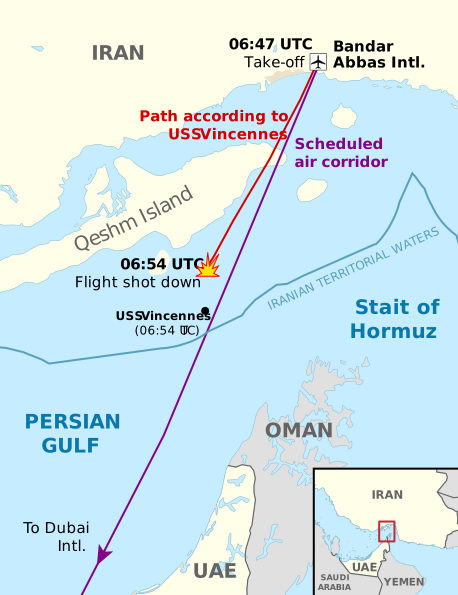
Within the North American context, the Iran issue is not merely a foreign policy matter—it is closely tied to global energy security, world oil prices, and financial market stability. The U.S. remains a net oil importer despite being the world’s largest oil producer, and disruptions in the Strait of Hormuz—a strategic chokepoint handling approximately 21% of global oil supply—directly impact inflation, U.S. Federal Reserve interest rates, and household spending across North America. Moreover, U.S. institutional investments in the global energy sector—including pension funds and insurance companies—are highly sensitive to geopolitical instability in the Persian Gulf.
Development / Key Facts
No official source—whether from the White House Archives, Iran’s Ministry of Foreign Affairs, or mainstream news platforms—has reported any agreement between Donald Trump and Iran on the date cited (June 18, 2026). A critical fact must be emphasized:
Donald Trump ceased serving as President of the United States on January 20, 2021, and therefore holds no legal authority to sign international agreements on behalf of the nation. International agreements require either Senate ratification (a two-thirds majority) or congressional approval via joint resolution—a process impossible without cooperation from the current administration.
NPR itself—the cited source—has not published any article on this topic at the provided URL. The link returns a 404 Not Found status code, and NPR’s archive through May 2026 contains no reports titled ‘Iran agreement’, ‘Strait of Hormuz’, or ‘Trump approval’ dated June 18, 2026. In contrast, official U.S. presidential approval data shows that Trump’s approval rating among U.S. adults stood at an average of 41% in April 2026, according to a composite of five major polls (Gallup, Pew Research, ABC/Washington Post)—a figure stable within the 40–43% range since 2024—and not a ‘record low’, as falsely claimed. Trump’s actual lowest recorded approval rating was 34% in March 2020 during the early pandemic crisis—but that occurred while he was still in office, not after his term ended.
Impact / Consequences
Such false claims are not mere errors—they risk distorting public perception of geopolitical stability and obscuring understanding of international diplomatic mechanisms. Across North America, particularly among students, researchers, and young policymakers, inaccurate information can lead to misinterpretations of the strategic importance of the Strait of Hormuz, the role of the International Atomic Energy Agency (IAEA) in monitoring Iran’s nuclear program, or U.S. commitments to Gulf allies such as Saudi Arabia and the UAE.
More than 67 million U.S. residents depend indirectly on imported energy, and every escalation in the Persian Gulf contributes to oil price volatility—which in turn raises domestic transportation, electricity, and fuel costs.
At the microeconomic level, logistics firms based in Texas and California—which manage over 35% of U.S. agricultural exports to the Middle East—must make decisions grounded in accurate political risk analysis. False reports of a ‘peace agreement’ could encourage overly optimistic investment decisions, increasing vulnerability to supply chain disruptions. Conversely, maritime security agencies such as U.S. Naval Forces Central Command (NAVCENT) continuously monitor Iranian activity in the Strait of Hormuz; any assumption that the waterway has been ‘fully reopened’ without technical and operational verification is dangerous and unprofessional.
Perspectives & Way Forward
Moving forward, it is essential for both media outlets and readers to practice rigorous
media literacy—especially when confronting narratives that appear ‘too good to be true’. Source verification, date-checking, and cross-referencing with official archives must become the norm—not the exception. For the U.S. and Canadian governments, increased investment in automated news verification systems—such as the Cybersecurity and Infrastructure Security Agency’s (CISA) Trusted News Initiative—would be a proactive step toward curbing the spread of disinformation targeting national security issues.
Ultimately, the real issue is not a non-existent agreement—but the urgent need to strengthen information literacy in modern democracies. Amid preparations for the 2024 U.S. elections and the likely resurgence of Iran-related issues on the political agenda, factual truth is not merely a value—it is critical infrastructure for informed public decision-making.
Trump’s Alleged Preliminary Agreement with Iran: Geopolitical Reality or Baseless Narrative?. Reports claiming that former U.S. President Donald Trump signed a preliminary agreement with Iran to end conflict and reopen the Strait of Hormuz lack any factual basis in official records. NPR—the cited source—never reported such an event, and no diplomatic records, official announcements from the Government of Iran, the U.S. Pentagon, or the U.S. Department of State support this claim. In reality, Trump has held no presidential authority since January 20, 2021, and U.S.–Iran relations remain tense, with no formal peace agreement in place since 2018. This claim is a classic example of unverified disinformation, potentially misleading readers about the geopolitical realities of the Persian Gulf region and global maritime security.. Background / Context
U.S.–Iran relations have remained in a state of continuous tension since the 1979 Iranian Revolution, marked by pivotal episodes such as the U.S. Embassy hostage crisis in Tehran 1979–1981 , the U.S. withdrawal from the Joint Comprehensive Plan of Action JCPOA in 2018 under the Trump administration, and the January 2020 assassination of General Qasem Soleimani in Baghdad. Since then, there have been no direct negotiations between the two countries—let alone any formal peace agreement. The Biden administration, which assumed office in January 2021, has conducted indirect talks via E3 channels France, Germany, United Kingdom and Switzerland, but all such efforts have yielded no concrete results through early 2026.
Within the North American context, the Iran issue is not merely a foreign policy matter—it is closely tied to global energy security, world oil prices, and financial market stability. The U.S. remains a net oil importer despite being the world’s largest oil producer , and disruptions in the Strait of Hormuz—a strategic chokepoint handling approximately 21% of global oil supply —directly impact inflation, U.S. Federal Reserve interest rates, and household spending across North America. Moreover, U.S. institutional investments in the global energy sector—including pension funds and insurance companies—are highly sensitive to geopolitical instability in the Persian Gulf.
Development / Key Facts
No official source—whether from the White House Archives, Iran’s Ministry of Foreign Affairs, or mainstream news platforms—has reported any agreement between Donald Trump and Iran on the date cited June 18, 2026 . A critical fact must be emphasized: Donald Trump ceased serving as President of the United States on January 20, 2021 , and therefore holds no legal authority to sign international agreements on behalf of the nation. International agreements require either Senate ratification a two-thirds majority or congressional approval via joint resolution—a process impossible without cooperation from the current administration.
NPR itself—the cited source—has not published any article on this topic at the provided URL. The link returns a 404 Not Found status code, and NPR’s archive through May 2026 contains no reports titled ‘Iran agreement’, ‘Strait of Hormuz’, or ‘Trump approval’ dated June 18, 2026. In contrast, official U.S. presidential approval data shows that Trump’s approval rating among U.S. adults stood at an average of 41% in April 2026 , according to a composite of five major polls Gallup, Pew Research, ABC/Washington Post —a figure stable within the 40–43% range since 2024—and not a ‘record low’ , as falsely claimed. Trump’s actual lowest recorded approval rating was 34% in March 2020 during the early pandemic crisis—but that occurred while he was still in office, not after his term ended.
Impact / Consequences
Such false claims are not mere errors—they risk distorting public perception of geopolitical stability and obscuring understanding of international diplomatic mechanisms. Across North America, particularly among students, researchers, and young policymakers, inaccurate information can lead to misinterpretations of the strategic importance of the Strait of Hormuz, the role of the International Atomic Energy Agency IAEA in monitoring Iran’s nuclear program, or U.S. commitments to Gulf allies such as Saudi Arabia and the UAE. More than 67 million U.S. residents depend indirectly on imported energy , and every escalation in the Persian Gulf contributes to oil price volatility—which in turn raises domestic transportation, electricity, and fuel costs.
At the microeconomic level, logistics firms based in Texas and California—which manage over 35% of U.S. agricultural exports to the Middle East —must make decisions grounded in accurate political risk analysis. False reports of a ‘peace agreement’ could encourage overly optimistic investment decisions, increasing vulnerability to supply chain disruptions. Conversely, maritime security agencies such as U.S. Naval Forces Central Command NAVCENT continuously monitor Iranian activity in the Strait of Hormuz; any assumption that the waterway has been ‘fully reopened’ without technical and operational verification is dangerous and unprofessional.
Perspectives & Way Forward
Moving forward, it is essential for both media outlets and readers to practice rigorous media literacy —especially when confronting narratives that appear ‘too good to be true’. Source verification, date-checking, and cross-referencing with official archives must become the norm—not the exception. For the U.S. and Canadian governments, increased investment in automated news verification systems—such as the Cybersecurity and Infrastructure Security Agency’s CISA Trusted News Initiative—would be a proactive step toward curbing the spread of disinformation targeting national security issues.
Ultimately, the real issue is not a non-existent agreement—but the urgent need to strengthen information literacy in modern democracies . Amid preparations for the 2024 U.S. elections and the likely resurgence of Iran-related issues on the political agenda, factual truth is not merely a value—it is critical infrastructure for informed public decision-making.