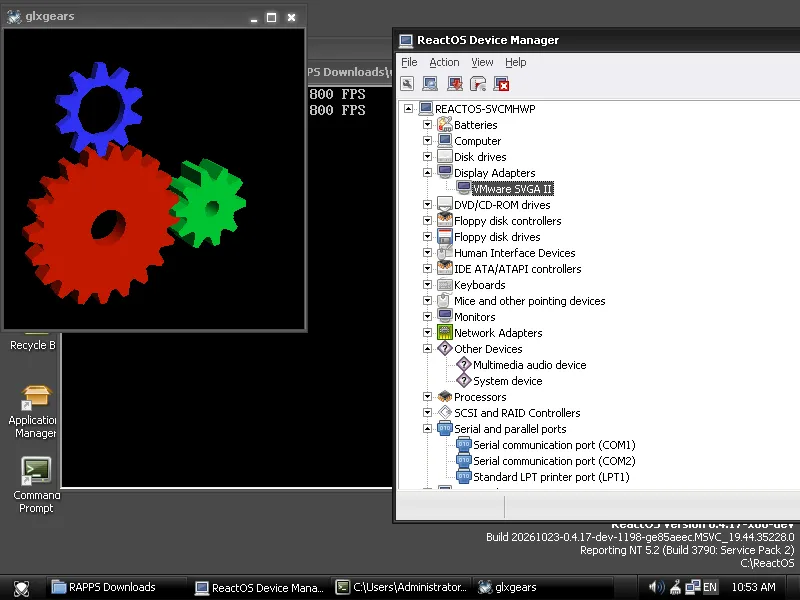
Searches for the term 'SMP' or Symmetric Multiprocessing showed an increasing trend across various digital platforms, driven by the announcement of recent progress in the open-source operating system project, ReactOS. Based on a report from technology portal Phoronix, the project aimed at translating the Windows NT architecture design into a free and open-source environment has achieved several key technical milestones, including support for legacy hardware and multi-core processing integration.
The ReactOS operating system has long been a focal point for the software engineering community and computer system enthusiasts due to its rather unique goal: providing an operating system fully compatible with Windows applications and drivers without using any Microsoft proprietary source code. In the latest update, special focus was given to improving SMP support, floppy disk driver support, as well as the integration of 3D graphics acceleration via VMware virtual hardware.
Understanding the Term SMP and Its Role in Modern Processor Architecture
Technically,
Symmetric Multiprocessing (SMP) refers to a computer processing architecture where two or more processors operate based on a single shared main memory. In an SMP environment, all central processing units (CPUs) have equal access to device hardware, memory, and the system bus, while the operating system is responsible for distributing tasks evenly across any available processor cores.
For modern computing environments, SMP support is no longer an option but a fundamental requirement. This is because almost all laptop, desktop, and server processors today are built with multiple cores (multi-core). Without stable and robust SMP support, an operating system can only use a single core, thereby wasting the physical performance capabilities present in these modern processors.
Latest ReactOS Developments and the Surge in Multi-Core Support
The main issue that has always been a constraint for the ReactOS project previously was its ability to operate stably on multi-core systems. Although the original design of Windows NT came with a symmetric processing architecture, recreating the effectiveness and stability of that kernel module without infringing on Microsoft's copyright is a very complex software engineering challenge.
The latest reported progress shows that ReactOS engineers and contributors have successfully resolved various core synchronization issues as well as inter-processor interrupt management. This success enables the operating system to run more smoothly on modern hardware, reducing kernel panics or system instability that often occurred when more than one processor was activated.
The Importance of Driver Update Progress and VMware 3D Acceleration
Besides achievements in the scope of SMP, the Phoronix report also highlights renewed support for floppy disk drives. Although this physical storage medium is considered obsolete by the general public, legacy drive support remains valuable for engineers' testing environments, older industrial systems, and software preservation enthusiasts.
Another critical achievement is the progress in VMware 3D graphics acceleration. By allowing ReactOS to leverage hardware graphics acceleration directly within a virtual machine environment, users and developers can run complex graphics applications and legacy video games with much more stable frame rates without requiring a dedicated physical graphics card.
Why This Issue Has Become a Search Focus for Malaysia's Tech Community
In Malaysia, search trends for the term 'SMP' and ReactOS developments are driven by the local software developer community, computer science students, and IT practitioners who closely follow alternative operating system trends. Furthermore, exposure to computing architecture topics at the higher education level also contributes to deep interest in practical SMP applications within open-source projects.
In conclusion, discussions on SMP progress in ReactOS reflect an ongoing desire in the tech community to understand the low-level mechanics of operating systems. Although ReactOS has not yet widely replaced commercial operating systems, this search surge proves that innovation in multi-core processing and open-source software remains a major focus for tech enthusiasts nationwide.
New ReactOS Developments: Why the Development of SMP Support and Multi-Core Processors is Catching the Tech Community's Attention. The latest report on the open-source operating system project ReactOS shows significant progress in Symmetric Multiprocessing (SMP) support, floppy disk drivers, and VMware 3D acceleration. This development triggered a surge in searches related to the term 'SMP' among local tech enthusiasts and system developers. The progress marks an important step in enabling ReactOS to utilize modern multi-core processors more efficiently.. Searches for the term 'SMP' or Symmetric Multiprocessing showed an increasing trend across various digital platforms, driven by the announcement of recent progress in the open-source operating system project, ReactOS. Based on a report from technology portal Phoronix, the project aimed at translating the Windows NT architecture design into a free and open-source environment has achieved several key technical milestones, including support for legacy hardware and multi-core processing integration.
The ReactOS operating system has long been a focal point for the software engineering community and computer system enthusiasts due to its rather unique goal: providing an operating system fully compatible with Windows applications and drivers without using any Microsoft proprietary source code. In the latest update, special focus was given to improving SMP support, floppy disk driver support, as well as the integration of 3D graphics acceleration via VMware virtual hardware.
Understanding the Term SMP and Its Role in Modern Processor Architecture
Technically, Symmetric Multiprocessing SMP refers to a computer processing architecture where two or more processors operate based on a single shared main memory. In an SMP environment, all central processing units CPUs have equal access to device hardware, memory, and the system bus, while the operating system is responsible for distributing tasks evenly across any available processor cores.
For modern computing environments, SMP support is no longer an option but a fundamental requirement. This is because almost all laptop, desktop, and server processors today are built with multiple cores multi-core . Without stable and robust SMP support, an operating system can only use a single core, thereby wasting the physical performance capabilities present in these modern processors.
Latest ReactOS Developments and the Surge in Multi-Core Support
The main issue that has always been a constraint for the ReactOS project previously was its ability to operate stably on multi-core systems. Although the original design of Windows NT came with a symmetric processing architecture, recreating the effectiveness and stability of that kernel module without infringing on Microsoft's copyright is a very complex software engineering challenge.
The latest reported progress shows that ReactOS engineers and contributors have successfully resolved various core synchronization issues as well as inter-processor interrupt management. This success enables the operating system to run more smoothly on modern hardware, reducing kernel panics or system instability that often occurred when more than one processor was activated.
The Importance of Driver Update Progress and VMware 3D Acceleration
Besides achievements in the scope of SMP, the Phoronix report also highlights renewed support for floppy disk drives. Although this physical storage medium is considered obsolete by the general public, legacy drive support remains valuable for engineers' testing environments, older industrial systems, and software preservation enthusiasts.
Another critical achievement is the progress in VMware 3D graphics acceleration. By allowing ReactOS to leverage hardware graphics acceleration directly within a virtual machine environment, users and developers can run complex graphics applications and legacy video games with much more stable frame rates without requiring a dedicated physical graphics card.
Why This Issue Has Become a Search Focus for Malaysia's Tech Community
In Malaysia, search trends for the term 'SMP' and ReactOS developments are driven by the local software developer community, computer science students, and IT practitioners who closely follow alternative operating system trends. Furthermore, exposure to computing architecture topics at the higher education level also contributes to deep interest in practical SMP applications within open-source projects.
In conclusion, discussions on SMP progress in ReactOS reflect an ongoing desire in the tech community to understand the low-level mechanics of operating systems. Although ReactOS has not yet widely replaced commercial operating systems, this search surge proves that innovation in multi-core processing and open-source software remains a major focus for tech enthusiasts nationwide.