The Most Baffling Natural Display
In the depths of Death Valley (Death Valley), California—known as the hottest and driest location in North America—lies a dry lake bed (playa) called Racetrack Playa. This place is not only arid but also eerily quiet. However, on the surface of this cracked clay soil, a visual mystery has been unfolding for over six decades, sparking scientific debate.
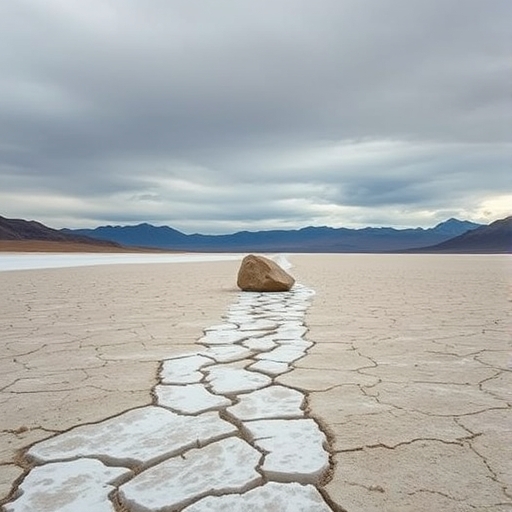
Visitors who come here will witness an extraordinary sight: large rocks of various sizes, some weighing hundreds of kilograms, appear to be moving on their own at the bottom of the lake bed without any human or animal assistance. Even more astonishing, each rock leaves a long track behind it, as if they are 'sailing' or sliding across the ground. These tracks can be beautifully curved, straight, or overlapping each other, forming abstract geometric patterns that are both fascinating and captivating.
Theories of the Unknown and Science
Since this phenomenon was first documented in the 1940s, researchers and geologists have been scratching their heads. How can heavy objects move across a flat surface without a significant gravitational force?
Various theories have been proposed. Some attribute it to the Earth's magnetic force, seismic waves from earthquakes, or even extraterrestrial beings moving the rocks as a joke. Others have suggested more logical yet less accurate theories, such as strong winds that might push the rocks when the ground is wet due to rain. However, no one has ever witnessed the rocks moving in real-time, making this phenomenon even more mysterious than Bigfoot or the Loch Ness Monster.
The Eureka Moment: The Mechanism of Thin Ice and Wind
The secret was finally uncovered in 2014 by a team of researchers led by Richard Norris's nephew and James Norris. They spent years installing GPS monitoring equipment and time-lapse cameras at Racetrack Playa, hoping to capture the rare moment.
Finally, in December 2013, their luck changed. The phenomenon occurred under very specific and rare weather conditions. It began when heavy rain soaked Racetrack Playa, forming a thin layer of water only a few inches deep. Overnight, the temperature dropped dramatically, causing the water to freeze and form thin 'windowpane ice' that covered the rocks.
When the sun rose, the ice began to melt and crack into large panels. This is the key. When strong winds blew, they would push these floating ice panels on the thin layer of water. The rocks trapped in or under these ice panels were then 'carried' sliding across the smooth clay surface. Friction was significantly reduced by the presence of water and ice, allowing the strong winds to propel the heavy rocks at a slow but steady pace—up to 5 meters per minute.
Conclusion: The Beauty of Science
This discovery proves that we don't need to look for answers in the unknown or science fiction to understand the wonders of the universe. The 'sailing rocks' phenomenon at Racetrack Playa is a perfect example of how a combination of simple elements—water, cold temperature, wind, and basic physics—can produce something that seems impossible and magical. It reminds us that our planet still holds many secrets waiting to be uncovered by careful observation and scientific patience.
The Secret of 'Batu Berlayar' in Death Valley: A Scientific Phenomenon that Shatters Myth. For decades, the movement of large rocks at Racetrack Playa, Death Valley, has been a mystery that has spawned various mystical theories. This article uncovers the secrets behind the mysterious 'tracks' through a stunning scientific discovery about the role of thin ice and wind.. The Most Baffling Natural Display
In the depths of Death Valley Death Valley , California—known as the hottest and driest location in North America—lies a dry lake bed playa called Racetrack Playa. This place is not only arid but also eerily quiet. However, on the surface of this cracked clay soil, a visual mystery has been unfolding for over six decades, sparking scientific debate.
Visitors who come here will witness an extraordinary sight: large rocks of various sizes, some weighing hundreds of kilograms, appear to be moving on their own at the bottom of the lake bed without any human or animal assistance. Even more astonishing, each rock leaves a long track behind it, as if they are 'sailing' or sliding across the ground. These tracks can be beautifully curved, straight, or overlapping each other, forming abstract geometric patterns that are both fascinating and captivating.
Theories of the Unknown and Science
Since this phenomenon was first documented in the 1940s, researchers and geologists have been scratching their heads. How can heavy objects move across a flat surface without a significant gravitational force?
Various theories have been proposed. Some attribute it to the Earth's magnetic force, seismic waves from earthquakes, or even extraterrestrial beings moving the rocks as a joke. Others have suggested more logical yet less accurate theories, such as strong winds that might push the rocks when the ground is wet due to rain. However, no one has ever witnessed the rocks moving in real-time, making this phenomenon even more mysterious than Bigfoot or the Loch Ness Monster.
The Eureka Moment: The Mechanism of Thin Ice and Wind
The secret was finally uncovered in 2014 by a team of researchers led by Richard Norris's nephew and James Norris. They spent years installing GPS monitoring equipment and time-lapse cameras at Racetrack Playa, hoping to capture the rare moment.
Finally, in December 2013, their luck changed. The phenomenon occurred under very specific and rare weather conditions. It began when heavy rain soaked Racetrack Playa, forming a thin layer of water only a few inches deep. Overnight, the temperature dropped dramatically, causing the water to freeze and form thin 'windowpane ice' that covered the rocks.
When the sun rose, the ice began to melt and crack into large panels. This is the key. When strong winds blew, they would push these floating ice panels on the thin layer of water. The rocks trapped in or under these ice panels were then 'carried' sliding across the smooth clay surface. Friction was significantly reduced by the presence of water and ice, allowing the strong winds to propel the heavy rocks at a slow but steady pace—up to 5 meters per minute.
Conclusion: The Beauty of Science
This discovery proves that we don't need to look for answers in the unknown or science fiction to understand the wonders of the universe. The 'sailing rocks' phenomenon at Racetrack Playa is a perfect example of how a combination of simple elements—water, cold temperature, wind, and basic physics—can produce something that seems impossible and magical. It reminds us that our planet still holds many secrets waiting to be uncovered by careful observation and scientific patience.