Introduction: The Square That Became the Heart of the World
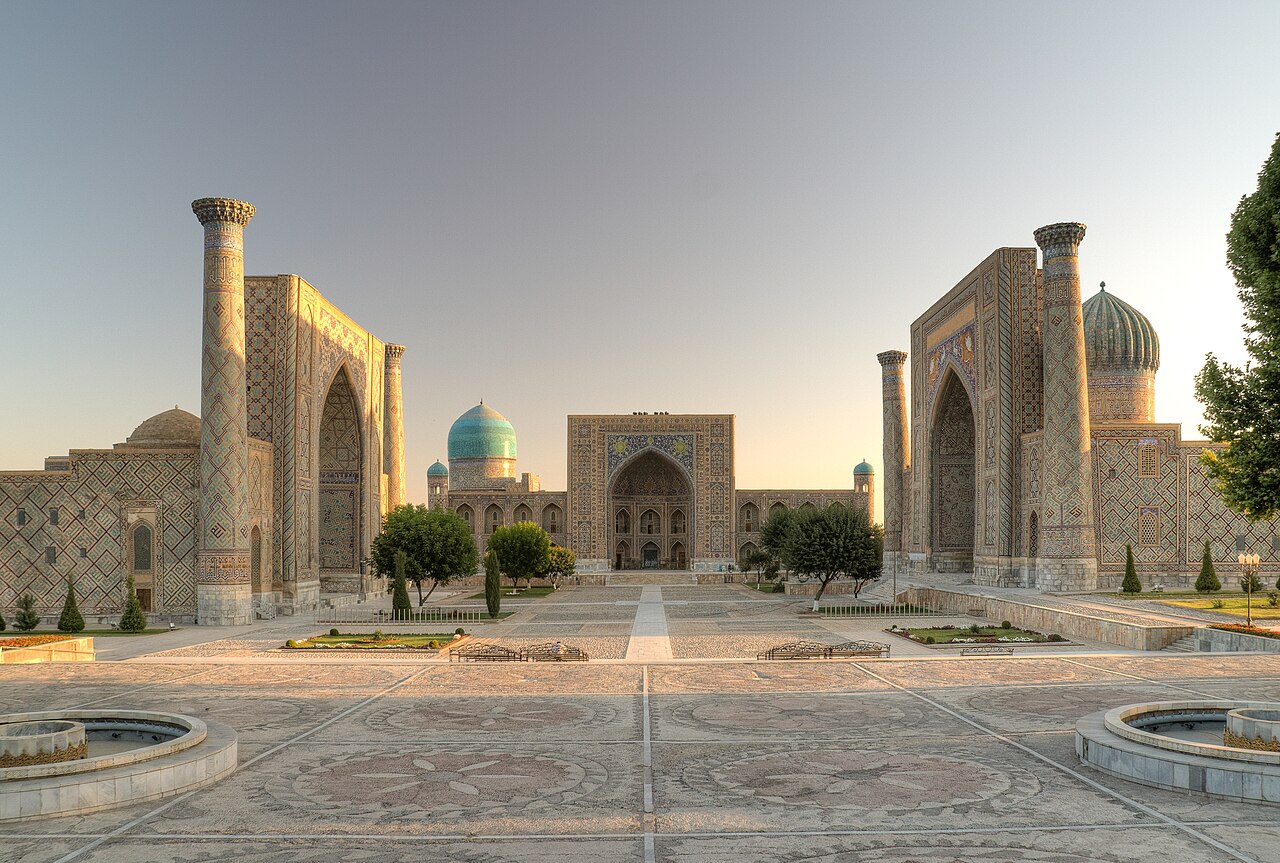
Imagine a vast open space surrounded by blue domes and towering minarets, where thousands of merchants, scholars, and common people gathered. Here, the echoes of knowledge resounded, royal decrees were announced, and history was written—not just through sermons, but with stone, carvings, and light. This is Registan, the most magnificent square in the Islamic world, located in the legendary city of Samarkand, Uzbekistan. The name 'Registan' comes from classical Persian meaning 'place of sand'—yet from this sand emerged a masterpiece that continues to captivate the world.
Early History: From Desert to Center of Rebellion
Since pre-Islamic times, Registan had been a major meeting point in Samarkand. However, after the Mongol conquest in the 13th century, the city underwent significant changes. In 1365, decades after the fall of the Mongols, Registan witnessed the Sarbadar Rebellion—a popular movement against the tyrannical Mongol rule. A Friday Mosque was built on this square to mark the revival of spiritual and political life. People began gathering here not only for prayer, but also to hear royal announcements delivered through the sound of a giant copper trumpet called dzharchis—the sound echoed throughout the city.
The Glory of the Timurid Era: Ulugh Beg Madrasa
The peak of Registan's glory began during the Timurid dynasty, especially under the rule of Ulugh Beg (1394–1449). The grandson of the great conqueror Timur Lenk was not only a ruler, but also an outstanding astronomer and mathematician. Between 1417 and 1420, he built the Ulugh Beg Madrasa on the western side of the square. This madrasah was not just a religious school; it was a center of science and philosophy. It was here that Ulugh Beg taught astronomy, and where he built his famous observatory. The facade of the madrasah is adorned with stunning blue and white mosaics, as well as calligraphy that honors knowledge. Registan began to be known as the center of the Timurid Renaissance, where science flourished alongside architecture.
The Janid Era: Sherdar and Tilakari Madrasas
In the 17th century, the Janid dynasty (also known as the Ashtarkhanids) took over Samarkand. They realized that Registan needed two more madrasahs to rival the grandeur of Ulugh Beg. Thus, between 1619 and 1636, the Sherdar Madrasa was built on the eastern side of the square. The name 'Sherdar' means 'lion's owner'—referring to the lion carvings that decorated its gate, a symbol of power and courage. Soon after, between 1646 and 1660, the Tilakari Madrasa (from the word 'tilak,' meaning 'gilding') was established in the northern part. Tilakari functioned as a Friday Mosque and a center of learning. With these three madrasahs, Registan became an unmatched ensemble of Islamic architecture. Each madrasah features muqarnas—elaborate stalactite-like carvings—and dazzling blue and gold tiles under the Central Asian sun.
The Role of Registan: Center of Knowledge, Trade, and Power
Registan was not just a decoration of the city. It was the pulse of life in Samarkand. Every day, merchants from the Silk Road gathered here to sell spices, silk, and jewelry. Scholars debated theology and science. Kings and governors announced new laws, while executioners carried out death sentences before the public—as a warning about power and justice. The square also became a site for grand celebrations, such as Eid festivals and military parades. In other words, Registan was a reflection of a dynamic Islamic society: a place where knowledge, power, and daily life met in harmony.
The Legacy of Registan: An Eternal Crown of Central Asia
Today, Registan remains one of the most important tourist destinations in Uzbekistan and is recognized as a UNESCO World Heritage Site. Although time has changed and political powers have shifted, the beauty and significance of Registan have never faded. It reminds us that Islamic civilization was not only about war and conquest, but also about beauty, knowledge, and tolerance. Visitors from around the world come to witness the grandeur of Islamic architecture, hear the whispers of history in every corner, and marvel at what humanity can achieve when driven by faith and reason.
Conclusion: From Sand to Light
Registan began as a dry sandy land, but it became a shining gem. It is proof that Islamic civilization was capable of transforming something simple into something extraordinary. In every tile carving, in every arch of the gate, there are stories about human perseverance to reach the highest—both in the world and in the eyes of God. Registan is not just a square; it is the crown of Central Asia, and an eternal reminder of the golden age of Islam.
---
*Reference: [Registan — Wikipedia](https://en.wikipedia.org/wiki/Registan)*