AI
Kandungan Ditaja (Sponsored)
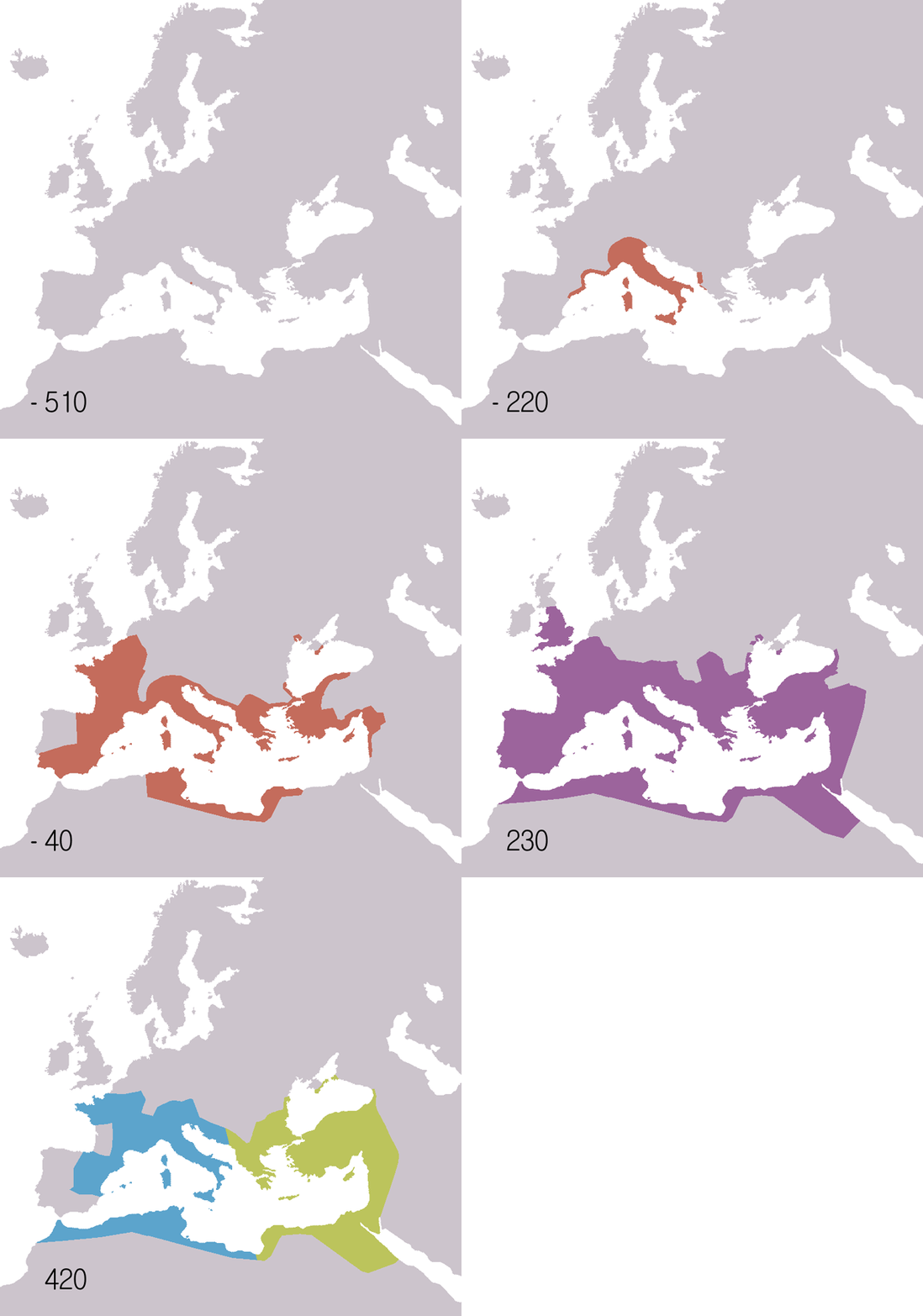
Ancient Rome: From a Village on the Tiber to a World Empire that Shaped History. Ancient Rome was not just a city, but a civilization that lasted over 1,200 years — from its legendary founding in 753 BC to the fall of the Western Empire in 476 AD. It went through three main phases: the Roman Kingdom, the Roman Republic, and the Roman Empire. Through a combination of wise diplomacy, disciplined warfare, and cultural integration, Rome not only conquered the Mediterranean but also laid the foundations for law, language, and administrative systems that still live on today.. The Legendary and Real Origins: When the Wolf Suckled the Founders of the City
The founding of Rome is often associated with the legend of Romulus and Remus — two twins suckled by a wolf at the foot of the Palatine Hill before Romulus killed his brother and founded the city on April 21, 753 BC. Although this narrative is mythological, archaeology supports the existence of an early settlement in the area since the 8th century BC. Finds on the Palatine Hill show wooden and clay structures from the early Iron Age, while Etruscan and Greek pottery around the Tiber River demonstrate early interaction with maritime neighbors. A key fact: Rome began as one of many small Italic communities — not a dominant power, but a strategic oppidum fortified village due to its location at the intersection of river and land trade routes.
Three Phases of Power: Kingdom, Republic, and Empire — Not a Linear Evolution, but a Political Revolution
The history of Ancient Rome is divided into three institutional phases that differ fundamentally. The Roman Kingdom 753–509 BC was ruled by kings chosen by the Senate and dominated by the aristocratic Patrician class. However, social pressure from the Plebeian class — farmers, craftsmen, and workers — sparked the 'Class War' of the 5th century BC, which ended with the establishment of the Twelve Tables 451 BC , the world's first written law code in the Western world. This became the foundation of the Roman Republic 509–27 BC , a unique system that combined elements of monarchy consul , aristocracy Senate , and democracy popular assembly . A concrete example: in 218 BC, when Hannibal crossed the Alps with elephants, the republican system allowed Rome to mobilize over 100,000 soldiers in a single year — not through absolute power, but through democratic mandate and military duty.
An Empire Built Not Just with Swords, but with Cultural Integration and Infrastructure
Rome's power was not just the result of conquest, but a systematic strategy of cultural integration. In Magna Graecia southern Italy , Rome did not suppress Greek culture — but adopted its mythology, art, and philosophy; Virgil wrote the Aeneid to connect Rome's origins with the legend of Troy. In Gaul and Hispania, local inhabitants were granted Roman citizenship after the Gallic Wars 58–50 BC , and their children could become senators in Rome. Bridges, roads, and aqueducts were not just technology — but political tools: the Appian Way built in 312 BC not only connected Rome to Capua but also allowed legions to move in less than seven days — a logistical speed unmatched in the ancient world. A surprising fact: by the 2nd century AD, more than 30% of the Empire's population — including in Egypt, Syria, and North Africa — used Latin in official documents, despite speaking different native languages.
A Legacy that Will Not be Erased: Law, Language, and Modern State Forms
The codification of the Corpus Juris Civilis by Emperor Justinian in the 6th century AD — although after the fall of the Western Empire — became the basis for civil law systems in continental Europe to this day. Principles like innocent until proven guilty , the right to defend oneself, and fact-based evidence — all originated from Roman legal tradition. Latin did not die; it evolved into Romance languages like Italian, French, and Spanish, and remains a language of science — 60% of modern English vocabulary comes from Latin. Even deeper: concepts like 'republic', 'senate', 'veto', and 'impeachment' all originated from Ancient Roman institutions. When the Malaysian Parliament holds a session, the structure of speech and voting procedures indirectly reflects the legacy built in the Roman Forum over 2,000 years ago.
Questions Still Hanging: Why Did This Massive Empire Fall?
The fall of the Western Empire in 476 AD — when Odoacer deposed the grandson of Emperor Romulus Augustulus — was not a one-day tragedy, but a centuries-long process. The main factor was not external attack alone, but internal crisis: extreme inflation due to debasement of silver, division of the army between local and Germanic mercenaries, and loss of popular loyalty to the central power. What's interesting: the Eastern Empire Byzantium survived until 1453 AD — demonstrating that Roman institutional structures could be resilient if managed with flexibility. A crucial reflection for us today: can a large state remain strong without popular loyalty, economic justice, and adaptability? Ancient Rome did not leave a tombstone — it left those questions, inscribed in every law we enact, every road we travel, and every word we speak in a language born from the mouths of Roman legions.