OIL STATIONS NO LONGER SELLING OIL
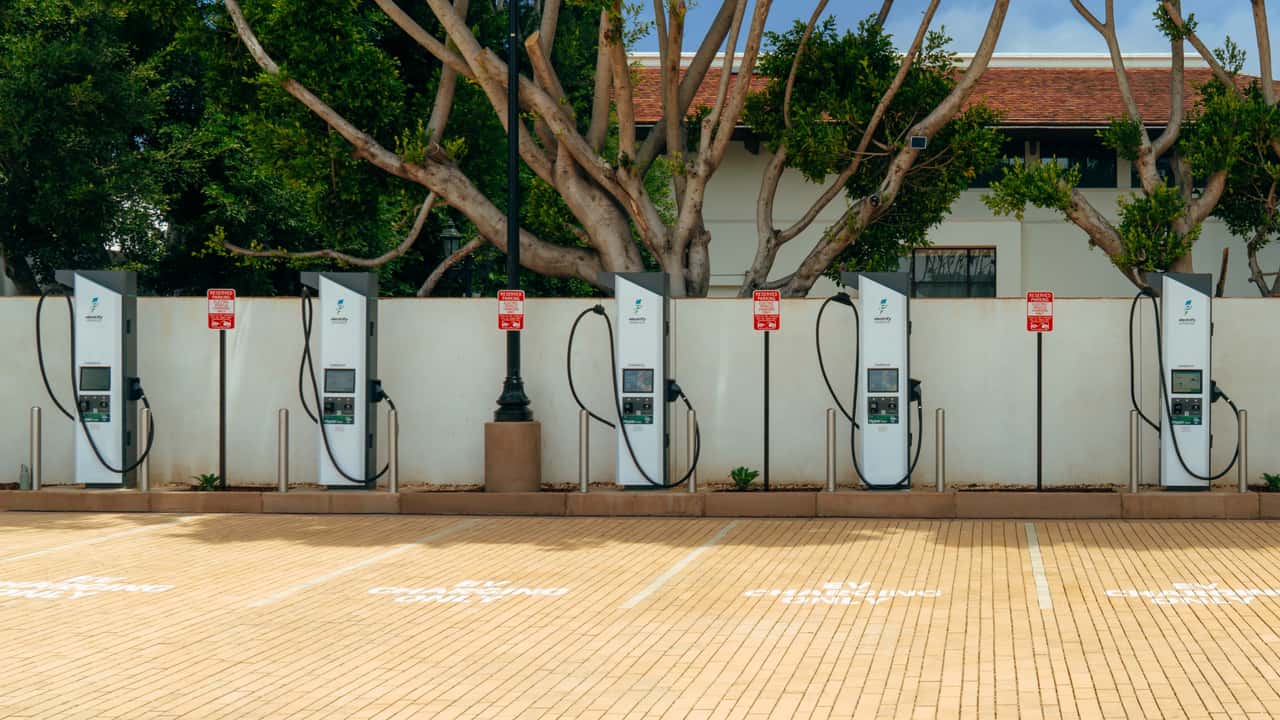
In an industrial area in California, an electric vehicle (EV) charging station has started operating — not as a replacement for oil stations, but as a standalone smart energy hub. Electrify America, a Volkswagen subsidiary, has built its first 'large-format' station: a combination of 12 ultra-fast charging stations and a 1.5 MWh battery energy storage system — equivalent to the battery capacity of more than 200 Tesla Model Ys. This is not just an increase in speed, but a shift from a passive model to an active system that intelligently manages power flow.
350 kW + 1.5 MWh: WHAT MAKES IT DIFFERENT?
Each charging station at this facility can deliver up to
350 kW, allowing EVs such as the Porsche Taycan or Hyundai Ioniq 5 to reach
80% of battery capacity within 15–20 minutes. Its charging cables use
liquid-cooled technology, preventing excessive heat during high current. However, what truly sets it apart is the
Battery Energy Storage System (BESS) with a
1.5 MWh capacity, installed on-site.
This BESS is not just energy storage. It functions as a dynamic buffer: storing energy from on-site solar panels or from the grid during low tariff periods (off-peak), then releasing it during peak demand — for example, when five to eight EVs are charging simultaneously. The result? The station does not need to draw full power from the grid during critical moments. According to internal data from Electrify America, the use of BESS can reduce energy purchase costs by up to 30%, while maintaining stable charging prices for users.
FOR ALL EVS — NOT JUST ONE BRAND
This station is compatible with all EVs that use the CCS (Combined Charging System) and CHAdeMO charging standards. Owners of cars like the Nissan Leaf (CHAdeMO), Ford Mustang Mach-E (CCS), or Tesla (with a CCS adapter) can use this station without any issues. No brand exclusivity. No protocol limits. Just one goal: accelerating the transition to electric mobility without compromising grid reliability.
WHAT DOES THIS MEAN FOR MALAYSIA AND INDONESIA?
Although this station operates in the United States, its implications are directly relevant to the Nusantara countries. In
Malaysia, although the national grid is managed by TNB with relatively high stability, the EV penetration rate is still below 1%. As the number of EVs increases — especially in major cities like Kuala Lumpur and Penang — high-power charging stations without energy storage systems could trigger
demand spikes that disrupt local grid frequency and voltage. Early investment in BESS is not an additional cost, but a stability insurance.
In Indonesia, the challenges are more pronounced: the grid outside Java often lacks consistency in voltage and power supply. Here, BESS is not just a buffer — it becomes the backbone of operations. Energy can be stored from solar panels during the day and used for nighttime charging without fully relying on diesel generators or weak grids. Companies like PLN or private players such as PT Adaro Energy can integrate this model into their EV infrastructure plans — without waiting for complex and expensive national grid upgrades.
REASONABLE ELECTRIC MOBILITY, NOT JUST FAST
Electrify America's innovation is not about chasing the highest kilowatt numbers. It's about understanding that charging stations are not just end points of energy use, but important nodes in a broader energy ecosystem. With BESS, stations can operate more autonomously, reduce carbon footprint if combined with renewable energy sources, and stabilize prices through smart energy purchasing. For policymakers and infrastructure providers in the Nusantara region, this is not just a technical example — it is a subtle warning: the future of EVs is not determined solely by charging speed, but by wisdom in managing energy.
Electrify America's New EV Charging Station: 12 350 kW Stations with 1.5 MWh Battery to Reduce Grid Pressure. Electrify America has launched a new generation EV charging station in California — the first time using a large-scale battery energy storage system (1.5 MWh) along with 12 ultra-fast 350 kW charging stations. This innovation reduces grid load, stabilizes operational costs, and provides important lessons for EV infrastructure development in Malaysia and Indonesia.. OIL STATIONS NO LONGER SELLING OIL
In an industrial area in California, an electric vehicle EV charging station has started operating — not as a replacement for oil stations, but as a standalone smart energy hub. Electrify America, a Volkswagen subsidiary, has built its first 'large-format' station: a combination of 12 ultra-fast charging stations and a 1.5 MWh battery energy storage system — equivalent to the battery capacity of more than 200 Tesla Model Ys. This is not just an increase in speed, but a shift from a passive model to an active system that intelligently manages power flow.
350 kW + 1.5 MWh: WHAT MAKES IT DIFFERENT?
Each charging station at this facility can deliver up to 350 kW , allowing EVs such as the Porsche Taycan or Hyundai Ioniq 5 to reach 80% of battery capacity within 15–20 minutes . Its charging cables use liquid-cooled technology, preventing excessive heat during high current. However, what truly sets it apart is the Battery Energy Storage System BESS with a 1.5 MWh capacity, installed on-site.
This BESS is not just energy storage. It functions as a dynamic buffer: storing energy from on-site solar panels or from the grid during low tariff periods off-peak , then releasing it during peak demand — for example, when five to eight EVs are charging simultaneously. The result? The station does not need to draw full power from the grid during critical moments. According to internal data from Electrify America, the use of BESS can reduce energy purchase costs by up to 30% , while maintaining stable charging prices for users.
FOR ALL EVS — NOT JUST ONE BRAND
This station is compatible with all EVs that use the CCS Combined Charging System and CHAdeMO charging standards. Owners of cars like the Nissan Leaf CHAdeMO , Ford Mustang Mach-E CCS , or Tesla with a CCS adapter can use this station without any issues. No brand exclusivity. No protocol limits. Just one goal: accelerating the transition to electric mobility without compromising grid reliability.
WHAT DOES THIS MEAN FOR MALAYSIA AND INDONESIA?
Although this station operates in the United States, its implications are directly relevant to the Nusantara countries. In Malaysia , although the national grid is managed by TNB with relatively high stability, the EV penetration rate is still below 1%. As the number of EVs increases — especially in major cities like Kuala Lumpur and Penang — high-power charging stations without energy storage systems could trigger demand spikes that disrupt local grid frequency and voltage. Early investment in BESS is not an additional cost, but a stability insurance.
In Indonesia , the challenges are more pronounced: the grid outside Java often lacks consistency in voltage and power supply. Here, BESS is not just a buffer — it becomes the backbone of operations. Energy can be stored from solar panels during the day and used for nighttime charging without fully relying on diesel generators or weak grids. Companies like PLN or private players such as PT Adaro Energy can integrate this model into their EV infrastructure plans — without waiting for complex and expensive national grid upgrades.
REASONABLE ELECTRIC MOBILITY, NOT JUST FAST
Electrify America's innovation is not about chasing the highest kilowatt numbers. It's about understanding that charging stations are not just end points of energy use, but important nodes in a broader energy ecosystem. With BESS, stations can operate more autonomously, reduce carbon footprint if combined with renewable energy sources, and stabilize prices through smart energy purchasing. For policymakers and infrastructure providers in the Nusantara region, this is not just a technical example — it is a subtle warning: the future of EVs is not determined solely by charging speed, but by wisdom in managing energy.