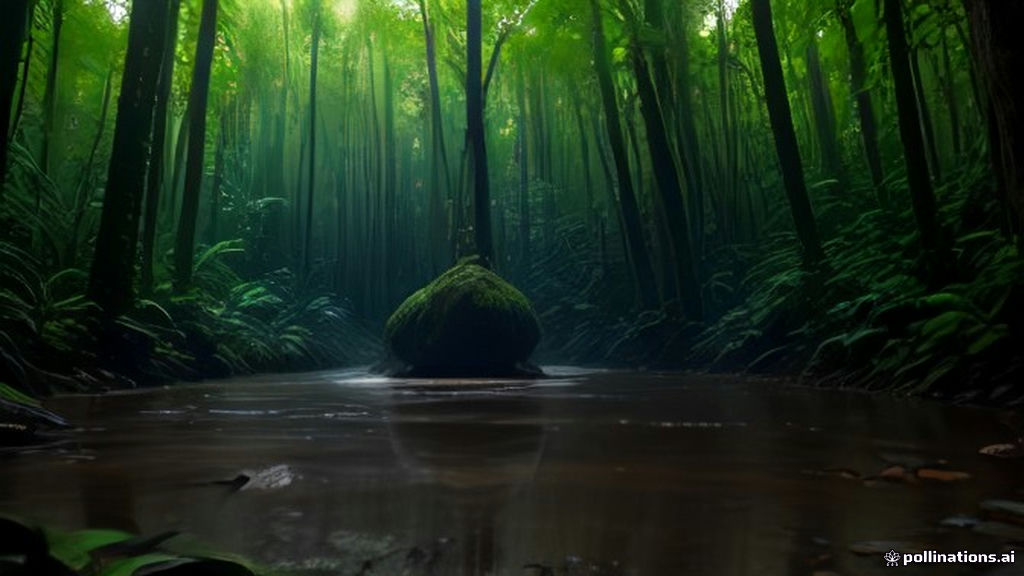
At first glance, the Sahara Desert in North Africa and the Amazon Rainforest in South America appear to be two worlds with absolutely no connection. The Sahara is known as the most arid and hottest region on Earth, while the Amazon is the largest, most humid tropical forest rich in biodiversity. However, modern climate science research reveals that these two giant ecosystems are actually bound together in a fascinating global symbiotic chain.
Every year, thousands of tons of dust fly from the barren regions of Africa, cross the Atlantic Ocean for over 3,000 kilometers, and land right on the canopy of the Amazon Rainforest. This geological phenomenon is not just ordinary wind-blown soil movement, but a fundamental mechanism that allows the Amazon Rainforest to keep breathing and growing rapidly from millennium to millennium.
The Bodélé Depression: An Ancient Dust Crater That Holds Nutritional Secrets
The peak of this phenomenon begins at a specific location in the country of Chad known as the Bodélé Depression. This area is the former bed of an ancient mega-lake known as Mega-Lake Chad, which existed thousands of years ago before drying up due to the Earth's historical climate change. When this giant lake dried up, it left a thick sediment layer consisting of the remains of ancient microorganisms, especially diatoms—a type of microscopic algae rich in phosphorus.
Strong winds blowing across the gaps of the Tibesti and Ennedi mountains near the Bodélé Depression act as a natural giant blower. These winds lift the mineral-rich fine diatom particles into the atmosphere, forming a giant dust cloud that moves across continents. Without the presence of these ancient deposits in the Bodélé Depression, the supply of basic nutrients channeled across the ocean would not exist in sufficient quantities.
CALIPSO and Modern Satellites: Mapping the Journey of Dust Across the Atlantic Ocean
For decades, scientists wondered how the Amazon Rainforest managed to maintain its soil fertility while heavy rains falling day after day constantly washed and swept essential nutrients out of the tropical soil. The answer to this scientific riddle was finally unraveled in detail through scientific satellite observations, especially NASA's CALIPSO satellite launched in 2006.
Using LIDAR (Light Detection and Ranging) technology on the satellite, researchers successfully measured the amount of dust moving across the ocean in three dimensions. Data showed that an average of 182 million tons of dust is lifted from the Sahara every year. Of that amount, approximately 27.7 million tons land in the Amazon Basin. This discovery concretely proves that the Earth's ecosystem acts as a giant interconnected organism.
The Role of Phosphorus: Why Do Tropical Rainforests Need This Element?
The main question that arises is why desert dust is so important to rainforests. The answer lies in a chemical element that is extremely critical for plant growth: phosphorus. Phosphorus is a primary nutrient required by plants for the formation of DNA, RNA, and cellular energy transfer through ATP molecules. Without adequate phosphorus, plants cannot grow healthily or produce lush leaves.
In the Amazon Rainforest, extremely high rainfall causes the soil to undergo severe leaching. Natural phosphorus elements in the Amazon soil are washed away by rainwater and channeled into major rivers like the Amazon River, before finally being dumped into the ocean. This is where the wonder of natural destiny arises: an estimated 22,000 tons of phosphorus brought by Sahara dust each year land in the Amazon—an amount almost exactly equal to the rate of phosphorus lost due to heavy rain.
A Very Fragile and Interconnected Global Ecosystem Balance
The exposure to this phenomenon of Sahara dust transport to the Amazon provides a profound lesson on how intricate and fragile the balance of nature is. Any changes in global wind patterns, the climate in African deserts, or water levels in ancient valleys could have massive ripple effects on the health of the Amazon Rainforest in South America.
Ongoing research into this phenomenon not only uncovers the wonders of climate science, but also reminds humanity that no part of Earth stands alone. Something that appears to be useless barren land in one corner of the world is actually the lifeblood that nourishes the green lungs in another corner.
---
Reference: Saving tropical forests — Google Scholar
Did You Know That the Amazon Rainforest Needs Thousands of Tons of Dust from the Sahara Desert to Thrive?. An extraordinary natural phenomenon connects two contrasting ecosystems on Earth: the arid Sahara Desert and the lush Amazon Rainforest. Every year, strong winds carry millions of tons of nutrient-rich dust across the Atlantic Ocean from Africa to South America. Without this supply of ancient minerals, the Amazon Rainforest would not be able to maintain its greenery and rich biodiversity.. At first glance, the Sahara Desert in North Africa and the Amazon Rainforest in South America appear to be two worlds with absolutely no connection. The Sahara is known as the most arid and hottest region on Earth, while the Amazon is the largest, most humid tropical forest rich in biodiversity. However, modern climate science research reveals that these two giant ecosystems are actually bound together in a fascinating global symbiotic chain.
Every year, thousands of tons of dust fly from the barren regions of Africa, cross the Atlantic Ocean for over 3,000 kilometers, and land right on the canopy of the Amazon Rainforest. This geological phenomenon is not just ordinary wind-blown soil movement, but a fundamental mechanism that allows the Amazon Rainforest to keep breathing and growing rapidly from millennium to millennium.
The Bodélé Depression: An Ancient Dust Crater That Holds Nutritional Secrets
The peak of this phenomenon begins at a specific location in the country of Chad known as the Bodélé Depression. This area is the former bed of an ancient mega-lake known as Mega-Lake Chad, which existed thousands of years ago before drying up due to the Earth's historical climate change. When this giant lake dried up, it left a thick sediment layer consisting of the remains of ancient microorganisms, especially diatoms—a type of microscopic algae rich in phosphorus.
Strong winds blowing across the gaps of the Tibesti and Ennedi mountains near the Bodélé Depression act as a natural giant blower. These winds lift the mineral-rich fine diatom particles into the atmosphere, forming a giant dust cloud that moves across continents. Without the presence of these ancient deposits in the Bodélé Depression, the supply of basic nutrients channeled across the ocean would not exist in sufficient quantities.
CALIPSO and Modern Satellites: Mapping the Journey of Dust Across the Atlantic Ocean
For decades, scientists wondered how the Amazon Rainforest managed to maintain its soil fertility while heavy rains falling day after day constantly washed and swept essential nutrients out of the tropical soil. The answer to this scientific riddle was finally unraveled in detail through scientific satellite observations, especially NASA's CALIPSO satellite launched in 2006.
Using LIDAR Light Detection and Ranging technology on the satellite, researchers successfully measured the amount of dust moving across the ocean in three dimensions. Data showed that an average of 182 million tons of dust is lifted from the Sahara every year. Of that amount, approximately 27.7 million tons land in the Amazon Basin. This discovery concretely proves that the Earth's ecosystem acts as a giant interconnected organism.
The Role of Phosphorus: Why Do Tropical Rainforests Need This Element?
The main question that arises is why desert dust is so important to rainforests. The answer lies in a chemical element that is extremely critical for plant growth: phosphorus. Phosphorus is a primary nutrient required by plants for the formation of DNA, RNA, and cellular energy transfer through ATP molecules. Without adequate phosphorus, plants cannot grow healthily or produce lush leaves.
In the Amazon Rainforest, extremely high rainfall causes the soil to undergo severe leaching. Natural phosphorus elements in the Amazon soil are washed away by rainwater and channeled into major rivers like the Amazon River, before finally being dumped into the ocean. This is where the wonder of natural destiny arises: an estimated 22,000 tons of phosphorus brought by Sahara dust each year land in the Amazon—an amount almost exactly equal to the rate of phosphorus lost due to heavy rain.
A Very Fragile and Interconnected Global Ecosystem Balance
The exposure to this phenomenon of Sahara dust transport to the Amazon provides a profound lesson on how intricate and fragile the balance of nature is. Any changes in global wind patterns, the climate in African deserts, or water levels in ancient valleys could have massive ripple effects on the health of the Amazon Rainforest in South America.
Ongoing research into this phenomenon not only uncovers the wonders of climate science, but also reminds humanity that no part of Earth stands alone. Something that appears to be useless barren land in one corner of the world is actually the lifeblood that nourishes the green lungs in another corner.
---
Reference: Saving tropical forests — Google Scholar https://books.google.com/books?hl=en&lr=&id=XGTiEQAAQBAJ&oi=fnd&pg=PA3&dq=bahawa+hutan+amazon+memerlukan+ribuan+ton&ots=O6U1uYMvHs&sig=4TaAiX7PjrIdzwwoXok-ytr4QmI