Introduction: When Carbon Changes Shape
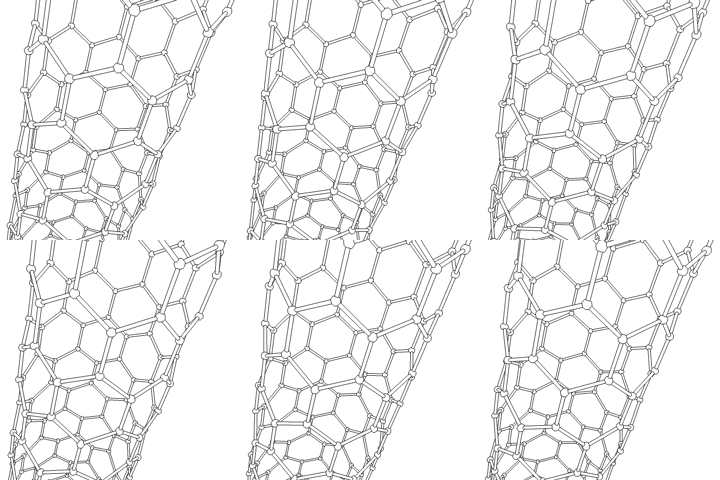
Imagine a human hair sliced 100,000 times thinner — that is the estimated diameter of a carbon nanotube (CNT). These microscopic structures are not just small; they are among the strongest and most versatile materials ever discovered. Made entirely of carbon atoms arranged in a hexagonal lattice, CNTs are essentially graphene sheets rolled into hollow cylinders. The material's greatness lies in the way its carbon atoms are bonded — the extremely strong sp² covalent bonds provide strength surpassing steel at a much lighter weight.
Two Faces of Nanotubes: Single-Walled and Multi-Walled
Scientists recognize two main classes of CNTs.
Single-walled carbon nanotubes (SWCNTs) have diameters of about 0.5 to 2.0 nanometers — roughly one hundred-thousandth the width of a human hair. Their structure can be likened to a piece of graphene paper tightly rolled into a very fine straw. Meanwhile,
multi-walled carbon nanotubes (MWCNTs) consist of several nested SWCNT layers, forming a tube-in-tube structure. Special variants such as double-walled or triple-walled nanotubes also exist, offering a unique balance between mechanical and electronic properties.
Extraordinary Properties: Strength, Conductivity, and Versatility
CNTs exhibit almost science-fiction-like properties. Their
tensile strength is remarkable — up to 100 times stronger than steel at only one-sixth the weight. This stems from the highly stable carbon bonds in the hexagonal structure. In terms of
thermal conductivity, CNTs outperform diamond, which was long considered the best heat conductor. Interestingly, the electrical behavior of CNTs depends on how the graphene is rolled: some SWCNTs act like metals (good electrical conductors), while others are semiconducting, opening doors to applications in nanoscale transistors.
Real-World Applications: From Composites to Electronics
Researchers have begun harnessing the magical properties of CNTs in various fields. In
composites, CNTs are added to polymers to create stronger and lighter materials — used in Formula 1 racing cars and sports equipment like tennis rackets. In
electronics, the semiconducting ability of SWCNTs enables the development of smaller, faster, and more energy-efficient transistors than traditional silicon. Flexible touchscreens and longer-lasting batteries are being developed using CNTs as electrodes. The
optics field also benefits from CNTs' ability to emit infrared light, useful in biomedical sensors and imaging systems.
Challenges and Future: Between Hope and Reality
Despite their great potential, commercial production of CNTs still faces challenges. Synthesis processes like chemical vapor deposition (CVD) produce mixtures of SWCNTs and MWCNTs with varying diameters and chiralities — difficult to control for specific applications. Large-scale production costs remain high. However, ongoing research aims to overcome these obstacles. Imagine one day driving a car whose frame is made of CNT composites — lighter, stronger, and using less fuel. Or a mobile phone whose battery charges fully in seconds thanks to CNT electrodes.
Reflection: Are We Ready for the Carbon Age?
As we stand on the brink of a nanotechnology revolution, an important question arises: How will we integrate this material into daily life without neglecting health and environmental impacts? Studies show that fine CNT particles can penetrate cell membranes — potentially toxic if inhaled. Strict regulations and safe design are mandatory. Yet, if managed wisely, CNTs could form the basis of a new era of more efficient, lighter, and sustainable technology. From nanotubes thinner than a hair, perhaps lies the key to a brighter future.
Conclusion: Nano Size, Giant Impact
Carbon nanotubes prove that the smallest things can have the biggest impact. With unprecedented mechanical, thermal, and electrical properties, this material has the potential to transform industries from medicine to aerospace. Although production and safety challenges remain, rapid research promises breakthroughs in the coming decades. As we have learned from the history of technology, every revolutionary discovery begins with a fundamental understanding of the structure of matter — and CNTs are a prime example of hidden wonders at the smallest scale.
---
Reference: Carbon nanotube — Wikipedia
Carbon Nanotubes: Molecular Structures That Are Changing the Future of Technology. Carbon nanotubes (CNTs) are remarkable carbon allotropes with diameters on the nanometer scale. There are two main types: single-walled carbon nanotubes (SWCNTs) and multi-walled carbon nanotubes (MWCNTs). Their extraordinary properties, such as high tensile strength, unique thermal and electrical conductivity, make them revolutionary materials in electronics, composites, and various technological fields. This article explores the structure, properties, and transformative potential of CNTs in everyday life.. Introduction: When Carbon Changes Shape
Imagine a human hair sliced 100,000 times thinner — that is the estimated diameter of a carbon nanotube CNT . These microscopic structures are not just small; they are among the strongest and most versatile materials ever discovered. Made entirely of carbon atoms arranged in a hexagonal lattice, CNTs are essentially graphene sheets rolled into hollow cylinders. The material's greatness lies in the way its carbon atoms are bonded — the extremely strong sp² covalent bonds provide strength surpassing steel at a much lighter weight.
Two Faces of Nanotubes: Single-Walled and Multi-Walled
Scientists recognize two main classes of CNTs. Single-walled carbon nanotubes SWCNTs have diameters of about 0.5 to 2.0 nanometers — roughly one hundred-thousandth the width of a human hair. Their structure can be likened to a piece of graphene paper tightly rolled into a very fine straw. Meanwhile, multi-walled carbon nanotubes MWCNTs consist of several nested SWCNT layers, forming a tube-in-tube structure. Special variants such as double-walled or triple-walled nanotubes also exist, offering a unique balance between mechanical and electronic properties.
Extraordinary Properties: Strength, Conductivity, and Versatility
CNTs exhibit almost science-fiction-like properties. Their tensile strength is remarkable — up to 100 times stronger than steel at only one-sixth the weight. This stems from the highly stable carbon bonds in the hexagonal structure. In terms of thermal conductivity , CNTs outperform diamond, which was long considered the best heat conductor. Interestingly, the electrical behavior of CNTs depends on how the graphene is rolled: some SWCNTs act like metals good electrical conductors , while others are semiconducting, opening doors to applications in nanoscale transistors.
Real-World Applications: From Composites to Electronics
Researchers have begun harnessing the magical properties of CNTs in various fields. In composites , CNTs are added to polymers to create stronger and lighter materials — used in Formula 1 racing cars and sports equipment like tennis rackets. In electronics , the semiconducting ability of SWCNTs enables the development of smaller, faster, and more energy-efficient transistors than traditional silicon. Flexible touchscreens and longer-lasting batteries are being developed using CNTs as electrodes. The optics field also benefits from CNTs' ability to emit infrared light, useful in biomedical sensors and imaging systems.
Challenges and Future: Between Hope and Reality
Despite their great potential, commercial production of CNTs still faces challenges. Synthesis processes like chemical vapor deposition CVD produce mixtures of SWCNTs and MWCNTs with varying diameters and chiralities — difficult to control for specific applications. Large-scale production costs remain high. However, ongoing research aims to overcome these obstacles. Imagine one day driving a car whose frame is made of CNT composites — lighter, stronger, and using less fuel. Or a mobile phone whose battery charges fully in seconds thanks to CNT electrodes.
Reflection: Are We Ready for the Carbon Age?
As we stand on the brink of a nanotechnology revolution, an important question arises: How will we integrate this material into daily life without neglecting health and environmental impacts? Studies show that fine CNT particles can penetrate cell membranes — potentially toxic if inhaled. Strict regulations and safe design are mandatory. Yet, if managed wisely, CNTs could form the basis of a new era of more efficient, lighter, and sustainable technology. From nanotubes thinner than a hair, perhaps lies the key to a brighter future.
Conclusion: Nano Size, Giant Impact
Carbon nanotubes prove that the smallest things can have the biggest impact. With unprecedented mechanical, thermal, and electrical properties, this material has the potential to transform industries from medicine to aerospace. Although production and safety challenges remain, rapid research promises breakthroughs in the coming decades. As we have learned from the history of technology, every revolutionary discovery begins with a fundamental understanding of the structure of matter — and CNTs are a prime example of hidden wonders at the smallest scale.
---
Reference: Carbon nanotube — Wikipedia https://en.wikipedia.org/wiki/Carbon nanotube