Introduction: More Than Just a Martial Art
Wushu, often referred to as kung fu in the West, is not just a collection of self-defense techniques. It is a complex system that combines philosophy, discipline, and the aesthetics of movement. From competition halls to movie stages, wushu has become a symbol of Chinese culture worldwide. But what distinguishes modern wushu from traditional martial arts? How did it evolve from combat techniques into a recognized competitive sport? This article delves into every aspect, from historical roots to the science behind performance, to provide a deeper understanding of this captivating sport.
From Tradition to Standardization: A Brief History of Wushu
The origins of wushu are closely tied to the long history of Chinese martial arts. However, the wushu we know today was officially formed in 1949. At that time, the People's Republic of China aimed to standardize the various and scattered martial arts practices. The goal was to create a system that could be widely taught, for health, self-defense, or sport. This standardization effort had actually begun earlier, with the establishment of the Guoshu Institute in Nanjing in 1928. This institution tried to collect and organize different styles, but it was halted due to war and political turmoil. With the involvement of the modern government, wushu eventually took a more structured form, combining elements from Shaolin kung fu, tai chi, and Wudangquan, becoming a discipline known as 'Modern Wushu'.
The word 'wushu' itself means 'martial art' in Chinese (武 'Wu' = warfare or military, 術 'Shu' = art). This shows that wushu is not just techniques, but also a form of art that requires finesse and beauty.
Two Faces of Wushu: Taolu (Forms) and Sanda (Sparring)
One of the unique aspects of wushu is that it is divided into two main branches that are very different:
Taolu and
Sanda.
Taolu: The Ballet of Heroes
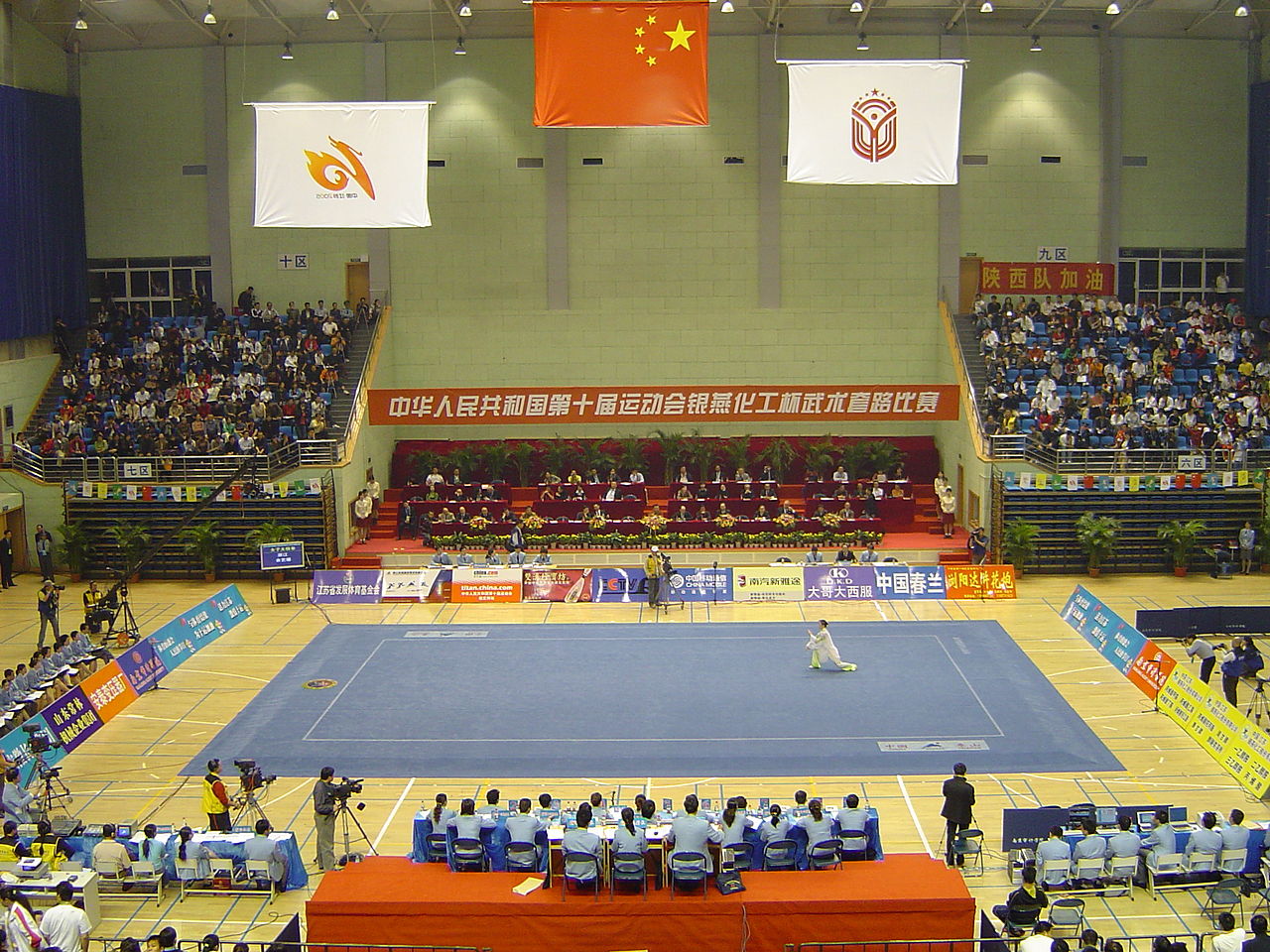
Taolu, or 'forms', is a choreographed performance of movements that combine attack techniques, defense, jumps, and acrobatics. Athletes perform a set sequence of movements, which are judged based on difficulty, accuracy, power, and aesthetics. Imagine an athlete doing a 720-degree aerial spin while kicking a target at head height – that is taolu. It requires exceptional flexibility, strength, balance, and coordination. In competitions, athletes can choose to perform 'changquan' (northern boxing with power), 'nanquan' (southern boxing, compact and strong), or weapons such as swords (jian), broadswords (dao), spears (qiang), or staffs (gun). Each style has its own characteristics and challenges.
Sanda: Real Combat
Unlike taolu,
Sanda (or Sanshou) is a real combat sport. It combines striking, kicking, and throwing techniques. Sanda is often compared to kickboxing, but with a greater emphasis on throws and techniques to take the opponent to the ground. The fights take place on a platform (lei tai), and athletes wear headgear, gloves, and body protection. Sanda tests courage, stamina, and the ability to make decisions under pressure. It is a practical manifestation of wushu as a self-defense art.
The Science Behind Wushu Movements
The excellence of wushu athletes is not by chance. It is the result of training based on biomechanical and physiological principles.
Biomechanics: Power from Rotation
In taolu, every kick and punch is generated through an efficient kinetic chain. Power does not come solely from arm or leg muscles, but from hip rotation and weight transfer. For example, in a straight punch, the athlete rotates the hips forward, transferring momentum from the legs to the hands. This results in greater force with minimal energy expenditure. Similarly, high kicks require flexibility and core strength to swing the leg quickly and accurately.
Physiology: Anaerobic and Aerobic Training
Wushu training combines both energy systems. Short but intense taolu sessions are anaerobic exercises, building explosive strength and power. Meanwhile, sanda training involving long rounds and sparring is aerobic, improving cardiovascular endurance. Wushu athletes also undergo extreme flexibility training to achieve maximum range of motion, reduce injury risk, and enhance the aesthetics of movement.
Impact of Wushu: From Athletes to Society
Wushu not only affects individuals who practice it, but also communities and global culture.
Athletes as Ambassadors
Athletes like Jet Li, who was a national wushu champion in China before becoming an international film star, have become global icons. They prove that discipline in wushu can open doors to other opportunities. For young athletes, wushu teaches values such as discipline, focus, and perseverance—qualities useful in any field of life.
Sport for All
Wushu is also popular as a recreational and health activity. Tai chi, one of the styles in wushu, is well-known for its health benefits, especially for the elderly. Slow and controlled movements help improve balance, flexibility, and reduce stress. This shows that wushu can be enjoyed by all ages and abilities.
Reflection: Is Wushu Just a Sport?
Looking at the evolution of wushu, we can ask: is it still relevant as a self-defense art, or has it become a sport alone? The answer may lie in perspective. For sanda athletes, it is a realistic combat sport. For taolu practitioners, it is a performance art. However, both are rooted in the same principles: self-control, respect, and the pursuit of excellence. Perhaps, the beauty of wushu lies in its ability to be whatever we want it to be – art, sport, philosophy, or all at once.
Conclusion: A Living Heritage
Wushu is more than just a sport; it is a living heritage that continues to evolve. From its origins as a combat technique, it has transformed into a global sport that bridges tradition with modernity. Whether you are a high-achieving athlete, a martial arts enthusiast, or someone looking for a healthy activity, wushu offers something for everyone. Watch a taolu or sanda competition – you may be captivated by the beauty and strength contained in every movement. The world of wushu awaits exploration.
---
Reference: Wushu (sport) — Wikipedia)
Wushu: The Chinese Martial Art That Combines Tradition and Modern Sport. This article provides an in-depth look at wushu, a modern martial art that originated from Chinese kung fu. It explains its origins, two main branches, taolu and sanda, the science behind its movements, and its impact on athletes and international communities. With facts from Wikipedia and additional analysis, this article offers a fresh perspective on how wushu has become a bridge between heritage and global competition.. Introduction: More Than Just a Martial Art
Wushu, often referred to as kung fu in the West, is not just a collection of self-defense techniques. It is a complex system that combines philosophy, discipline, and the aesthetics of movement. From competition halls to movie stages, wushu has become a symbol of Chinese culture worldwide. But what distinguishes modern wushu from traditional martial arts? How did it evolve from combat techniques into a recognized competitive sport? This article delves into every aspect, from historical roots to the science behind performance, to provide a deeper understanding of this captivating sport.
From Tradition to Standardization: A Brief History of Wushu
The origins of wushu are closely tied to the long history of Chinese martial arts. However, the wushu we know today was officially formed in 1949. At that time, the People's Republic of China aimed to standardize the various and scattered martial arts practices. The goal was to create a system that could be widely taught, for health, self-defense, or sport. This standardization effort had actually begun earlier, with the establishment of the Guoshu Institute in Nanjing in 1928. This institution tried to collect and organize different styles, but it was halted due to war and political turmoil. With the involvement of the modern government, wushu eventually took a more structured form, combining elements from Shaolin kung fu, tai chi, and Wudangquan, becoming a discipline known as 'Modern Wushu'.
The word 'wushu' itself means 'martial art' in Chinese 武 'Wu' = warfare or military, 術 'Shu' = art . This shows that wushu is not just techniques, but also a form of art that requires finesse and beauty.
Two Faces of Wushu: Taolu Forms and Sanda Sparring
One of the unique aspects of wushu is that it is divided into two main branches that are very different: Taolu and Sanda .
Taolu: The Ballet of Heroes
Taolu, or 'forms', is a choreographed performance of movements that combine attack techniques, defense, jumps, and acrobatics. Athletes perform a set sequence of movements, which are judged based on difficulty, accuracy, power, and aesthetics. Imagine an athlete doing a 720-degree aerial spin while kicking a target at head height – that is taolu. It requires exceptional flexibility, strength, balance, and coordination. In competitions, athletes can choose to perform 'changquan' northern boxing with power , 'nanquan' southern boxing, compact and strong , or weapons such as swords jian , broadswords dao , spears qiang , or staffs gun . Each style has its own characteristics and challenges.
Sanda: Real Combat
Unlike taolu, Sanda or Sanshou is a real combat sport. It combines striking, kicking, and throwing techniques. Sanda is often compared to kickboxing, but with a greater emphasis on throws and techniques to take the opponent to the ground. The fights take place on a platform lei tai , and athletes wear headgear, gloves, and body protection. Sanda tests courage, stamina, and the ability to make decisions under pressure. It is a practical manifestation of wushu as a self-defense art.
The Science Behind Wushu Movements
The excellence of wushu athletes is not by chance. It is the result of training based on biomechanical and physiological principles.
Biomechanics: Power from Rotation
In taolu, every kick and punch is generated through an efficient kinetic chain. Power does not come solely from arm or leg muscles, but from hip rotation and weight transfer. For example, in a straight punch, the athlete rotates the hips forward, transferring momentum from the legs to the hands. This results in greater force with minimal energy expenditure. Similarly, high kicks require flexibility and core strength to swing the leg quickly and accurately.
Physiology: Anaerobic and Aerobic Training
Wushu training combines both energy systems. Short but intense taolu sessions are anaerobic exercises, building explosive strength and power. Meanwhile, sanda training involving long rounds and sparring is aerobic, improving cardiovascular endurance. Wushu athletes also undergo extreme flexibility training to achieve maximum range of motion, reduce injury risk, and enhance the aesthetics of movement.
Impact of Wushu: From Athletes to Society
Wushu not only affects individuals who practice it, but also communities and global culture.
Athletes as Ambassadors
Athletes like Jet Li, who was a national wushu champion in China before becoming an international film star, have become global icons. They prove that discipline in wushu can open doors to other opportunities. For young athletes, wushu teaches values such as discipline, focus, and perseverance—qualities useful in any field of life.
Sport for All
Wushu is also popular as a recreational and health activity. Tai chi, one of the styles in wushu, is well-known for its health benefits, especially for the elderly. Slow and controlled movements help improve balance, flexibility, and reduce stress. This shows that wushu can be enjoyed by all ages and abilities.
Reflection: Is Wushu Just a Sport?
Looking at the evolution of wushu, we can ask: is it still relevant as a self-defense art, or has it become a sport alone? The answer may lie in perspective. For sanda athletes, it is a realistic combat sport. For taolu practitioners, it is a performance art. However, both are rooted in the same principles: self-control, respect, and the pursuit of excellence. Perhaps, the beauty of wushu lies in its ability to be whatever we want it to be – art, sport, philosophy, or all at once.
Conclusion: A Living Heritage
Wushu is more than just a sport; it is a living heritage that continues to evolve. From its origins as a combat technique, it has transformed into a global sport that bridges tradition with modernity. Whether you are a high-achieving athlete, a martial arts enthusiast, or someone looking for a healthy activity, wushu offers something for everyone. Watch a taolu or sanda competition – you may be captivated by the beauty and strength contained in every movement. The world of wushu awaits exploration.
---
Reference: Wushu sport — Wikipedia https://en.wikipedia.org/wiki/Wushu sport