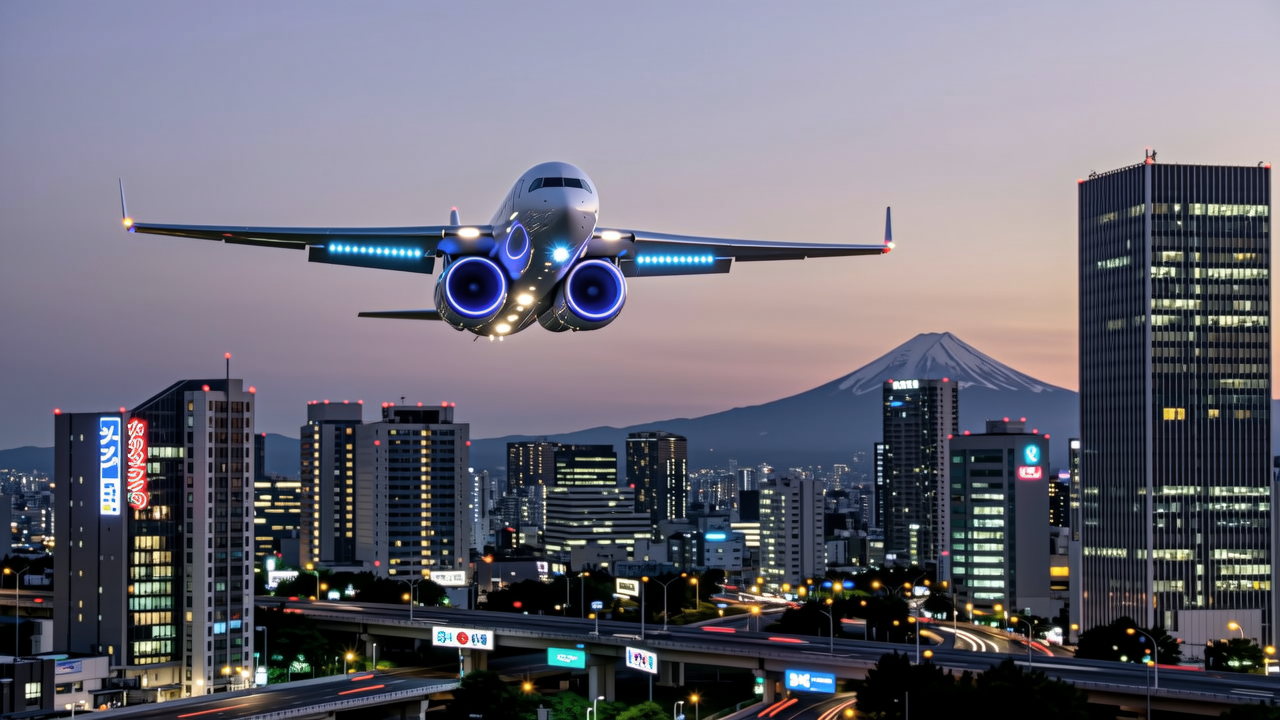
TOKYO — In a remarkable development for the global transportation and technology sectors, Japan officially launched a detailed action plan today to implement the world's first commercial flying train network. This mega-project, fully supported by the federal government and local automotive and aerospace giants, is expected to start trial operations as early as next year.
This bold step is no longer a science fiction fantasy, but a reality being carefully built in research centers across Japan. According to Japan's Ministry of Economy, Trade and Industry (METI), the initiative named "SkyDrive Mobility" will focus on the use of electric unmanned aerial vehicles (UAVs) that can safely, quickly, and efficiently transport passengers from one location to another. These vehicles, technically known as eVTOL (electric vertical takeoff and landing), are designed specifically to reduce carbon emissions and noise pollution, aligning with Japan's environmental sustainability goals.
"We are at the threshold of a transportation revolution that will change the way humans interact with urban and rural spaces," said Kenjiro Kanamori, one of the main engineers of the project. He added that the initial phase of operations will focus on major cities such as Tokyo and Osaka, where traffic congestion often becomes a major obstacle to economic productivity. By providing alternative air routes, travel times that take hours can be reduced to just a few minutes.
However, the launch of this advanced technology is not without various technical and legal challenges. Safety aspects are the top priority. The Japanese government is drafting a comprehensive set of new aviation regulations to coordinate the traffic of these high-speed vehicles in already crowded airspace. This includes the development of an advanced artificial intelligence (AI)-based air traffic control system, capable of automatically avoiding collisions and planning the most optimal routes in real time. In addition, infrastructure such as "vertiports" - special terminals for eVTOL takeoff and landing - are being actively built on top of skyscrapers and major railway stations.
For the general public, the prospect of riding a flying train opens up new possibilities. It is not only seen as a luxury transportation mode for corporate groups, but the government plans to provide subsidies in the initial phase to ensure that this service is accessible to all social strata. Economists predict that this air mobility industry will contribute billions of dollars to Japan's GDP in the coming decade. The world is now looking towards the "Land of the Rising Sun" to see whether this dream of commercial air movement can truly become the backbone of future transportation.
Revolution in Smart Transportation: Japan Launches the World's First Commercial Flying Train Network. Japan is leading the world with the introduction of a commercial flying train network, which promises to solve urban traffic congestion problems and transform the public transportation sector as a new decade approaches.. TOKYO — In a remarkable development for the global transportation and technology sectors, Japan officially launched a detailed action plan today to implement the world's first commercial flying train network. This mega-project, fully supported by the federal government and local automotive and aerospace giants, is expected to start trial operations as early as next year.
This bold step is no longer a science fiction fantasy, but a reality being carefully built in research centers across Japan. According to Japan's Ministry of Economy, Trade and Industry METI , the initiative named "SkyDrive Mobility" will focus on the use of electric unmanned aerial vehicles UAVs that can safely, quickly, and efficiently transport passengers from one location to another. These vehicles, technically known as eVTOL electric vertical takeoff and landing , are designed specifically to reduce carbon emissions and noise pollution, aligning with Japan's environmental sustainability goals.
"We are at the threshold of a transportation revolution that will change the way humans interact with urban and rural spaces," said Kenjiro Kanamori, one of the main engineers of the project. He added that the initial phase of operations will focus on major cities such as Tokyo and Osaka, where traffic congestion often becomes a major obstacle to economic productivity. By providing alternative air routes, travel times that take hours can be reduced to just a few minutes.
However, the launch of this advanced technology is not without various technical and legal challenges. Safety aspects are the top priority. The Japanese government is drafting a comprehensive set of new aviation regulations to coordinate the traffic of these high-speed vehicles in already crowded airspace. This includes the development of an advanced artificial intelligence AI -based air traffic control system, capable of automatically avoiding collisions and planning the most optimal routes in real time. In addition, infrastructure such as "vertiports" - special terminals for eVTOL takeoff and landing - are being actively built on top of skyscrapers and major railway stations.
For the general public, the prospect of riding a flying train opens up new possibilities. It is not only seen as a luxury transportation mode for corporate groups, but the government plans to provide subsidies in the initial phase to ensure that this service is accessible to all social strata. Economists predict that this air mobility industry will contribute billions of dollars to Japan's GDP in the coming decade. The world is now looking towards the "Land of the Rising Sun" to see whether this dream of commercial air movement can truly become the backbone of future transportation.