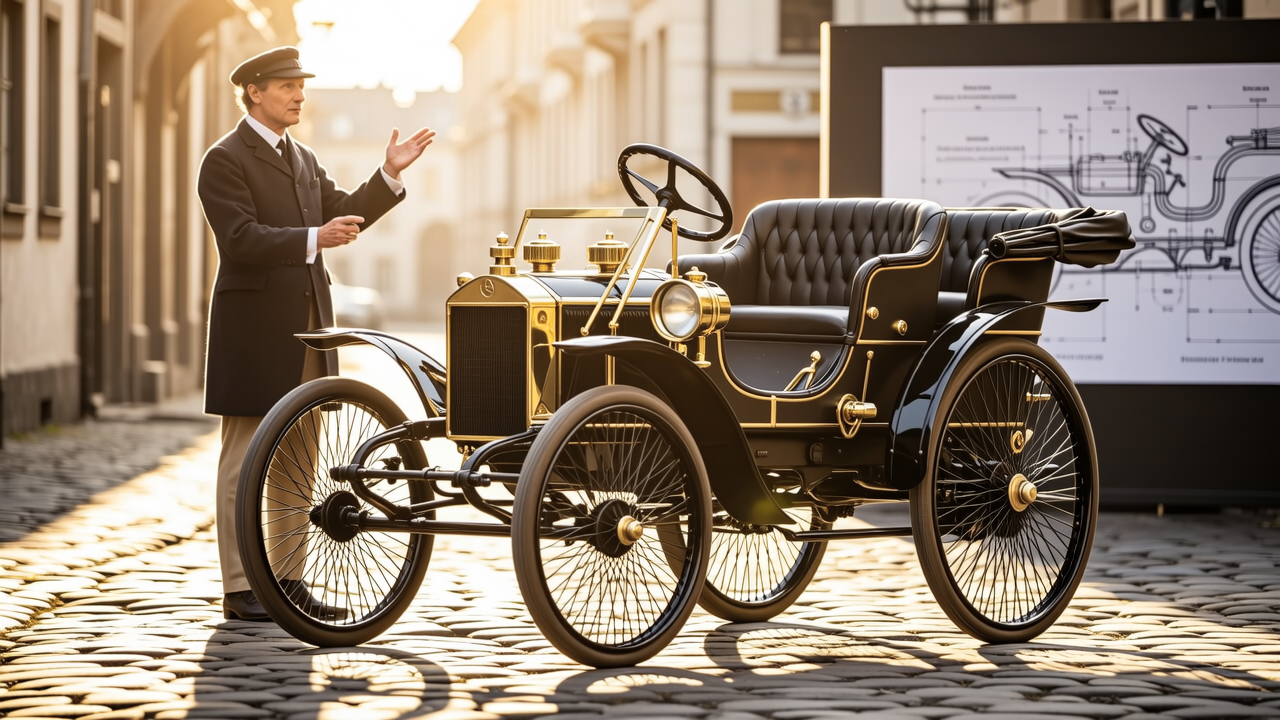
Have you ever wondered what the first lorry to roam the roads looked like and how it functioned? Imagine an era where large-scale goods transportation was entirely dependent on animal strength or human power. Then, in 1896, a German engineering genius came up with a creation that would revolutionize global logistics. Karl Benz, a name synonymous with the beginning of the automotive industry, was not only the inventor of the first motorcar but also the individual behind the world's first powered lorry. His grand creation, known as the 'Motor-Lastwagen' or 'Bermotorwagen', opened a new chapter in the history of commercial transportation. Let's dive into five interesting facts about how a simple innovation at the end of the 19th century gave birth to the transportation giants we know today.
1. The Birth of a Revolution: 1896
The beginning of the modern commercial transportation era started in
1896, when Karl Benz, who had previously introduced the Benz Patent-Motorwagen in 1886, shifted his focus to the need for transporting goods. He saw great potential in applying internal combustion engine technology to larger, more powerful vehicles. This year marked the introduction of Benz's first lorry prototype, signaling a paradigm shift from traditional transportation that had been in place for centuries. It was not just a vehicle, but a vision of the future that drove economies and industries.
This creation was not a simple adaptation; Benz took the time to redesign key components to accommodate heavier loads. With the emergence of the 'Motor-Lastwagen', it offered a much more efficient and faster solution compared to horse-drawn carriages. This opened new opportunities for businesses, enabling the distribution of goods over longer distances in shorter periods, thus significantly stimulating economic and trade growth across Europe and beyond.
2. Power Behind the Wheels: The 'Kontra-Motor' Engine
Benz's first lorry was powered by a two-cylinder internal combustion engine, known as the
'Kontra-Motor'. Initially, the engine produced about 2.5 horsepower (hp), which may seem small by today's standards but was revolutionary at the time. The power was later increased to 5 hp, giving the lorry the capability to carry more substantial loads. The Kontra-Motor engine was specifically designed to be placed horizontally at the rear of the vehicle, a configuration that allowed for better weight distribution and easier power transmission.
The power transmission system to the rear wheels used a belt drive, a technology common in the early automotive era. Although this system was somewhat primitive compared to modern transmissions, it proved effective at the time for moving the lorry with heavy loads. The use of a powered engine was evidence of Benz's expertise in engineering, and it became the basis for the development of more powerful lorry engines in the future.
3. Designed for Load: Capacity and Structure
The primary function of a lorry is to transport loads, and Benz's 'Motor-Lastwagen' was designed with an impressive capacity for its time. The early model could carry a load of around
1.5 metric tons. To accommodate this weight, Benz equipped the lorry with solid rubber tires that were durable. Although these tires offered little driving comfort, they were highly suitable for carrying heavy loads without the risk of punctures, a critical advantage for commercial vehicles.
Additionally, the lorry featured a specially designed spring suspension system to support the chassis and the robust cargo platform. The overall structure of the vehicle reflected Benz's focus on durability and hard work, far different from the design of lighter passenger vehicles. Every component, from the chassis to the cargo area, was built with the needs of heavy transportation in mind, making it a pioneer in functional lorry design.
4. The First Customer: A British Brewery
Interestingly, the first buyer of Benz's lorry was not from Germany, but a British brewery,
Brewery L. & J. Hirsch from Rhoades. This showed that the potential of the lorry as a commercial transportation tool was quickly recognized internationally. The brewery clearly saw the value in the lorry's ability to deliver their beer barrels more efficiently and quickly to pubs and customers.
This purchase not only marked the first commercial success for Benz's lorry but also proved the global appeal of automotive innovation. It showed how new technology knows no borders and how business needs constantly seek better methods to operate. The story of the first buyer also underscored the role of lorries as the backbone of industrial logistics, even in other countries.
5. A Lasting Legacy: From 'Bermotorwagen' to Modern Lorries
From a simple prototype in 1896, Karl Benz's 'Motor-Lastwagen' has sparked a continuous evolution that has brought us to the high-tech lorries of today. Every lorry we see on the road — from light pickup trucks to large trailers transporting containers across continents — has its roots in the basic design and concept introduced by Benz.
The legacy of Benz's first lorry goes beyond the vehicle itself. It symbolizes the beginning of an era where goods transportation became faster, more efficient, and capable of supporting massive growth in global industry and trade. Without Karl Benz's vision and innovation, the world of logistics and supply chains would not be what we know today, continually driving progress and connecting the world through roads.
---
Reference: Lorry — Wikipedia
Revisiting 'Motorwagen': The Inspiring Story of the World's First Lorry Invented by Karl Benz. Before modern commercial vehicles filled the roads, the world witnessed the emergence of the first lorry in 1896, thanks to Karl Benz's innovation, a creation that drastically changed the landscape of goods transportation..
Have you ever wondered what the first lorry to roam the roads looked like and how it functioned? Imagine an era where large-scale goods transportation was entirely dependent on animal strength or human power. Then, in 1896, a German engineering genius came up with a creation that would revolutionize global logistics. Karl Benz, a name synonymous with the beginning of the automotive industry, was not only the inventor of the first motorcar but also the individual behind the world's first powered lorry. His grand creation, known as the 'Motor-Lastwagen' or 'Bermotorwagen', opened a new chapter in the history of commercial transportation. Let's dive into five interesting facts about how a simple innovation at the end of the 19th century gave birth to the transportation giants we know today.
1. The Birth of a Revolution: 1896
The beginning of the modern commercial transportation era started in 1896 , when Karl Benz, who had previously introduced the Benz Patent-Motorwagen in 1886, shifted his focus to the need for transporting goods. He saw great potential in applying internal combustion engine technology to larger, more powerful vehicles. This year marked the introduction of Benz's first lorry prototype, signaling a paradigm shift from traditional transportation that had been in place for centuries. It was not just a vehicle, but a vision of the future that drove economies and industries.
This creation was not a simple adaptation; Benz took the time to redesign key components to accommodate heavier loads. With the emergence of the 'Motor-Lastwagen', it offered a much more efficient and faster solution compared to horse-drawn carriages. This opened new opportunities for businesses, enabling the distribution of goods over longer distances in shorter periods, thus significantly stimulating economic and trade growth across Europe and beyond.
2. Power Behind the Wheels: The 'Kontra-Motor' Engine
Benz's first lorry was powered by a two-cylinder internal combustion engine, known as the 'Kontra-Motor' . Initially, the engine produced about 2.5 horsepower hp , which may seem small by today's standards but was revolutionary at the time. The power was later increased to 5 hp, giving the lorry the capability to carry more substantial loads. The Kontra-Motor engine was specifically designed to be placed horizontally at the rear of the vehicle, a configuration that allowed for better weight distribution and easier power transmission.
The power transmission system to the rear wheels used a belt drive, a technology common in the early automotive era. Although this system was somewhat primitive compared to modern transmissions, it proved effective at the time for moving the lorry with heavy loads. The use of a powered engine was evidence of Benz's expertise in engineering, and it became the basis for the development of more powerful lorry engines in the future.
3. Designed for Load: Capacity and Structure
The primary function of a lorry is to transport loads, and Benz's 'Motor-Lastwagen' was designed with an impressive capacity for its time. The early model could carry a load of around 1.5 metric tons . To accommodate this weight, Benz equipped the lorry with solid rubber tires that were durable. Although these tires offered little driving comfort, they were highly suitable for carrying heavy loads without the risk of punctures, a critical advantage for commercial vehicles.
Additionally, the lorry featured a specially designed spring suspension system to support the chassis and the robust cargo platform. The overall structure of the vehicle reflected Benz's focus on durability and hard work, far different from the design of lighter passenger vehicles. Every component, from the chassis to the cargo area, was built with the needs of heavy transportation in mind, making it a pioneer in functional lorry design.
4. The First Customer: A British Brewery
Interestingly, the first buyer of Benz's lorry was not from Germany, but a British brewery, Brewery L. & J. Hirsch from Rhoades . This showed that the potential of the lorry as a commercial transportation tool was quickly recognized internationally. The brewery clearly saw the value in the lorry's ability to deliver their beer barrels more efficiently and quickly to pubs and customers.
This purchase not only marked the first commercial success for Benz's lorry but also proved the global appeal of automotive innovation. It showed how new technology knows no borders and how business needs constantly seek better methods to operate. The story of the first buyer also underscored the role of lorries as the backbone of industrial logistics, even in other countries.
5. A Lasting Legacy: From 'Bermotorwagen' to Modern Lorries
From a simple prototype in 1896, Karl Benz's 'Motor-Lastwagen' has sparked a continuous evolution that has brought us to the high-tech lorries of today. Every lorry we see on the road — from light pickup trucks to large trailers transporting containers across continents — has its roots in the basic design and concept introduced by Benz.
The legacy of Benz's first lorry goes beyond the vehicle itself. It symbolizes the beginning of an era where goods transportation became faster, more efficient, and capable of supporting massive growth in global industry and trade. Without Karl Benz's vision and innovation, the world of logistics and supply chains would not be what we know today, continually driving progress and connecting the world through roads.
---
Reference: Lorry — Wikipedia https://en.wikipedia.org/wiki/Lorry