Shadows Dancing on the Horizon
You sit in a park at dusk. In front of you, a bird perches on a branch—its wings blue under the orange light. Your eyes are fixed on its sharp beak. However, as your focus remains steady, something strange happens: the background—leaves, grass, even the sky—starts to fade, as if the world around the bird is being sucked into emptiness. You rub your eyes, and everything returns to normal. What just happened? That is Troxler's fading, an illusion that questions the boundary between vision and the creation of the brain.
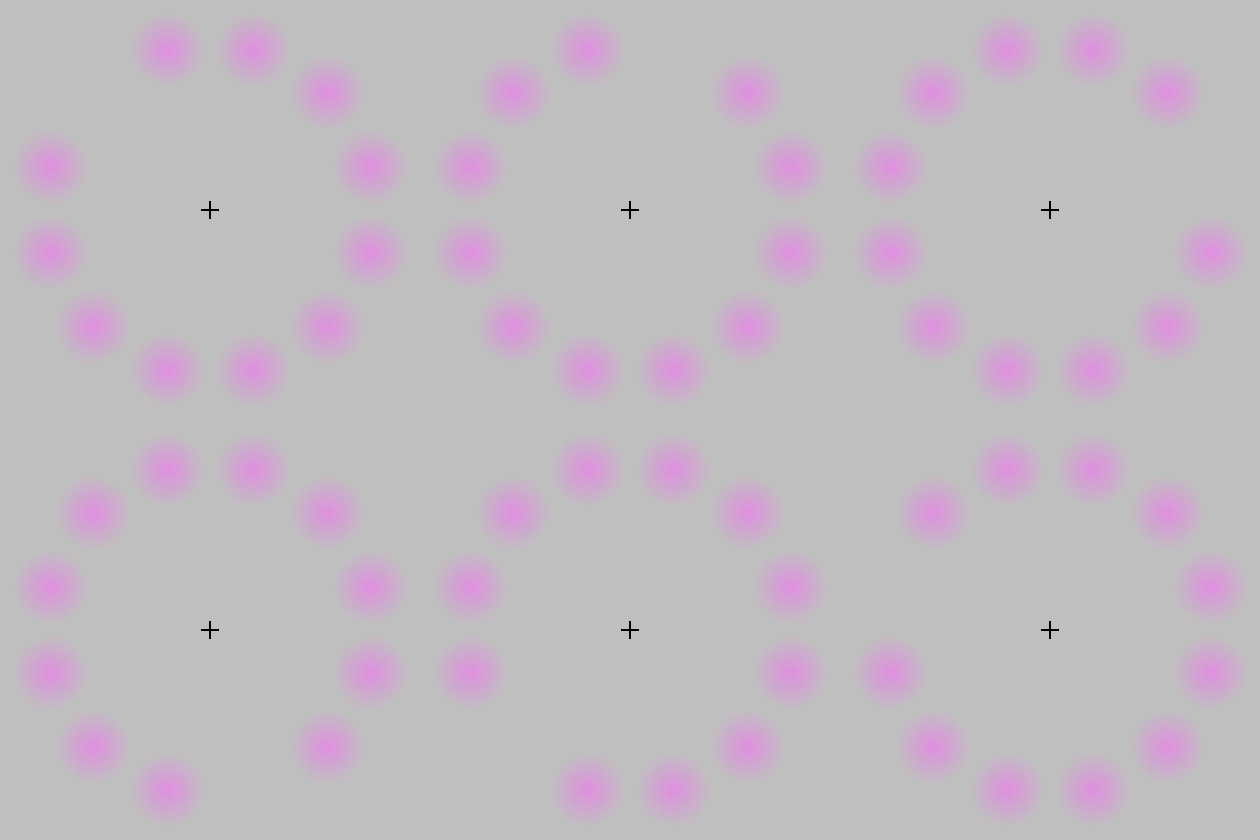
This phenomenon was first recorded by Swiss medical expert Ignaz Paul Vital Troxler in 1804. In his experiments, he found that when a person stares at a single point without moving, unchanging visual stimuli around it will disappear within a few seconds. Not because the eyes are tired, but because the brain—surprisingly efficiently—decides to 'turn off' signals considered unimportant.
Why Does Our Brain 'Turn Off' Reality?
Troxler's fading is not just a weakness of the eyes, but a miracle of evolution. Our brain is designed to detect change—not stability. When you stare at a single point, the neurons in the retina that detect edges, movement, and contrast start to 'get tired' due to repeated stimulation. These signals are sent to the visual cortex, but without new changes, the brain considers the information as 'background noise' that can be ignored. The result is that stationary objects at the edge of your vision disappear—like mist swallowed by the sun.
Research using fMRI has found that the part of the brain processing vision—the primary visual cortex—remains active, but higher areas, such as the parietal cortex, reduce their response to unchanging stimuli. This proves that Troxler's fading is an active process, not just a 'nerve numbness.' Our brain consciously chooses not to see what is unnecessary.
A Simple Experiment That Challenges Perception
If you want to test it yourself, try this: place your index finger about 30 cm from your nose. Stare at the tip of your finger without blinking for 15-20 seconds. Do not shift your gaze. Slowly, watch what happens around your finger—walls, books, or lights—start to blur and disappear. When you shift your gaze, everything returns immediately. This is Troxler's fading in its purest form.
This experiment shows how fragile our perception is. Imagine if you stared at someone's face for too long—perhaps their nose or forehead would disappear for a moment. Or on the road, a stationary traffic light might fade if you focus too much on one point. This is why drivers are advised to move their eyes periodically—to avoid 'temporary blindness' caused by this illusion.
From Philosophy to Neuroscience: Meaning Behind the Illusion
Troxler's fading is not just a trick of the eye; it raises deep philosophical questions. If the brain can 'erase' reality simply because it is static, how far can we trust our vision? Philosophers like Immanuel Kant might see this as evidence that the world we experience is a creation of the mind—not an exact copy of reality. In neuroscience, this illusion becomes a tool to understand how the brain prioritizes information and discards 'visual noise'.
Dr. David Eagleman, a renowned neuroscientist, explains that Troxler's fading is an example of 'perceptual filtering'—the brain's ability to filter out inputs that do not bring new information. This is the same mechanism that causes us to not notice the sound of a clock or the smell of our own room. However, if the stimulus suddenly changes—like a clock stopping ticking—the brain immediately warns us. In the context of Troxler, the fading objects are like 'white noise' visual that is ignored.
The Wonder Behind Neuronal Laziness
At the cellular level, Troxler's fading is rooted in 'neural adaptation'. Neurons in the retina—especially ganglion and amacrine cells—reduce signal transmission when stimuli are repeated. This is a natural response to save energy; the brain prefers to process change rather than stability. However, interestingly, this effect is not uniform across the visual field. Objects at the periphery of vision fade faster than those in the center due to different densities of cone and rod cells. This explains why ghosts or shadows often 'disappear' when we stare at them—not because they don't exist, but because our brain is 'tired' of seeing them.
Dancing with Reality: Applications in Everyday Life
Troxler's fading is not just a laboratory illusion; it affects how we interact with the world. Graphic designers use this principle to create logos or images that 'move' optically. Street illusion artists often take advantage of it to make murals appear alive. Even in the world of virtual reality, understanding Troxler's fading helps programmers reduce user discomfort by ensuring visual stimuli are always changing.
However, there is a dark side: in dangerous situations, such as driving at night, focusing too strongly on a single point—such as a vehicle's headlight in front of you—can cause other objects like pedestrians to disappear from view. This is the risk of 'tunnel vision' intensified by Troxler's fading. Fortunately, with awareness, we can counter it: move your eyes periodically, blink frequently, or change focus to ensure the brain continues to 'activate' the world around us.
Conclusion: Reflections at the Edge of Nothingness
Troxler's fading is a call to reflect on how fragile the connection between the mind and reality is. In a world full of stimuli, our brain is like a curator who chooses what should be seen—and what should be forgotten. When you next look at a star or a campfire, remember that in the periphery of your vision, reality may be fading. Perhaps, in the silence of focus, we learn a truth: to truly see, we must be willing to lose for a moment.
Reference: Troxler's fading — Wikipedia
Your View at This Point Erases Everything Around — The Mystery of Troxler's Fading. Have you ever stared at a single point and felt the entire world around you slowly disappear? That is Troxler's Fading, an optical illusion that changes the way we see reality. This article explores the phenomenon that proves your brain can trick your eyes—without any magic.. Shadows Dancing on the Horizon
You sit in a park at dusk. In front of you, a bird perches on a branch—its wings blue under the orange light. Your eyes are fixed on its sharp beak. However, as your focus remains steady, something strange happens: the background—leaves, grass, even the sky—starts to fade, as if the world around the bird is being sucked into emptiness. You rub your eyes, and everything returns to normal. What just happened? That is Troxler's fading, an illusion that questions the boundary between vision and the creation of the brain.
This phenomenon was first recorded by Swiss medical expert Ignaz Paul Vital Troxler in 1804. In his experiments, he found that when a person stares at a single point without moving, unchanging visual stimuli around it will disappear within a few seconds. Not because the eyes are tired, but because the brain—surprisingly efficiently—decides to 'turn off' signals considered unimportant.
Why Does Our Brain 'Turn Off' Reality?
Troxler's fading is not just a weakness of the eyes, but a miracle of evolution. Our brain is designed to detect change—not stability. When you stare at a single point, the neurons in the retina that detect edges, movement, and contrast start to 'get tired' due to repeated stimulation. These signals are sent to the visual cortex, but without new changes, the brain considers the information as 'background noise' that can be ignored. The result is that stationary objects at the edge of your vision disappear—like mist swallowed by the sun.
Research using fMRI has found that the part of the brain processing vision—the primary visual cortex—remains active, but higher areas, such as the parietal cortex, reduce their response to unchanging stimuli. This proves that Troxler's fading is an active process, not just a 'nerve numbness.' Our brain consciously chooses not to see what is unnecessary.
A Simple Experiment That Challenges Perception
If you want to test it yourself, try this: place your index finger about 30 cm from your nose. Stare at the tip of your finger without blinking for 15-20 seconds. Do not shift your gaze. Slowly, watch what happens around your finger—walls, books, or lights—start to blur and disappear. When you shift your gaze, everything returns immediately. This is Troxler's fading in its purest form.
This experiment shows how fragile our perception is. Imagine if you stared at someone's face for too long—perhaps their nose or forehead would disappear for a moment. Or on the road, a stationary traffic light might fade if you focus too much on one point. This is why drivers are advised to move their eyes periodically—to avoid 'temporary blindness' caused by this illusion.
From Philosophy to Neuroscience: Meaning Behind the Illusion
Troxler's fading is not just a trick of the eye; it raises deep philosophical questions. If the brain can 'erase' reality simply because it is static, how far can we trust our vision? Philosophers like Immanuel Kant might see this as evidence that the world we experience is a creation of the mind—not an exact copy of reality. In neuroscience, this illusion becomes a tool to understand how the brain prioritizes information and discards 'visual noise'.
Dr. David Eagleman, a renowned neuroscientist, explains that Troxler's fading is an example of 'perceptual filtering'—the brain's ability to filter out inputs that do not bring new information. This is the same mechanism that causes us to not notice the sound of a clock or the smell of our own room. However, if the stimulus suddenly changes—like a clock stopping ticking—the brain immediately warns us. In the context of Troxler, the fading objects are like 'white noise' visual that is ignored.
The Wonder Behind Neuronal Laziness
At the cellular level, Troxler's fading is rooted in 'neural adaptation'. Neurons in the retina—especially ganglion and amacrine cells—reduce signal transmission when stimuli are repeated. This is a natural response to save energy; the brain prefers to process change rather than stability. However, interestingly, this effect is not uniform across the visual field. Objects at the periphery of vision fade faster than those in the center due to different densities of cone and rod cells. This explains why ghosts or shadows often 'disappear' when we stare at them—not because they don't exist, but because our brain is 'tired' of seeing them.
Dancing with Reality: Applications in Everyday Life
Troxler's fading is not just a laboratory illusion; it affects how we interact with the world. Graphic designers use this principle to create logos or images that 'move' optically. Street illusion artists often take advantage of it to make murals appear alive. Even in the world of virtual reality, understanding Troxler's fading helps programmers reduce user discomfort by ensuring visual stimuli are always changing.
However, there is a dark side: in dangerous situations, such as driving at night, focusing too strongly on a single point—such as a vehicle's headlight in front of you—can cause other objects like pedestrians to disappear from view. This is the risk of 'tunnel vision' intensified by Troxler's fading. Fortunately, with awareness, we can counter it: move your eyes periodically, blink frequently, or change focus to ensure the brain continues to 'activate' the world around us.
Conclusion: Reflections at the Edge of Nothingness
Troxler's fading is a call to reflect on how fragile the connection between the mind and reality is. In a world full of stimuli, our brain is like a curator who chooses what should be seen—and what should be forgotten. When you next look at a star or a campfire, remember that in the periphery of your vision, reality may be fading. Perhaps, in the silence of focus, we learn a truth: to truly see, we must be willing to lose for a moment.
Reference: Troxler's fading — Wikipedia https://en.wikipedia.org/wiki/Troxler's fading