A Confounding Discovery in the Dry Valleys
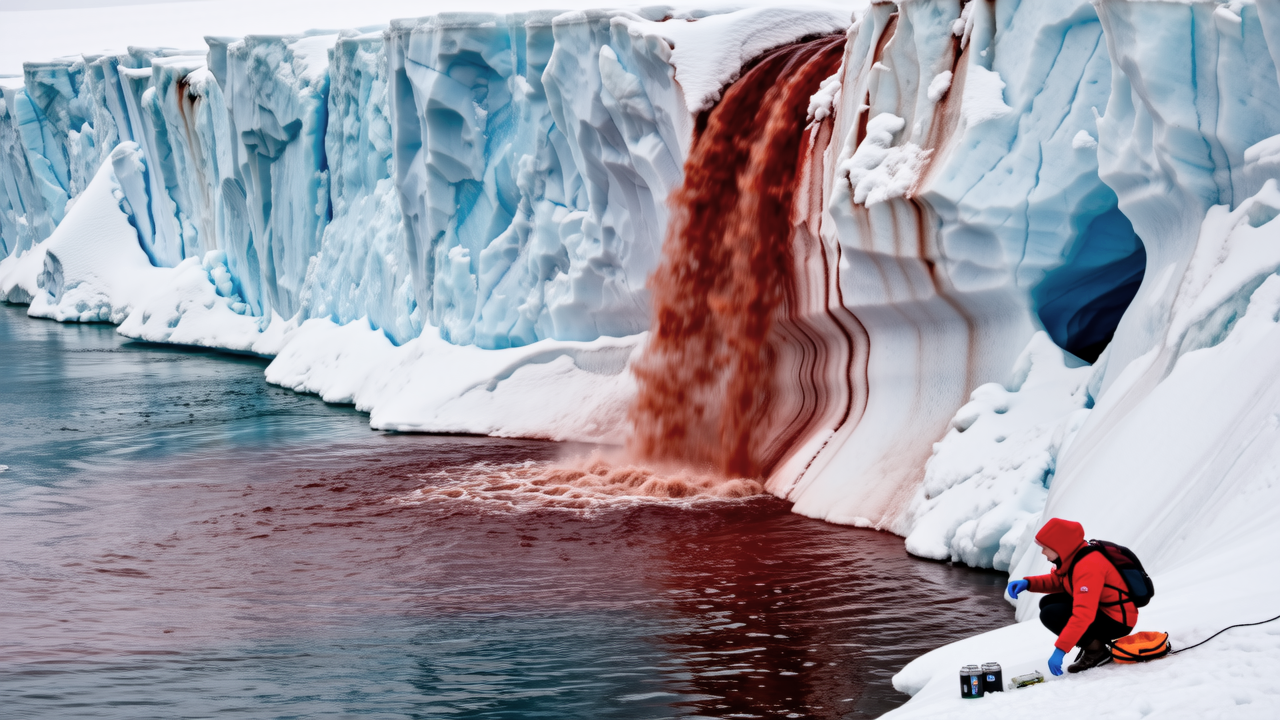
In eastern Antarctica, in a snowless and nearly moistureless area — the McMurdo Dry Valleys — a thick red flow emerges from the side of the Taylor Glacier. It is not blood, but it looks like fresh blood flowing down through thick layers of ice, staining the white surface with contrasting red streaks. This phenomenon was first recorded in 1911 by geologist Thomas Griffith Taylor, a member of Robert Falcon Scott's expedition. He suspected the presence of red algae, but early tests did not show chlorophyll. For more than a century, the color remained a mystery: how could something flow as liquid under -50°C temperatures? And why did it never freeze?
Chemistry Beneath the Ice: Ancient Saline Water Rusting
The answer emerged in 2014, when a team of researchers from the University of Alaska Fairbanks, led by Erin Pettit, used magnetic resonance imaging (MRI) to map the internal structure of the glacier without drilling. They confirmed the existence of a highly concentrated saltwater reservoir (brine) beneath the glacier — trapped since about
1.5 million years ago, when the valley was still covered by the sea.
This water is rich in dissolved iron. When it seeps to the surface through geological cracks and comes into contact with air, the iron reacts with oxygen, forming iron(III) oxide — rust — which gives the deep red color. The freezing point of this saltwater is much lower than that of freshwater, explaining its continued flow even in extreme temperatures. High levels of sulfur and other minerals also make it a unique chemical solution on Earth.
Microbes That Defy the Definition of Life
Even more surprising: this saltwater is not dead. Samples taken from the subglacial system contain living microbial communities — bacteria and archaea — that have been isolated from the outside world for millions of years. These organisms do not use oxygen or sunlight. Instead, they perform anaerobic respiration with sulfate as an electron acceptor, breaking down ancient organic material and generating energy autonomously.
This is not just resilient life; this is life that is completely dependent on geochemical processes — a form of metabolism that may have once dominated Earth before photosynthesis evolved.
A Real-World Analogy for Space
The environment beneath the Taylor Glacier has strong parallels with other places in the solar system. Beneath the surface of Jupiter's moon Europa, there are liquid water oceans heated by tidal friction — and possibly rich in salts and minerals from the rocky seabed. On Mars, NASA rovers have detected former water channels and iron oxide minerals (like hematite). If life can survive beneath Antarctic ice without light, without oxygen, and relying only on chemical energy, then the possibility of microbial life on Europa or beneath the Martian surface becomes much more plausible.
More Questions Than Answers
Solving the mystery of Blood Falls does not close the questions — it opens the door to even bigger ones. How do these microbes maintain genetic integrity for millions of years without genetic exchange? What are their DNA repair mechanisms? Is this community static — or still evolving slowly? And if this system operates beneath the Antarctic ice today, how many more 'hidden ecosystems' remain undiscovered beneath the global ice layers or under the ocean floor?
According to the research team's report, these findings confirm that the limits of life on Earth are far broader than previously expected — and that life does not require 'ideal' conditions, but only a stable source of chemical energy and a long-lasting liquid medium.
Not Just a Natural Wonder — But a Mirror of Possibilities
Blood Falls is not just an unusual color cascade. It is physical evidence that life can take root in absolute darkness, in geological isolation, and in the absence of elements we consider fundamental: oxygen, light, even fresh water. It reminds us that the definition of 'life can exist' must be rewritten — not based on what we know, but based on what truly exists.
And when the Europa Clipper mission is launched or Mars drill probes begin boring into subsurface layers, scientists will not be looking for 'Earth-like creatures'. They will be searching for signs of the same processes: reduced sulfate, unbalanced iron oxides, or chemical signals indicating anaerobic metabolism. It is there, perhaps, that we will hear the first whispers of life beyond Earth — not in the form of creatures, but in the form of undeniable chemical reactions.
Antarctic Blood Falls: A Century-Old Mystery Solved, Life Without Light Discovered. Blood Falls in the McMurdo Dry Valleys, Antarctica — a thick red saltwater flow from beneath the Taylor Glacier — was first seen in 1911. A full scientific explanation emerged in 2014: the color comes from iron oxidation in ancient saline water over 1.5 million years old; within it, anaerobic microorganisms live without light or oxygen, offering new insights for astrobiology on Mars and Europa.. A Confounding Discovery in the Dry Valleys
In eastern Antarctica, in a snowless and nearly moistureless area — the McMurdo Dry Valleys — a thick red flow emerges from the side of the Taylor Glacier. It is not blood, but it looks like fresh blood flowing down through thick layers of ice, staining the white surface with contrasting red streaks. This phenomenon was first recorded in 1911 by geologist Thomas Griffith Taylor, a member of Robert Falcon Scott's expedition. He suspected the presence of red algae, but early tests did not show chlorophyll. For more than a century, the color remained a mystery: how could something flow as liquid under -50°C temperatures? And why did it never freeze?
Chemistry Beneath the Ice: Ancient Saline Water Rusting
The answer emerged in 2014, when a team of researchers from the University of Alaska Fairbanks, led by Erin Pettit, used magnetic resonance imaging MRI to map the internal structure of the glacier without drilling. They confirmed the existence of a highly concentrated saltwater reservoir brine beneath the glacier — trapped since about 1.5 million years ago , when the valley was still covered by the sea.
This water is rich in dissolved iron. When it seeps to the surface through geological cracks and comes into contact with air, the iron reacts with oxygen, forming iron III oxide — rust — which gives the deep red color. The freezing point of this saltwater is much lower than that of freshwater, explaining its continued flow even in extreme temperatures. High levels of sulfur and other minerals also make it a unique chemical solution on Earth.
Microbes That Defy the Definition of Life
Even more surprising: this saltwater is not dead. Samples taken from the subglacial system contain living microbial communities — bacteria and archaea — that have been isolated from the outside world for millions of years. These organisms do not use oxygen or sunlight. Instead, they perform anaerobic respiration with sulfate as an electron acceptor, breaking down ancient organic material and generating energy autonomously.
This is not just resilient life; this is life that is completely dependent on geochemical processes — a form of metabolism that may have once dominated Earth before photosynthesis evolved.
A Real-World Analogy for Space
The environment beneath the Taylor Glacier has strong parallels with other places in the solar system. Beneath the surface of Jupiter's moon Europa, there are liquid water oceans heated by tidal friction — and possibly rich in salts and minerals from the rocky seabed. On Mars, NASA rovers have detected former water channels and iron oxide minerals like hematite . If life can survive beneath Antarctic ice without light, without oxygen, and relying only on chemical energy, then the possibility of microbial life on Europa or beneath the Martian surface becomes much more plausible.
More Questions Than Answers
Solving the mystery of Blood Falls does not close the questions — it opens the door to even bigger ones. How do these microbes maintain genetic integrity for millions of years without genetic exchange? What are their DNA repair mechanisms? Is this community static — or still evolving slowly? And if this system operates beneath the Antarctic ice today, how many more 'hidden ecosystems' remain undiscovered beneath the global ice layers or under the ocean floor?
According to the research team's report, these findings confirm that the limits of life on Earth are far broader than previously expected — and that life does not require 'ideal' conditions, but only a stable source of chemical energy and a long-lasting liquid medium.
Not Just a Natural Wonder — But a Mirror of Possibilities
Blood Falls is not just an unusual color cascade. It is physical evidence that life can take root in absolute darkness, in geological isolation, and in the absence of elements we consider fundamental: oxygen, light, even fresh water. It reminds us that the definition of 'life can exist' must be rewritten — not based on what we know, but based on what truly exists.
And when the Europa Clipper mission is launched or Mars drill probes begin boring into subsurface layers, scientists will not be looking for 'Earth-like creatures'. They will be searching for signs of the same processes: reduced sulfate, unbalanced iron oxides, or chemical signals indicating anaerobic metabolism. It is there, perhaps, that we will hear the first whispers of life beyond Earth — not in the form of creatures, but in the form of undeniable chemical reactions.