Misunderstood Clouds: Introduction
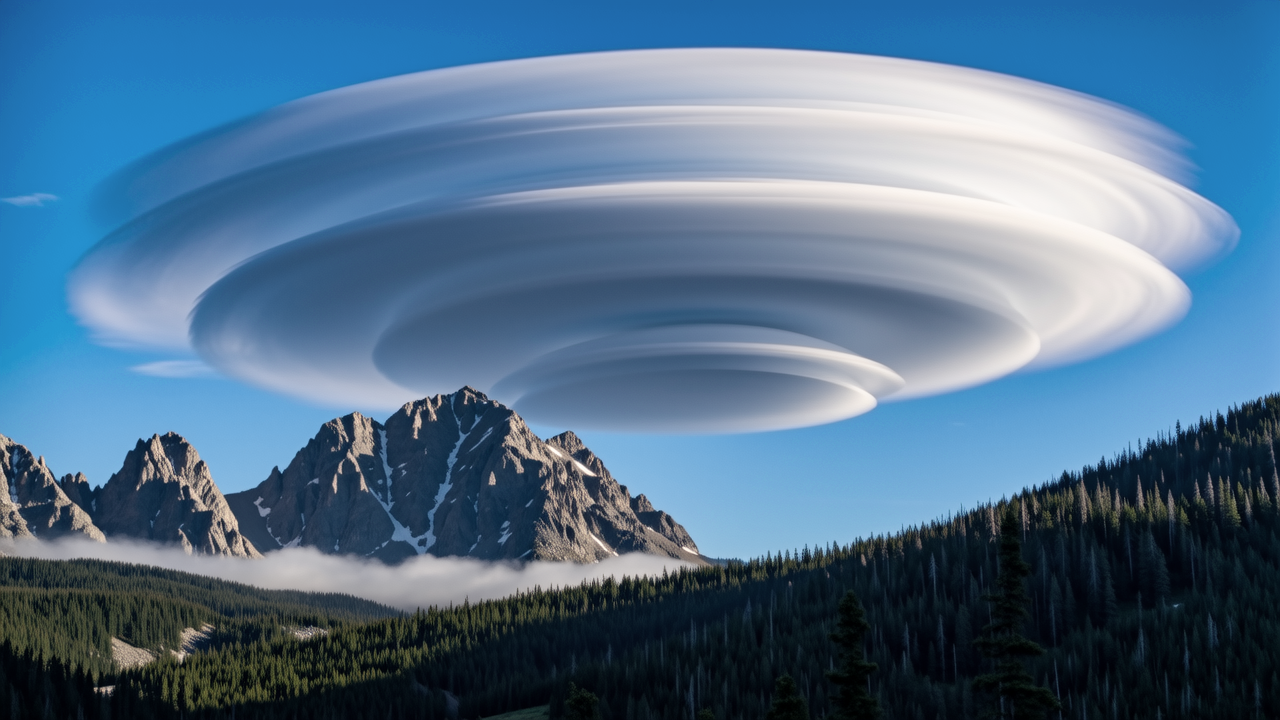
On a late afternoon at the base of Mount Rainier in Washington, a group of tourists was stunned. In the low sky, an orange, glossy oblate shape — smooth as glass, sharp-edged, and not trembling at all. A whisper, "UFO!" But the object did not move, did not blink, and finally disappeared slowly after 45 minutes. It was not a spacecraft. It was a lenticular cloud — an atmospheric phenomenon often misinterpreted, but rarely fully understood.
The uniqueness of these clouds is not only in their appearance. They remain still even when blown by strong winds. They seem to be created by an artist's hand, not by random physical processes. And although scientists have long identified their mechanisms, their presence always brings a sense of wonder — as if nature wants to remind us: what seems easily explained may not necessarily be easily predicted or fully mastered.
How Do Lenticular Clouds Form?
Lenticular clouds belong to the
Altocumulus lenticularis class. They are not ordinary clouds that move with wind currents. They are born from the interaction between moist air, topographic barriers, and dynamic waves in the atmosphere.
When strong winds pass through mountain ranges, the air is forced upward abruptly. The higher it goes, the lower the pressure and the colder the temperature — causing water vapor to reach its dew point and condense into microscopic droplets. However, this process does not stop there. The air that has risen will descend on the leeward side, then rise again, creating rhythmic air waves — known as mountain waves.
Lenticular clouds form at the peak of these waves. However, they appear static because water droplets continuously form at the front of the wave (where the air rises and cools), while at the back, the droplets evaporate again (where the air descends and warms). Thus, the cloud's shape remains — but its composition changes constantly. This is why it appears like a solid disc floating, not a moving cloud.
The occasional rainbow-like colors surrounding it — known as iridescence — are not caused by rain, but by the diffraction of light through uniformly sized water droplets or ice crystals, usually less than 0.05 mm. This condition occurs only when the atmosphere is stable and humidity is tightly controlled.
Variations and Common Locations
The shapes of lenticular clouds vary: some are flat like discs, some are convex like optical lenses, and some are stacked like pancakes — known as
stacked lenticulars. The rarest type is
Cirrocumulus lenticularis, which forms at high altitudes (above 6 km) and appears like a soft, glowing veil in the blue sky.
They are most commonly seen in high mountainous areas with consistent winds: the Andes in Chile and Argentina, the Himalayas in Nepal and Bhutan, the Rocky Mountains in the United States, and Mount Fuji in Japan. In Malaysia, formal observation records are very limited. However, informal reports from hikers and skywatchers in Kundasang, Sabah — the highest area in Borneo at over 1,800 meters — mention the appearance of clear lenticular cloud layers, especially during the northeast monsoon season when moist winds collide with the slopes of Mount Kinabalu.
Public and Scientific Reactions
In pop culture, lenticular clouds are often the culprits behind UFO sightings. Reports from organizations investigating unidentified aerial phenomena around the world show that up to 12% of early "unidentified floating objects" were eventually identified as lenticular clouds — especially when viewed from a distance, in low sunlight, or through camera lenses that magnify shape distortions.
However, in meteorology, they are not just visual beauties. They are practical indicators: the presence of lenticular clouds signals active mountain waves — which can produce severe turbulence at commercial flight altitudes. Pilots are trained to recognize them as an indirect warning that the air in the surrounding area is vertically unstable. Data from the US Federal Aviation Administration (FAA) shows that more than 30% of reported heavy turbulence incidents in mountainous regions are related to the presence of lenticular clouds or related cloud structures.
Lessons and Thought-Provoking Questions
Lenticular clouds teach two things at once: first, that scientific explanations do not diminish wonder — they deepen it. Second, that theoretical understanding is not the same as predictive power.
We know how they form, but it is still difficult to predict when and in what perfect shape they will appear. Why do some lenticular clouds remain stable for several hours, while others fade in five minutes? Why does iridescence only appear in 7% of recorded cases — and what role do local aerosols, inversion layer temperature, or precise cooling rates play in determining its occurrence?
These questions are not just technical. They touch on the reality that the atmospheric system is a complex one with many interrelated variables. Every lenticular cloud we see is a natural experiment — and each experiment tests the limits of our weather models.
Conclusion
Lenticular clouds are not just optical illusions or weather curiosities. They are proof that nature can create such orderly shapes without design, such stability without support, and such beauty without aesthetic intent.
They remind us to maintain a cautious attitude toward quick conclusions — and an open mind toward unanswered questions. The next time you see a smooth, round shape in the sky, don't immediately blame alien technology. It might just be air breathing through mountain gaps — and the Earth showing another of its secrets, quietly, without words.
Lenticular Clouds: Quiet and Mysterious Sky Discs. Lenticular clouds appear like natural flying saucers — smooth, oblate, and motionless — but they are the result of physical processes involving wind, mountains, and humidity. Although their formation is understood, the stability of their shape, the rarity of rainbow colors, and the inability to accurately predict their presence continue to raise deep questions about the limits of meteorological knowledge.. Misunderstood Clouds: Introduction
On a late afternoon at the base of Mount Rainier in Washington, a group of tourists was stunned. In the low sky, an orange, glossy oblate shape — smooth as glass, sharp-edged, and not trembling at all. A whisper, "UFO!" But the object did not move, did not blink, and finally disappeared slowly after 45 minutes. It was not a spacecraft. It was a lenticular cloud — an atmospheric phenomenon often misinterpreted, but rarely fully understood.
The uniqueness of these clouds is not only in their appearance. They remain still even when blown by strong winds. They seem to be created by an artist's hand, not by random physical processes. And although scientists have long identified their mechanisms, their presence always brings a sense of wonder — as if nature wants to remind us: what seems easily explained may not necessarily be easily predicted or fully mastered.
How Do Lenticular Clouds Form?
Lenticular clouds belong to the Altocumulus lenticularis class. They are not ordinary clouds that move with wind currents. They are born from the interaction between moist air, topographic barriers, and dynamic waves in the atmosphere.
When strong winds pass through mountain ranges, the air is forced upward abruptly. The higher it goes, the lower the pressure and the colder the temperature — causing water vapor to reach its dew point and condense into microscopic droplets. However, this process does not stop there. The air that has risen will descend on the leeward side, then rise again, creating rhythmic air waves — known as mountain waves .
Lenticular clouds form at the peak of these waves. However, they appear static because water droplets continuously form at the front of the wave where the air rises and cools , while at the back, the droplets evaporate again where the air descends and warms . Thus, the cloud's shape remains — but its composition changes constantly. This is why it appears like a solid disc floating, not a moving cloud.
The occasional rainbow-like colors surrounding it — known as iridescence — are not caused by rain, but by the diffraction of light through uniformly sized water droplets or ice crystals, usually less than 0.05 mm. This condition occurs only when the atmosphere is stable and humidity is tightly controlled.
Variations and Common Locations
The shapes of lenticular clouds vary: some are flat like discs, some are convex like optical lenses, and some are stacked like pancakes — known as stacked lenticulars . The rarest type is Cirrocumulus lenticularis , which forms at high altitudes above 6 km and appears like a soft, glowing veil in the blue sky.
They are most commonly seen in high mountainous areas with consistent winds: the Andes in Chile and Argentina, the Himalayas in Nepal and Bhutan, the Rocky Mountains in the United States, and Mount Fuji in Japan. In Malaysia, formal observation records are very limited. However, informal reports from hikers and skywatchers in Kundasang, Sabah — the highest area in Borneo at over 1,800 meters — mention the appearance of clear lenticular cloud layers, especially during the northeast monsoon season when moist winds collide with the slopes of Mount Kinabalu.
Public and Scientific Reactions
In pop culture, lenticular clouds are often the culprits behind UFO sightings. Reports from organizations investigating unidentified aerial phenomena around the world show that up to 12% of early "unidentified floating objects" were eventually identified as lenticular clouds — especially when viewed from a distance, in low sunlight, or through camera lenses that magnify shape distortions.
However, in meteorology, they are not just visual beauties. They are practical indicators: the presence of lenticular clouds signals active mountain waves — which can produce severe turbulence at commercial flight altitudes. Pilots are trained to recognize them as an indirect warning that the air in the surrounding area is vertically unstable. Data from the US Federal Aviation Administration FAA shows that more than 30% of reported heavy turbulence incidents in mountainous regions are related to the presence of lenticular clouds or related cloud structures.
Lessons and Thought-Provoking Questions
Lenticular clouds teach two things at once: first, that scientific explanations do not diminish wonder — they deepen it. Second, that theoretical understanding is not the same as predictive power.
We know how they form, but it is still difficult to predict when and in what perfect shape they will appear. Why do some lenticular clouds remain stable for several hours, while others fade in five minutes? Why does iridescence only appear in 7% of recorded cases — and what role do local aerosols, inversion layer temperature, or precise cooling rates play in determining its occurrence?
These questions are not just technical. They touch on the reality that the atmospheric system is a complex one with many interrelated variables. Every lenticular cloud we see is a natural experiment — and each experiment tests the limits of our weather models.
Conclusion
Lenticular clouds are not just optical illusions or weather curiosities. They are proof that nature can create such orderly shapes without design, such stability without support, and such beauty without aesthetic intent.
They remind us to maintain a cautious attitude toward quick conclusions — and an open mind toward unanswered questions. The next time you see a smooth, round shape in the sky, don't immediately blame alien technology. It might just be air breathing through mountain gaps — and the Earth showing another of its secrets, quietly, without words.