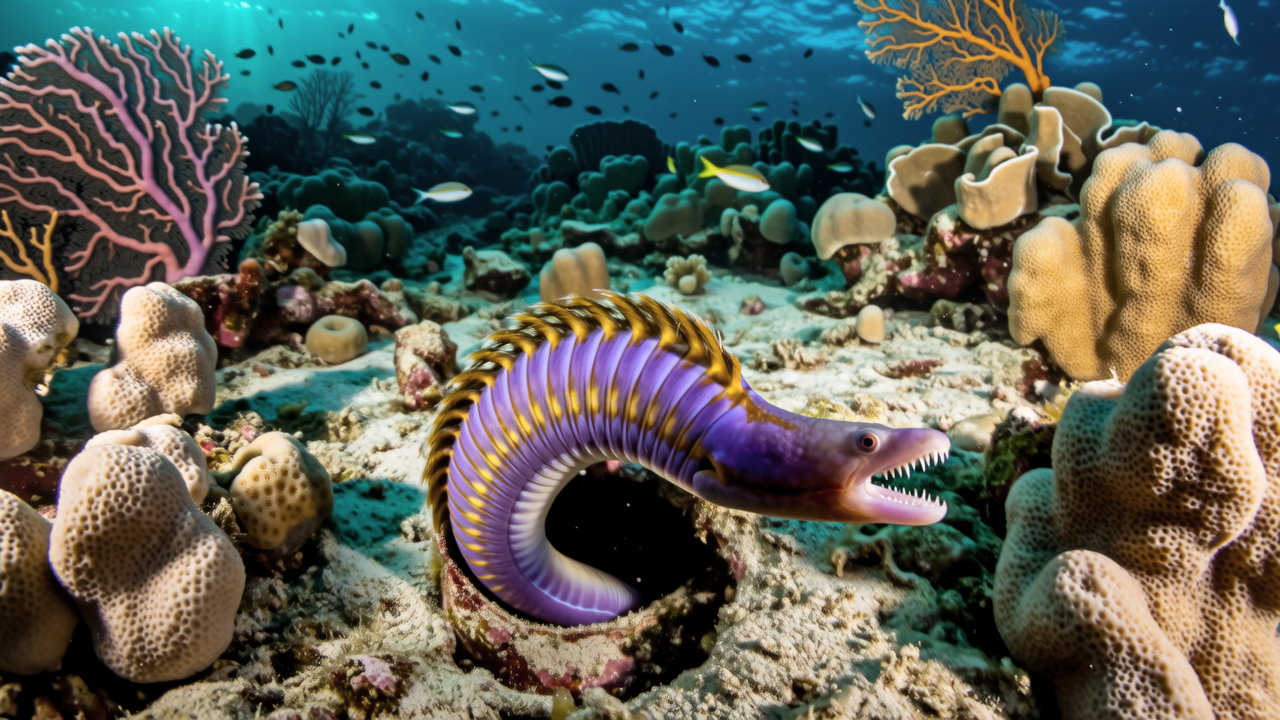
What Is a Bobbit Worm?
In the tropical sea floor — between coral reefs and the soft layers of the Western Pacific and Indian Oceans — lives a creature that appears ordinary from afar, yet contains rare biological excellence:
Eunice aphroditois, more commonly known as the Bobbit worm. It is not an ordinary worm. As a member of the Polychaeta class, it can reach lengths of up to three meters, with a thick body like an adult arm. Its name, taken from an incident in 1993, refers to the speed and precision of its attack — not to human aggression, but to a hunting mechanism that is so sudden and deadly.
Its body is equipped with unique structures: a rapidly extendable pharynx from the mouth, lined with sharp, saw-like teeth. These teeth are not just hard — they are composed of chitin enriched with zinc, making them among the most durable chewing structures among invertebrates. This worm does not swim actively. Instead, it digs a burrow in the sea floor, then embeds almost its entire body in the sand or mud, only revealing a pair of delicate antennae and a sensitive head end that detects vibrations. There, it waits — not passively, but in a state of full readiness.
A Unique Hunting Method
The Bobbit worm's attack is not just fast. It is an example of extraordinary biomechanical precision. When a small fish or crustacean swims within a few centimeters, the worm's antennae detect water flow disturbances. Within less than 0.1 seconds, the pharynx shoots out with enough force to break the prey's spine. Studies published in the
Journal of Zoology (2008) confirmed that these worms' teeth can penetrate fish skin and bones with efficiency rivaling some vertebrate predators.
Even more surprising: this worm often attacks prey larger than its own body diameter. Underwater footage shows fish twice the length of the worm being dragged into the burrow in an instant — often without time to react. Sand around the burrow erupts due to the sudden movement, leaving a bullet-hole-like impression on the sea floor.
Discoveries and Scientists' Reactions
Although this species was first described by a French naturalist at the end of the 19th century, a deep scientific understanding of its behavior only emerged in the past two decades. Marine expeditions in the waters of Sulawesi and the Sulu Sea in the early 2000s provided the first data on its hunting habits in its native habitat. However, the real breakthrough came when high-resolution cameras were able to capture the attack at high speed — footage that was later analyzed by biomechanics and neuroethology experts worldwide.
According to reports from researchers at the Scripps Institution of Oceanography, this strategy demonstrates a highly specialized evolutionary adaptation: a combination of subtle vibration perception, near-instant activation of pharyngeal muscles, and teeth structures that are resistant to wear. Dr. Lisa Levin, a deep-sea benthic ecologist, stated that the Bobbit worm likely functions as a population controller for small fish and crustaceans in intertidal and sublittoral zones — a role that is difficult to measure but crucial for the balance of the coral reef food chain.
Implications and Thought-Provoking Questions
The existence of the Bobbit worm raises two fundamental questions in evolutionary biology. First: how can a nervous system consisting only of scattered ganglia — without a central brain — coordinate an attack that requires precise calculation of distance, timing, and angle? Second: its regenerative ability is extraordinary. If cut, segments of the worm's body can regrow within a few weeks — a process involving the activation of specific genes that are still not fully mapped.
It also highlights the reality of marine ecology: no dominant predator is truly invulnerable. The Bobbit worm itself becomes prey for large squids, digging crabs, and fish such as moray eels. In the food web, it is not the top, but an important node — fragile, yet influential. For divers and researchers, its presence is a reminder: that the beauty of coral reefs is not just a spectacle, but a complex arena where every moment can bring surprises — whether in the form of colorful life or hidden threats beneath the sand.
The phenomenon of the Bobbit worm is not just an interesting story about a fierce animal. It is evidence that the ocean still holds many biological mechanisms we have yet to understand — not because it is too simple, but because it is too efficient, too specialized, and too hidden from the average eye.
Bobbit Worm: The Tropical Sea Floor Predator That Strikes in an Instant. The Bobbit worm (Eunice aphroditois) — a tropical sea floor predator that can grow up to three meters — hides in the sand and strikes its prey with zinc-infused jaws in milliseconds. Discovered since the 19th century but only deeply understood through 21st-century underwater recordings, this worm raises important questions about evolutionary perception, simple neural coordination, and its ecological role in coral reefs.. What Is a Bobbit Worm?
In the tropical sea floor — between coral reefs and the soft layers of the Western Pacific and Indian Oceans — lives a creature that appears ordinary from afar, yet contains rare biological excellence: Eunice aphroditois , more commonly known as the Bobbit worm. It is not an ordinary worm. As a member of the Polychaeta class, it can reach lengths of up to three meters, with a thick body like an adult arm. Its name, taken from an incident in 1993, refers to the speed and precision of its attack — not to human aggression, but to a hunting mechanism that is so sudden and deadly.
Its body is equipped with unique structures: a rapidly extendable pharynx from the mouth, lined with sharp, saw-like teeth. These teeth are not just hard — they are composed of chitin enriched with zinc, making them among the most durable chewing structures among invertebrates. This worm does not swim actively. Instead, it digs a burrow in the sea floor, then embeds almost its entire body in the sand or mud, only revealing a pair of delicate antennae and a sensitive head end that detects vibrations. There, it waits — not passively, but in a state of full readiness.
A Unique Hunting Method
The Bobbit worm's attack is not just fast. It is an example of extraordinary biomechanical precision. When a small fish or crustacean swims within a few centimeters, the worm's antennae detect water flow disturbances. Within less than 0.1 seconds, the pharynx shoots out with enough force to break the prey's spine. Studies published in the Journal of Zoology 2008 confirmed that these worms' teeth can penetrate fish skin and bones with efficiency rivaling some vertebrate predators.
Even more surprising: this worm often attacks prey larger than its own body diameter. Underwater footage shows fish twice the length of the worm being dragged into the burrow in an instant — often without time to react. Sand around the burrow erupts due to the sudden movement, leaving a bullet-hole-like impression on the sea floor.
Discoveries and Scientists' Reactions
Although this species was first described by a French naturalist at the end of the 19th century, a deep scientific understanding of its behavior only emerged in the past two decades. Marine expeditions in the waters of Sulawesi and the Sulu Sea in the early 2000s provided the first data on its hunting habits in its native habitat. However, the real breakthrough came when high-resolution cameras were able to capture the attack at high speed — footage that was later analyzed by biomechanics and neuroethology experts worldwide.
According to reports from researchers at the Scripps Institution of Oceanography, this strategy demonstrates a highly specialized evolutionary adaptation: a combination of subtle vibration perception, near-instant activation of pharyngeal muscles, and teeth structures that are resistant to wear. Dr. Lisa Levin, a deep-sea benthic ecologist, stated that the Bobbit worm likely functions as a population controller for small fish and crustaceans in intertidal and sublittoral zones — a role that is difficult to measure but crucial for the balance of the coral reef food chain.
Implications and Thought-Provoking Questions
The existence of the Bobbit worm raises two fundamental questions in evolutionary biology. First: how can a nervous system consisting only of scattered ganglia — without a central brain — coordinate an attack that requires precise calculation of distance, timing, and angle? Second: its regenerative ability is extraordinary. If cut, segments of the worm's body can regrow within a few weeks — a process involving the activation of specific genes that are still not fully mapped.
It also highlights the reality of marine ecology: no dominant predator is truly invulnerable. The Bobbit worm itself becomes prey for large squids, digging crabs, and fish such as moray eels. In the food web, it is not the top, but an important node — fragile, yet influential. For divers and researchers, its presence is a reminder: that the beauty of coral reefs is not just a spectacle, but a complex arena where every moment can bring surprises — whether in the form of colorful life or hidden threats beneath the sand.
The phenomenon of the Bobbit worm is not just an interesting story about a fierce animal. It is evidence that the ocean still holds many biological mechanisms we have yet to understand — not because it is too simple, but because it is too efficient, too specialized, and too hidden from the average eye.