Scientific History and Species Identification
The red-billed quelea (
Quelea quelea) was first identified and scientifically described in the early 19th century by European explorers and naturalists exploring Africa. The species belongs to the weaver bird family, known for their ability to build complex nests and commonly found in tropical regions. In the scientific community, the red-billed quelea has long attracted researchers due to its unstable population dynamics and the dynamic nature of its natural ecosystem. Ecologists have assessed that this species may have more than one subspecies distributed across various parts of Africa, and recent genetic studies are helping to outline its evolutionary history and genetic variation among different populations.
Morphology and Physical Characteristics
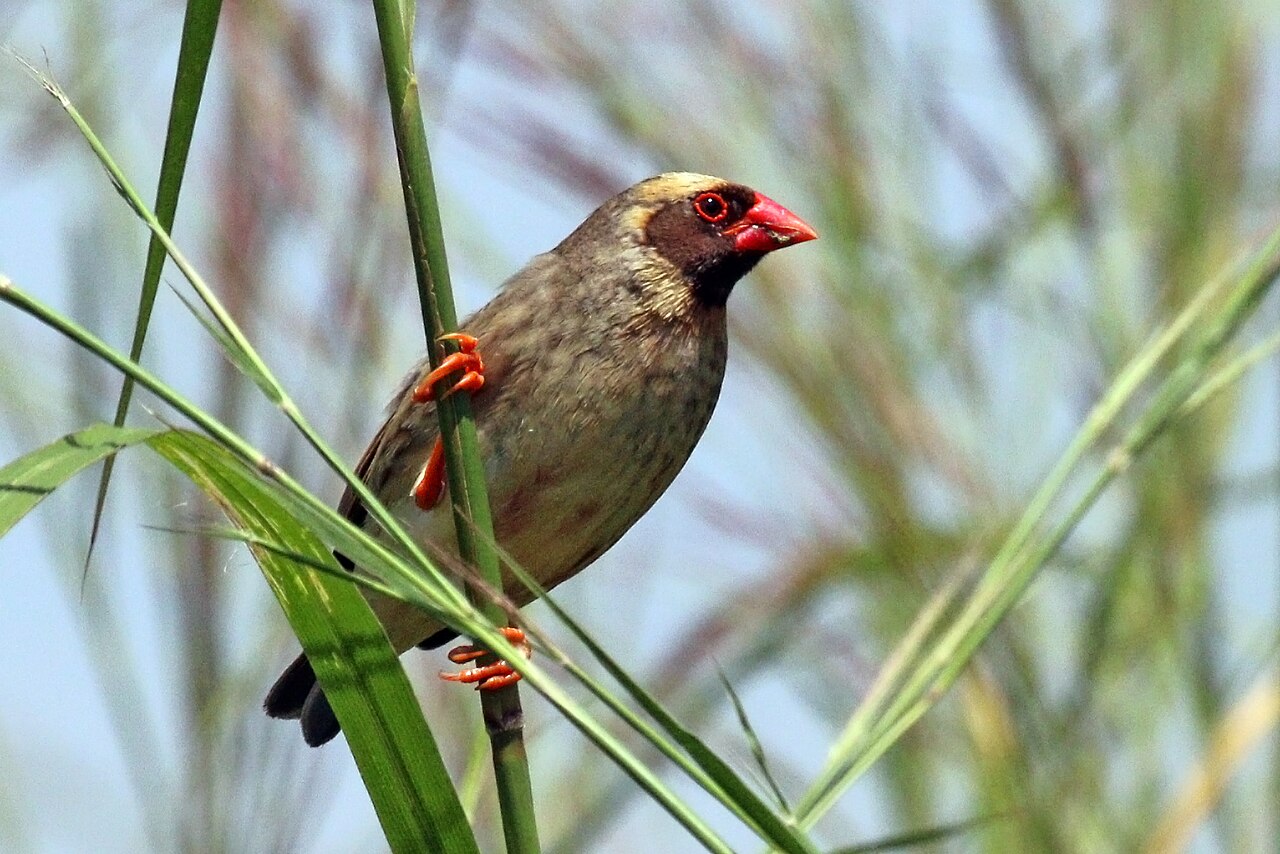
The red-billed quelea is a small and lightweight bird, with an average length of about 12 cm and a weight varying between 15 to 26 grams. Its strong legs and curved claws allow it to forage effectively in the soil and on the ground surface. Its speckled plumage, ranging from grey to light brown, gives it a rather plain appearance, while the red ring around its eyes and its thick, dark red beak provide distinctive visual identification features. Female individuals tend to have softer colors compared to males, which often display brighter plumage during the breeding season. These physical characteristics, combined with its slender body structure, enable the red-billed quelea to adapt well to various environments, from savannas to agricultural areas.
Behavior and Seasonal Migration Patterns
One of the most notable features of the red-billed quelea is its seasonal migration behavior. This species does not have a fixed location for survival; instead, it moves according to patterns of rain and drought, which directly influence the availability of its food sources such as seeds and insects. Studies have shown that red-billed queleas can gather in extremely large flocks—sometimes exceeding one million individuals. These movements typically occur at specific times of the year, especially after the rainy season, when these birds seek fresh food sources and new shelter areas. This behavior makes the species an excellent example for studying the interaction between climate factors and migratory behavior.
Ecological Importance and Impact on Agriculture
Although the red-billed quelea is often considered a harmless bird, its dense and rapid presence in agricultural areas can cause significant impacts. In some places, large flocks of red-billed queleas have directly led to the destruction of rice, corn, and wheat crops. However, the presence of these birds also helps control populations of damaging insects and contributes to seed dispersal that benefits the natural ecosystem. Ecological researchers emphasize that the balance between the ecological benefits and costs must be carefully understood so that natural resource management can be carried out sustainably without damaging the existing natural structure.
Role in Scientific Research and Environmental Education
The red-billed quelea has long been a subject in various scientific studies, including research on social behavior, population ecology, and the impact of climate on migration. Among young scientists and educational institutions, this species is also used as a practical example to understand concepts such as biodiversity, food chains, and specific population dynamics. The presence of the red-billed quelea in biology textbooks and environmental study modules also highlights its importance as an "indicator" of environmental change. Thus, knowing about the red-billed quelea is not just about gaining knowledge of a single bird species, but also helps readers understand how living organisms interact with their broader environment.
Source: Wikipedia — https://en.wikipedia.org/wiki/Red-billed_quelea | License: CC BY-SA 4.0
Red-billed Quelea: The Small Nomadic Bird That Stirs Sub-Saharan Africa. The red-billed quelea (*Quelea quelea*) is a small, red-billed, migratory (nomadic) bird found in sub-Saharan Africa. It belongs to the weaver bird family (Ploceidae) and measures about 12 cm in length, weighing between 15 to 26 grams. Despite its small size, this species is known to have a very large population and exerts significant effects on agriculture and the surrounding ecology. Its unique lifestyle, including seasonal migration and large flocking behavior, makes it an important subject in ecological research and natural resource management.. Scientific History and Species Identification
The red-billed quelea Quelea quelea was first identified and scientifically described in the early 19th century by European explorers and naturalists exploring Africa. The species belongs to the weaver bird family, known for their ability to build complex nests and commonly found in tropical regions. In the scientific community, the red-billed quelea has long attracted researchers due to its unstable population dynamics and the dynamic nature of its natural ecosystem. Ecologists have assessed that this species may have more than one subspecies distributed across various parts of Africa, and recent genetic studies are helping to outline its evolutionary history and genetic variation among different populations.
Morphology and Physical Characteristics
The red-billed quelea is a small and lightweight bird, with an average length of about 12 cm and a weight varying between 15 to 26 grams. Its strong legs and curved claws allow it to forage effectively in the soil and on the ground surface. Its speckled plumage, ranging from grey to light brown, gives it a rather plain appearance, while the red ring around its eyes and its thick, dark red beak provide distinctive visual identification features. Female individuals tend to have softer colors compared to males, which often display brighter plumage during the breeding season. These physical characteristics, combined with its slender body structure, enable the red-billed quelea to adapt well to various environments, from savannas to agricultural areas.
Behavior and Seasonal Migration Patterns
One of the most notable features of the red-billed quelea is its seasonal migration behavior. This species does not have a fixed location for survival; instead, it moves according to patterns of rain and drought, which directly influence the availability of its food sources such as seeds and insects. Studies have shown that red-billed queleas can gather in extremely large flocks—sometimes exceeding one million individuals. These movements typically occur at specific times of the year, especially after the rainy season, when these birds seek fresh food sources and new shelter areas. This behavior makes the species an excellent example for studying the interaction between climate factors and migratory behavior.
Ecological Importance and Impact on Agriculture
Although the red-billed quelea is often considered a harmless bird, its dense and rapid presence in agricultural areas can cause significant impacts. In some places, large flocks of red-billed queleas have directly led to the destruction of rice, corn, and wheat crops. However, the presence of these birds also helps control populations of damaging insects and contributes to seed dispersal that benefits the natural ecosystem. Ecological researchers emphasize that the balance between the ecological benefits and costs must be carefully understood so that natural resource management can be carried out sustainably without damaging the existing natural structure.
Role in Scientific Research and Environmental Education
The red-billed quelea has long been a subject in various scientific studies, including research on social behavior, population ecology, and the impact of climate on migration. Among young scientists and educational institutions, this species is also used as a practical example to understand concepts such as biodiversity, food chains, and specific population dynamics. The presence of the red-billed quelea in biology textbooks and environmental study modules also highlights its importance as an "indicator" of environmental change. Thus, knowing about the red-billed quelea is not just about gaining knowledge of a single bird species, but also helps readers understand how living organisms interact with their broader environment.
Source: Wikipedia — https://en.wikipedia.org/wiki/Red-billed quelea License: CC BY-SA 4.0