In 1904, at a small stall at the St. Louis World’s Fair, a meat vendor named Fletcher Davis is said to have served a bun filled with grilled ground meat, onions, and mustard—without a specific name, logo, or brand. But that is one of the earliest records recognized by the United States Patent and Trademark Office as the origin of the American commercial burger. Not in a fancy restaurant, not in a big city, but amidst the hustle and bustle of a world's fair—a place where the culinary future was unknowingly being showcased.
What exactly is a ‘burger’ in the context of commercial history?
The term
burger originates from
Hamburg steak, a 19th-century German dish brought to the United States by immigrants. However, the ‘burger’ as a concept of
ground meat sandwich between two slices of bread was born not in Hamburg, but in America—a result of practical adaptation to the mobility needs of early 20th-century industrial labor. Bread facilitated eating on the go; ground meat was cheap and easily processed on a large scale. This wasn't just about taste—it was about logistics, scale, and access.
How did burger sales evolve from a single stall to a global franchise system?
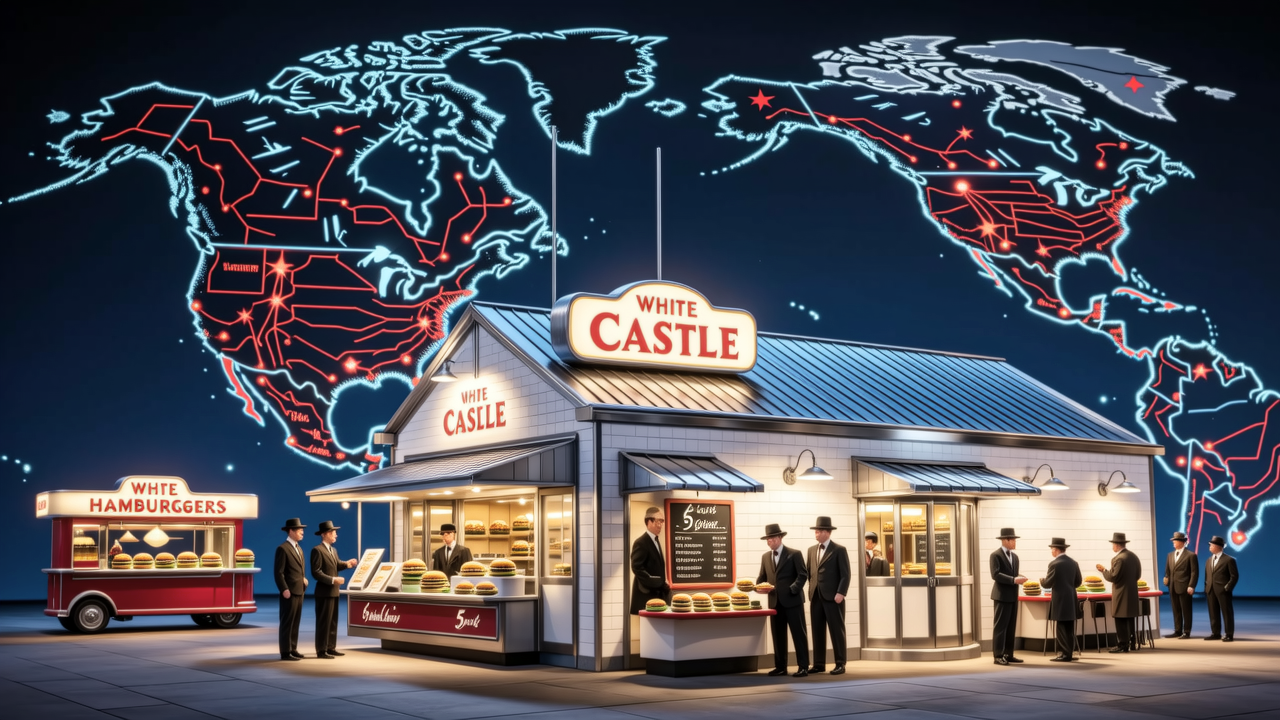
The year 1921 marked a significant leap: White Castle opened its first restaurant in Wichita, Kansas. It didn't just sell burgers—it created a new
operational model: standardized recipes, meat patty size (1/3 ounce), fixed price (5 cents), and uniform building design (small castle shapes). White Castle also launched marketing campaigns to clean up the burger's image, which was then associated with low-quality meat and the risk of food poisoning. This strategy laid the foundation for all subsequent fast-food chains.
Why doesn't Burger King exist in Australia—and who is ‘Hungry Jack’s’?
Here, the history of burger sales demonstrates the power of localization. In 1971, Burger King wanted to enter the Australian market, but the name ‘Burger King’ had already been registered by a small food shop owner in Adelaide. Instead of engaging in a legal battle, the parent company chose a new name:
Hungry Jack’s—taken from their own pancake mix brand in the US. Today, Hungry Jack’s operates over 200 restaurants in Australia, is wholly locally owned and managed, with a customized menu (like the ‘Aussie Burger’ with a fried egg and beetroot). This isn't just a name adaptation—it's a clear example of how global sales models must negotiate with brand legal realities and local tastes.
What is the impact on me as an ordinary consumer?
Every time you order a burger, you are activating a complex network: cattle farmers in Brazil or New Zealand, meat processing plants in Illinois, supply chain logistics centers in Atlanta, digital POS systems connecting orders to the kitchen in an average of 8.3 seconds, and marketing algorithms that tailor promotional offers based on your GPS location. Modern burger sales are no longer about ‘buy and eat’. It is the intersection of agriculture, information technology, consumer psychology, and economies of scale. Even the price is a result of micro-calculations: the cost of frozen transport, goods tax rates, and franchisee profit margins.
Why is the history of burger sales still relevant today?
Because it teaches us that culinary innovation rarely emerges from the kitchens of renowned chefs—more often, it arises from systemic pressures: rapid urbanization, the need for labor efficiency, food safety regulations, and price competition. Burger King, McDonald’s, and even their local successors in Malaysia like
Restoran Burger Bakar or
MyBurgerLab—all stand on the same foundation: the belief that food can be standardized, measured, and sold with consistency. And that has not only changed how we eat—but also how we understand value, time, and even social justice within the global food system.
The history of burger sales is not a story about meat and buns. It is an archaeology of everyday capitalism—written in spices, frying oil, and cash receipts.
---
Reference: Burger King — Wikipedia
From Home Kitchens to Global Chains: The History of Burger Sales That Changed the Food World. The burger is more than just fast food—it's a product of cultural evolution, preservation technology, and the modern business revolution. The history of its sales reveals how a simple dish became a symbol of global culinary capitalism.. In 1904, at a small stall at the St. Louis World’s Fair, a meat vendor named Fletcher Davis is said to have served a bun filled with grilled ground meat, onions, and mustard—without a specific name, logo, or brand. But that is one of the earliest records recognized by the United States Patent and Trademark Office as the origin of the American commercial burger. Not in a fancy restaurant, not in a big city, but amidst the hustle and bustle of a world's fair—a place where the culinary future was unknowingly being showcased.
What exactly is a ‘burger’ in the context of commercial history?
The term burger originates from Hamburg steak , a 19th-century German dish brought to the United States by immigrants. However, the ‘burger’ as a concept of ground meat sandwich between two slices of bread was born not in Hamburg, but in America—a result of practical adaptation to the mobility needs of early 20th-century industrial labor. Bread facilitated eating on the go; ground meat was cheap and easily processed on a large scale. This wasn't just about taste—it was about logistics, scale, and access.
How did burger sales evolve from a single stall to a global franchise system?
The year 1921 marked a significant leap: White Castle opened its first restaurant in Wichita, Kansas. It didn't just sell burgers—it created a new operational model : standardized recipes, meat patty size 1/3 ounce , fixed price 5 cents , and uniform building design small castle shapes . White Castle also launched marketing campaigns to clean up the burger's image, which was then associated with low-quality meat and the risk of food poisoning. This strategy laid the foundation for all subsequent fast-food chains.
Why doesn't Burger King exist in Australia—and who is ‘Hungry Jack’s’?
Here, the history of burger sales demonstrates the power of localization. In 1971, Burger King wanted to enter the Australian market, but the name ‘Burger King’ had already been registered by a small food shop owner in Adelaide. Instead of engaging in a legal battle, the parent company chose a new name: Hungry Jack’s —taken from their own pancake mix brand in the US. Today, Hungry Jack’s operates over 200 restaurants in Australia, is wholly locally owned and managed, with a customized menu like the ‘Aussie Burger’ with a fried egg and beetroot . This isn't just a name adaptation—it's a clear example of how global sales models must negotiate with brand legal realities and local tastes.
What is the impact on me as an ordinary consumer?
Every time you order a burger, you are activating a complex network: cattle farmers in Brazil or New Zealand, meat processing plants in Illinois, supply chain logistics centers in Atlanta, digital POS systems connecting orders to the kitchen in an average of 8.3 seconds, and marketing algorithms that tailor promotional offers based on your GPS location. Modern burger sales are no longer about ‘buy and eat’. It is the intersection of agriculture, information technology, consumer psychology, and economies of scale. Even the price is a result of micro-calculations: the cost of frozen transport, goods tax rates, and franchisee profit margins.
Why is the history of burger sales still relevant today?
Because it teaches us that culinary innovation rarely emerges from the kitchens of renowned chefs—more often, it arises from systemic pressures: rapid urbanization, the need for labor efficiency, food safety regulations, and price competition. Burger King, McDonald’s, and even their local successors in Malaysia like Restoran Burger Bakar or MyBurgerLab —all stand on the same foundation: the belief that food can be standardized, measured, and sold with consistency. And that has not only changed how we eat—but also how we understand value, time, and even social justice within the global food system.
The history of burger sales is not a story about meat and buns. It is an archaeology of everyday capitalism—written in spices, frying oil, and cash receipts.
---
Reference: Burger King — Wikipedia https://ms.wikipedia.org/wiki/Burger King