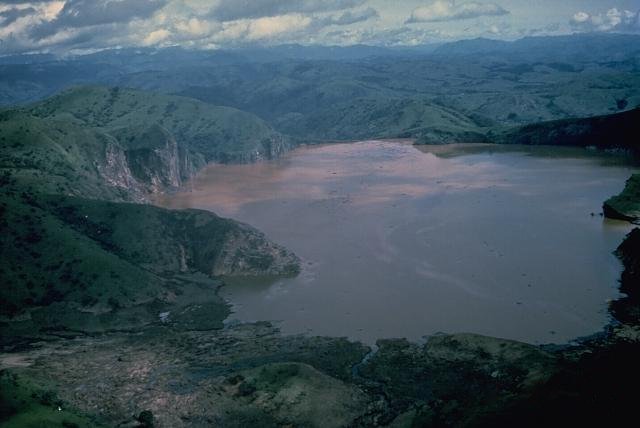
A Night Without Screams in Nyos
9:30 PM, August 21, 1986 — the small village of Nyos in northwest Cameroon was still quiet. Chickens were already in their coops, children were asleep on pandanus leaf mats, and the humid air carried the scent of wet earth after a light rain. There was no thunder. No ground tremors. No lightning. Yet, by 10:00 PM, over 1,700 residents — including 317 children — were found lying still in their yards, inside their homes, even on their beds, eyes open, faces serene as if in deep sleep. There were no wounds. No blood. Only one trace: bluish lips, and a faint smell of 'rotten eggs' in the air — although it was later known that it wasn't sulfur, but a byproduct of concentrated CO₂ that had replaced oxygen.
No one screamed. No one had time to wake up. Because carbon dioxide gas — colorless, odorless, twice as heavy as air — had flowed from the bottom of Lake Nyos like a gas waterfall, filling the narrow valleys up to a height of 100 meters, killing all breathing creatures within a 23 km² radius in less than 20 minutes.
Lake Monoun: A Warning Ignored One Year Prior
It turned out that Nyos was not the first. Exactly one year before the tragedy, on August 15, 1984, Lake Monoun — a smaller lake nearby, just 100 km to the south — had done the same thing. 37 people died, including an entire family in Subum Village. Initial reports mentioned a 'strange cloud' that 'caused suffocation', but because there were no gas measuring instruments at the site, and no scientific model to explain the phenomenon, geologists initially considered it a natural gas event from underground sources — or even 'mass food poisoning'.
However, French volcanologist Haroun Tazieff, who flew to Monoun in the weeks following the incident, found irrefutable evidence: the water layers at the bottom of the lake contained dissolved CO₂ up to 5,000 times more concentrated than ordinary seawater; the lake surface showed no high temperatures (thus not direct magma activity), but its bottom had extreme hydrostatic pressure — like a shaken carbonated drink bottle for centuries underground.
A Rare Geological Formation: Underground 'Carbonated' Lakes
What made Nyos and Monoun unique was not just their depth (Nyos: 208 meters), but the geology of their region. Both lakes are located within the
Cameroon Volcanic Line — a series of ancient volcanoes that are still geochemically active, even though they haven't erupted visually for thousands of years. Beneath the lakebeds, magma that did not reach the surface continued to heat carbonate rocks, releasing CO₂ in the form of dissolved gas that seeped into the groundwater. This water then flowed into the lakes through rock fissures — carrying large amounts of CO₂ to the static, unmixed lower layers of the lakes.
As a result, a meromictic system formed: the upper layer (epilimnion) is warm and oxygen-rich; the lower layer (hypolimnion) is cold, dark, and CO₂-saturated — like soda in a closed bottle. When a small disturbance — such as a minor landslide on the lake's edge, a micro-earthquake, or even a sudden change in atmospheric pressure — disrupts the balance, the lower layer suddenly rises to the top, releasing CO₂ in a chain reaction of degassing. That is a limnic eruption: not a volcanic eruption, but a lake eruption — and it is very real.
Rescuers from the Lake Bottom: The Nyos Degassing Project
After the 1986 tragedy, the world was shocked — not only by the scale of the deaths but by the lack of warning or protection mechanisms. In 2001, an international team of scientists from Germany, France, and Cameroon began a revolutionary project: lowering a giant plastic tube (15 cm diameter, 210 meters long) from the surface to the bottom of Nyos. Utilizing the
siphon principle, the CO₂-saturated groundwater is naturally drawn upwards — then releases the gas at the surface in the form of small, harmless bubbles.
To this day, three active tubes continue to operate in Nyos, and two in Monoun. Each year, over 50,000 tons of CO₂ are safely released — equivalent to the annual emissions of 10,000 cars. This project is not just engineering; it is a monument to human wisdom learned from silent deaths.
A Silent Legacy: Lakes Still Waiting
Although Nyos and Monoun are now controlled, over 20 other lakes worldwide — including Lake Kivu on the Rwanda-DRC border — are monitored as 'potential limnic'. Kivu, with a volume 2,000 times larger than Nyos and a combined CO₂ and methane content exceeding 60 billion cubic meters, poses one of the greatest threats in modern geological history. If a
limnic eruption were to occur there, not thousands — but millions — of lives would be at risk.
However, the legacy of Nyos is not just about danger. It is a reminder that the earth does not always speak with earthquakes or eruptions. Sometimes, it whispers — in the form of calm lakes, clear waters, and quiet nights. And sometimes, those whispers are the deadliest.
Two African Lakes Exploded Without Fire — and 1,746 People Died in 20 Minutes. On the night of August 21, 1986, a serene lake in Cameroon suddenly 'exploded' — not with lava or chemical eruptions, but with an invisible cloud of carbon dioxide that flowed down the valley like a deadly ghost. There were no earthquakes, no active volcanoes, no warnings. How could a lake kill more people than the eruption of Mount Pinatubo — without a single spark?. A Night Without Screams in Nyos
9:30 PM, August 21, 1986 — the small village of Nyos in northwest Cameroon was still quiet. Chickens were already in their coops, children were asleep on pandanus leaf mats, and the humid air carried the scent of wet earth after a light rain. There was no thunder. No ground tremors. No lightning. Yet, by 10:00 PM, over 1,700 residents — including 317 children — were found lying still in their yards, inside their homes, even on their beds, eyes open, faces serene as if in deep sleep. There were no wounds. No blood. Only one trace: bluish lips, and a faint smell of 'rotten eggs' in the air — although it was later known that it wasn't sulfur, but a byproduct of concentrated CO₂ that had replaced oxygen.
No one screamed. No one had time to wake up. Because carbon dioxide gas — colorless, odorless, twice as heavy as air — had flowed from the bottom of Lake Nyos like a gas waterfall, filling the narrow valleys up to a height of 100 meters, killing all breathing creatures within a 23 km² radius in less than 20 minutes.
Lake Monoun: A Warning Ignored One Year Prior
It turned out that Nyos was not the first. Exactly one year before the tragedy, on August 15, 1984, Lake Monoun — a smaller lake nearby, just 100 km to the south — had done the same thing. 37 people died, including an entire family in Subum Village. Initial reports mentioned a 'strange cloud' that 'caused suffocation', but because there were no gas measuring instruments at the site, and no scientific model to explain the phenomenon, geologists initially considered it a natural gas event from underground sources — or even 'mass food poisoning'.
However, French volcanologist Haroun Tazieff, who flew to Monoun in the weeks following the incident, found irrefutable evidence: the water layers at the bottom of the lake contained dissolved CO₂ up to 5,000 times more concentrated than ordinary seawater; the lake surface showed no high temperatures thus not direct magma activity , but its bottom had extreme hydrostatic pressure — like a shaken carbonated drink bottle for centuries underground.
A Rare Geological Formation: Underground 'Carbonated' Lakes
What made Nyos and Monoun unique was not just their depth Nyos: 208 meters , but the geology of their region. Both lakes are located within the Cameroon Volcanic Line — a series of ancient volcanoes that are still geochemically active, even though they haven't erupted visually for thousands of years. Beneath the lakebeds, magma that did not reach the surface continued to heat carbonate rocks, releasing CO₂ in the form of dissolved gas that seeped into the groundwater. This water then flowed into the lakes through rock fissures — carrying large amounts of CO₂ to the static, unmixed lower layers of the lakes.
As a result, a meromictic system formed: the upper layer epilimnion is warm and oxygen-rich; the lower layer hypolimnion is cold, dark, and CO₂-saturated — like soda in a closed bottle. When a small disturbance — such as a minor landslide on the lake's edge, a micro-earthquake, or even a sudden change in atmospheric pressure — disrupts the balance, the lower layer suddenly rises to the top, releasing CO₂ in a chain reaction of degassing . That is a limnic eruption : not a volcanic eruption, but a lake eruption — and it is very real.
Rescuers from the Lake Bottom: The Nyos Degassing Project
After the 1986 tragedy, the world was shocked — not only by the scale of the deaths but by the lack of warning or protection mechanisms. In 2001, an international team of scientists from Germany, France, and Cameroon began a revolutionary project: lowering a giant plastic tube 15 cm diameter, 210 meters long from the surface to the bottom of Nyos. Utilizing the siphon principle, the CO₂-saturated groundwater is naturally drawn upwards — then releases the gas at the surface in the form of small, harmless bubbles.
To this day, three active tubes continue to operate in Nyos, and two in Monoun. Each year, over 50,000 tons of CO₂ are safely released — equivalent to the annual emissions of 10,000 cars. This project is not just engineering; it is a monument to human wisdom learned from silent deaths.
A Silent Legacy: Lakes Still Waiting
Although Nyos and Monoun are now controlled, over 20 other lakes worldwide — including Lake Kivu on the Rwanda-DRC border — are monitored as 'potential limnic'. Kivu, with a volume 2,000 times larger than Nyos and a combined CO₂ and methane content exceeding 60 billion cubic meters, poses one of the greatest threats in modern geological history. If a limnic eruption were to occur there, not thousands — but millions — of lives would be at risk.
However, the legacy of Nyos is not just about danger. It is a reminder that the earth does not always speak with earthquakes or eruptions. Sometimes, it whispers — in the form of calm lakes, clear waters, and quiet nights. And sometimes, those whispers are the deadliest.