What Was Lost Between Two Rivers?
Imagine standing on the banks of the Tigris River in the summer of 2024. The water is murky, muddy, and flows slowly — like usual. But if you close your eyes and imagine the same scene 9,800 years ago, what would you hear? Not the sound of container ships or drones. But the sound of stones being sharpened into sharp knives, wheat being cut with stone teeth, and the first child saying the name of an object — not just pointing. This is where, not in the Nile or Huang He valleys, humans
collectively made the most riskiest decision in their evolutionary history: stopping migration, settling, and controlling nature — not following it.
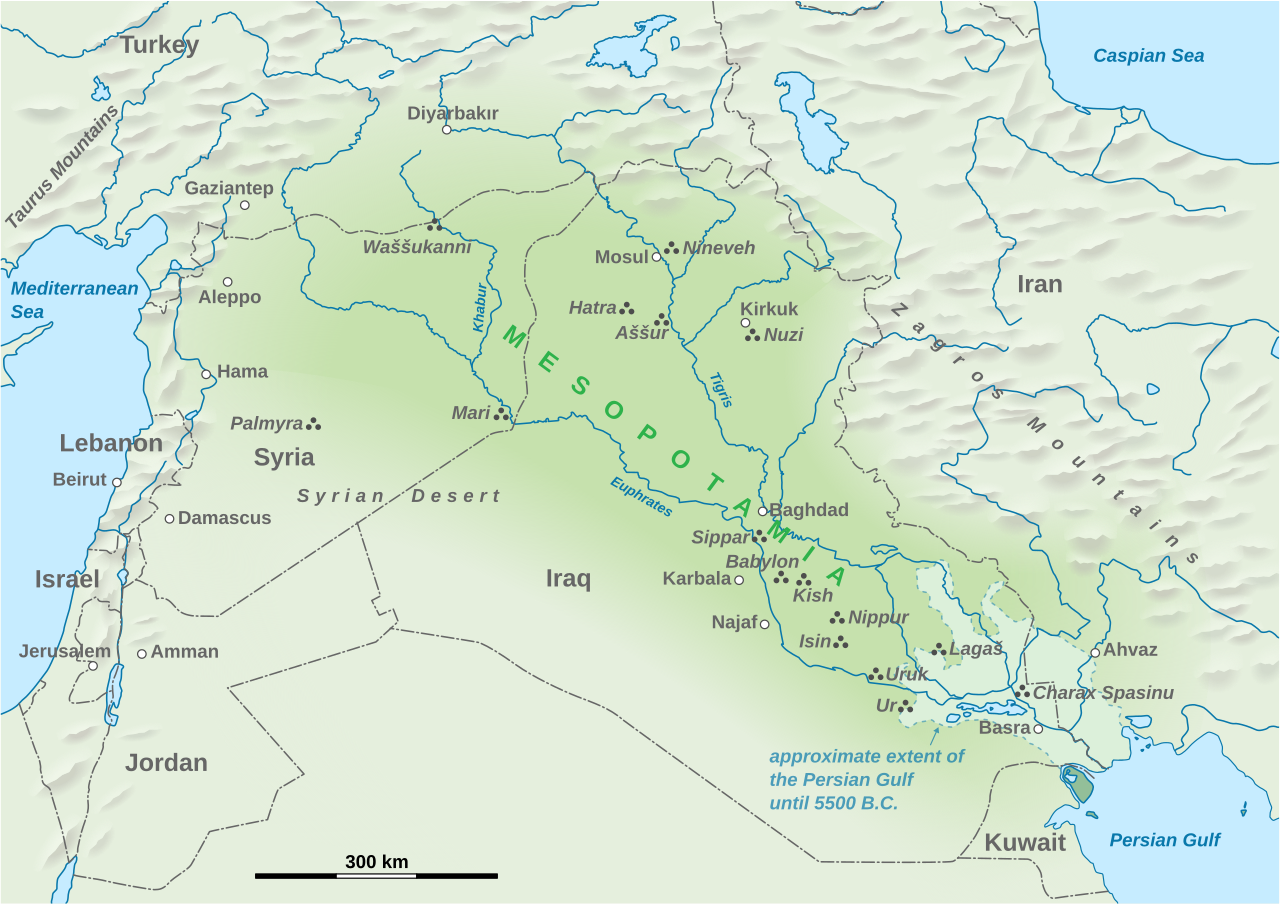
Mesopotamia is not a name given by its original inhabitants. It is a Greek term meaning 'land between two rivers' — the Tigris and Euphrates. But the name is deceiving. Because this land is not just 'between'. It is a life thread that humans were forced to sew themselves: the rivers did not provide water reliably. They flooded unpredictably — sometimes bringing fertility, sometimes bringing death. To survive, humans had to learn to read the clouds, count the days, and build canals — not as a sideline, but as a condition of existence.
When Writing Was Born Not for God — But for Debt
Many history books state: 'Writing was born to preserve sacred knowledge'. Wrong by a wide margin. Archaeological evidence from Uruk (c. 3,400 BCE) is not a tablet containing prayers or creation myths. It is a clay tablet inscribed: '290 goats were handed over to Nanna's storehouse', '3 goats are missing in transport', 'Enmerkar ordered 7 jars of beer for the 12th day ceremony'. This is not just a record. It is
the first audit system in the world. And it emerged not in a king's palace, but in a temple storage room — where wheat, beer, and livestock were counted like shares on the stock exchange. Cuneiform writing was not created to tell stories. It was created to
avoid conflict: so no one could say, 'I've already paid', while someone else says, 'You haven't'. In Mesopotamia, truth was no longer about oaths — but about records that could be touched, inscribed, and compared.
Why Did They Have 60 — Not 10?
If you look at your wristwatch now, you're using a legacy of Mesopotamia. Their sexagesimal system (base 60) — not 10 — used for calculating time, angles, and astronomy, still lives on today. Why? Not because they liked big numbers. But because 60 has 12 divisors: 1, 2, 3, 4, 5, 6, 10, 12, 15, 20, 30, 60. It made dividing land, distributing crops, and calculating wages easier — without needing complicated fractions.
The Plimpton 322 tablet (c. 1,800 BCE), found in Larsa, proves they had identified the Pythagorean theorem over 1,000 years before Pythagoras was born. Not as an abstract theory — but to measure the boundaries of a field after a flood receded. Mesopotamian mathematics was not a philosophy for philosophers. It was a tool for farmers, carpenters, and tax officials — who had to answer practical questions: 'How much land is left?', 'How much water is flowing into the canal?', 'How much wheat needs to be stored for the dry season?'
Temples Were Not Places of Worship — But the First Data Centers
Ziggurats were not pyramids. They were not tombs for kings, but logistics centers for the city. Under the stepped tower, there were natural refrigerated warehouses (thick walls + underground air flow), breweries, pottery workshops, and archives of clay tablets organized by category: 'wheat', 'livestock', 'workers', 'debt'. A 2022 study of 1,247 tablets from Nippur showed: 78% were economic documents; only 12% were related to rituals; and a mere 3% were epic stories like Gilgamesh.
This changes how we understand 'civilization': not about the power of kings or the grandeur of temples — but about systemic capacity to manage complexity. When the city of Uruk reached a population of 40,000 around 3,000 BCE, it was no longer a large village. It was a new entity: an organization that relied on coordination between 200 different types of jobs — from fish sellers to land surveyors — all dependent on a single record-keeping language: cuneiform.
Floods That Never Stopped
Mesopotamia today — modern Iraq — is often depicted as a barren land. But around 6,000 BCE, it was the 'Green River': riparian forests, waterlogged meadows, and fertile clay soil that allowed humans to experiment with domesticating emmer wheat, barley, and goats. However, this success came with its own burden. Continuous planting released salt into the soil. Within 1,500 years, wheat yields dropped to 65%. Compare: when the Sumerians reached their peak (2,500 BCE), they harvested 30 bushels of wheat per hectare. By 1,600 BCE, it was only 8 bushels.
Physical floods stopped. But the flood of meaning continued: from cuneiform to Phoenician alphabet, from the sexagesimal system to 9th-century Islamic astronomy, from the concept of 'debt' to the laws of Hammurabi — which first stated: 'An eye for an eye' and 'If someone borrows wheat, they must repay it with a fixed rate'. Here, justice was no longer a god's whim. It was a formula that could be tested, changed, and enforced.
And that's why Mesopotamia was not just 'the first'. It was a prototype of the modern human: not perfect — but trying to calculate, record, and improve — even as the land beneath their feet slowly turned into salt.
Why 12,000 Years Ago, Here, the First Humans Stopped Hunting — And Began Cheating Time?. In a land now called Iraq, something happened not just 'at the dawn of civilization' — but a radical turn in how humans looked at time, power, and truth itself. Not just wheat was sown there. But also a system of calculation that could predict floods 365 days before they arrived... and the first writing used not for poetry — but to write: 'You still owe 3 goats'. How a narrow valley between two rivers could produce all this — in less than 2,000 years?. What Was Lost Between Two Rivers?
Imagine standing on the banks of the Tigris River in the summer of 2024. The water is murky, muddy, and flows slowly — like usual. But if you close your eyes and imagine the same scene 9,800 years ago, what would you hear? Not the sound of container ships or drones. But the sound of stones being sharpened into sharp knives, wheat being cut with stone teeth, and the first child saying the name of an object — not just pointing. This is where, not in the Nile or Huang He valleys, humans collectively made the most riskiest decision in their evolutionary history: stopping migration, settling, and controlling nature — not following it.
Mesopotamia is not a name given by its original inhabitants. It is a Greek term meaning 'land between two rivers' — the Tigris and Euphrates. But the name is deceiving. Because this land is not just 'between'. It is a life thread that humans were forced to sew themselves: the rivers did not provide water reliably. They flooded unpredictably — sometimes bringing fertility, sometimes bringing death. To survive, humans had to learn to read the clouds, count the days, and build canals — not as a sideline, but as a condition of existence.
When Writing Was Born Not for God — But for Debt
Many history books state: 'Writing was born to preserve sacred knowledge'. Wrong by a wide margin. Archaeological evidence from Uruk c. 3,400 BCE is not a tablet containing prayers or creation myths. It is a clay tablet inscribed: '290 goats were handed over to Nanna's storehouse', '3 goats are missing in transport', 'Enmerkar ordered 7 jars of beer for the 12th day ceremony'. This is not just a record. It is the first audit system in the world . And it emerged not in a king's palace, but in a temple storage room — where wheat, beer, and livestock were counted like shares on the stock exchange. Cuneiform writing was not created to tell stories. It was created to avoid conflict : so no one could say, 'I've already paid', while someone else says, 'You haven't'. In Mesopotamia, truth was no longer about oaths — but about records that could be touched, inscribed, and compared.
Why Did They Have 60 — Not 10?
If you look at your wristwatch now, you're using a legacy of Mesopotamia. Their sexagesimal system base 60 — not 10 — used for calculating time, angles, and astronomy, still lives on today. Why? Not because they liked big numbers. But because 60 has 12 divisors: 1, 2, 3, 4, 5, 6, 10, 12, 15, 20, 30, 60. It made dividing land, distributing crops, and calculating wages easier — without needing complicated fractions.
The Plimpton 322 tablet c. 1,800 BCE , found in Larsa, proves they had identified the Pythagorean theorem over 1,000 years before Pythagoras was born. Not as an abstract theory — but to measure the boundaries of a field after a flood receded. Mesopotamian mathematics was not a philosophy for philosophers. It was a tool for farmers, carpenters, and tax officials — who had to answer practical questions: 'How much land is left?', 'How much water is flowing into the canal?', 'How much wheat needs to be stored for the dry season?'
Temples Were Not Places of Worship — But the First Data Centers
Ziggurats were not pyramids. They were not tombs for kings, but logistics centers for the city. Under the stepped tower, there were natural refrigerated warehouses thick walls + underground air flow , breweries, pottery workshops, and archives of clay tablets organized by category: 'wheat', 'livestock', 'workers', 'debt'. A 2022 study of 1,247 tablets from Nippur showed: 78% were economic documents; only 12% were related to rituals; and a mere 3% were epic stories like Gilgamesh.
This changes how we understand 'civilization': not about the power of kings or the grandeur of temples — but about systemic capacity to manage complexity. When the city of Uruk reached a population of 40,000 around 3,000 BCE, it was no longer a large village. It was a new entity: an organization that relied on coordination between 200 different types of jobs — from fish sellers to land surveyors — all dependent on a single record-keeping language: cuneiform.
Floods That Never Stopped
Mesopotamia today — modern Iraq — is often depicted as a barren land. But around 6,000 BCE, it was the 'Green River': riparian forests, waterlogged meadows, and fertile clay soil that allowed humans to experiment with domesticating emmer wheat, barley, and goats. However, this success came with its own burden. Continuous planting released salt into the soil. Within 1,500 years, wheat yields dropped to 65%. Compare: when the Sumerians reached their peak 2,500 BCE , they harvested 30 bushels of wheat per hectare. By 1,600 BCE, it was only 8 bushels.
Physical floods stopped. But the flood of meaning continued: from cuneiform to Phoenician alphabet, from the sexagesimal system to 9th-century Islamic astronomy, from the concept of 'debt' to the laws of Hammurabi — which first stated: 'An eye for an eye' and 'If someone borrows wheat, they must repay it with a fixed rate'. Here, justice was no longer a god's whim. It was a formula that could be tested, changed, and enforced.
And that's why Mesopotamia was not just 'the first'. It was a prototype of the modern human: not perfect — but trying to calculate, record, and improve — even as the land beneath their feet slowly turned into salt.