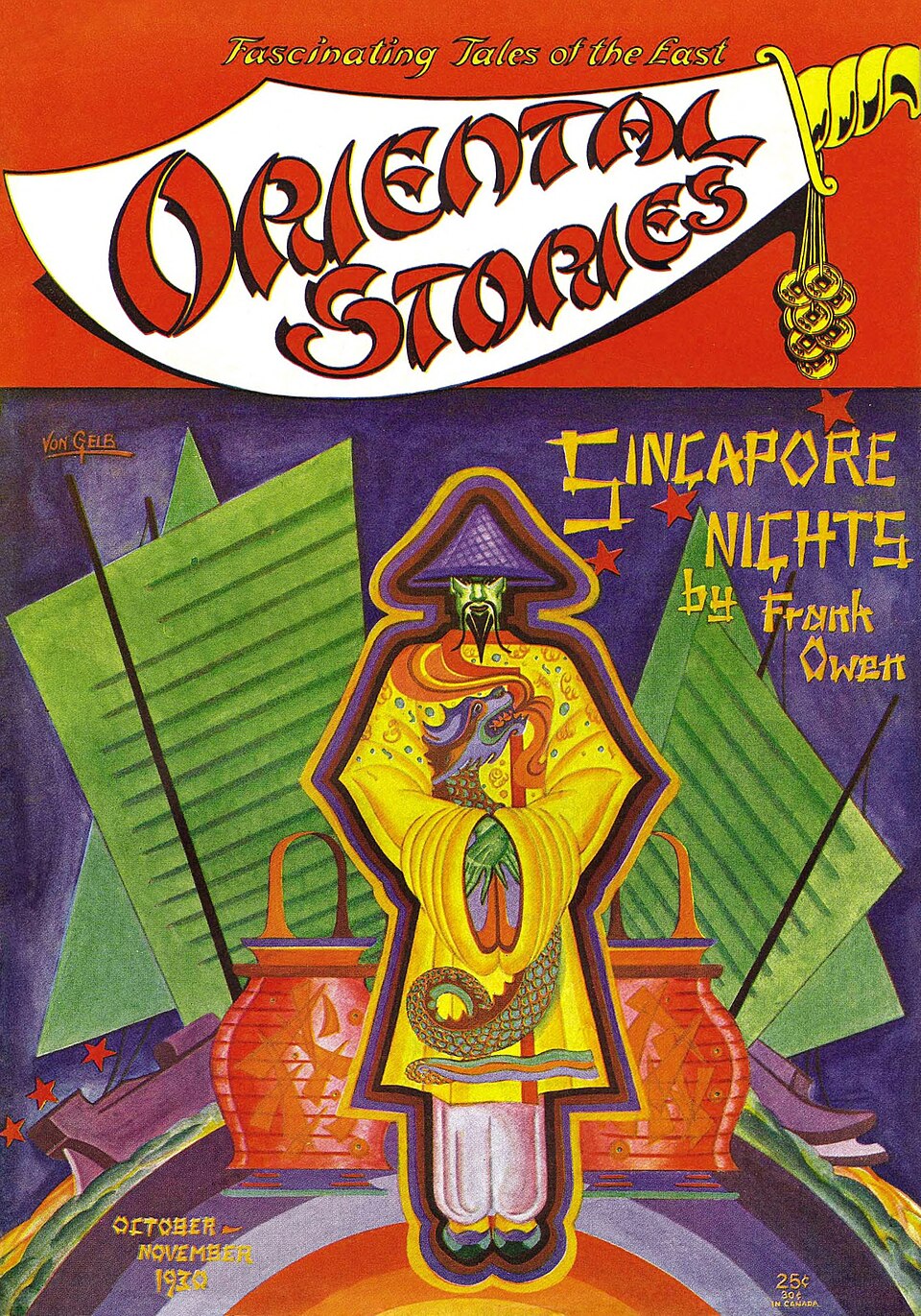
Origins and Launch as a Sister to Weird Tales
Oriental Stories was an American pulp magazine launched in 1930 as part of Popular Fiction's strategy to expand its influence into the fantasy and adventure fiction market. It served as a sister publication to legendary magazines like Weird Tales, which had achieved significant recognition among fans of dark fiction and adventure. With a similar background, Oriental Stories specifically aimed to highlight stories set in the East, including themes of mysticism, legend, and fantasy that had not been commonly featured in the more typical pulp fiction market. Its early launch marked a welcome effort to see how American pulp publishing attempted to encompass various global cultures and myths in an accessible format.
Leadership and Early Content
Under the editorship of Farnsworth Wright, also known as one of the key creative managers in the world of pulp fiction, Oriental Stories quickly developed into a space for authors who wished to explore themes of exoticism and cultural diversity. Its content included stories set in Asia, Africa, and the Pacific regions, often infused with elements of fantasy, magic, and adventure. Authors such as Robert E. Howard, famous for his Conan series, also contributed their works, while Frank Owen and E. Hoffmann Price became part of the community of writers supporting this vision. This content was not merely entertainment—it reflected the public's interest in exoticism and cultural diversity at the time, which is now an important subject of study in the fields of media history and popular culture.
Conclusion and Transition to The Magic Carpet Magazine
Although initially successful, Oriental Stories was forced to cease publication in the summer of 1932 due to economic pressures and changes in publishing policies. However, not long after, the magazine revived in 1933 under a new identity: The Magic Carpet Magazine. The name change did not merely symbolize a renewal, but also a major expansion in editorial scope. With a new brand and broader policies, it not only filtered exotic stories from Earth but also included science fiction focused on other planets, marking a step toward futuristic fiction and intergalactic adventure. This innovation made The Magic Carpet Magazine one of the early examples in mass media history where themes of exoticism and interstellar exploration were combined in a consistent format.
Historical Significance and Impact on Genres
Oriental Stories and later The Magic Carpet Magazine played an important role in shaping a more inclusive and diverse landscape of pulp fiction. It provided space for authors to experiment with new genres—from classic legends to amazing science fiction—and to explore global themes that were not long discovered in Western popular literature. Its impact was not limited to content alone; it also contributed to the evolution of narrative styles, where the depiction of foreign cultures and the use of rich language paved the way for a more daring and bold generation of writers. The magazine also reflected the socio-cultural trends of the time, where interest in exoticism and orientalism became a central element in popular narratives.
Legacy and Influence on Modern Media
Although no longer published, the legacy of Oriental Stories and The Magic Carpet Magazine continues to live on in the form of literary studies, reprints of classic works, and its influence on modern fiction. Many works that once appeared on its pages have been republished in thematic anthologies, while researchers and pulp fiction enthusiasts continue to reference it as a valuable source for understanding the evolution of fantasy, mystery, and science fiction genres. Its impact is also visible in the form of digital fiction, podcasts, and visual entertainment that now recreate the themes of exoticism and intergalactic adventure that were once popular in the past. For modern readers, recognizing the origins of the media we now take for granted provides us with a deeper lens to appreciate the creativity and endurance of popular literature that continues today.
Source: Wikipedia — https://en.wikipedia.org/wiki/Oriental_Stories | License: CC BY-SA 4.0
Oriental Stories: An American Pulp Magazine That Carried Eastern Fantasy Tales. Oriental Stories was an American pulp magazine launched in 1930 as a sister publication to Weird Tales. Edited by Farnsworth Wright, it featured fantasy stories set in the East and later changed its name to The Magic Carpet Magazine in 1933. It attracted writers such as Robert E. Howard and E. Hoffmann Price, and paved the way for broader exotic genres and science fiction. The magazine is significant in mass media and pulp fiction history due to its role in fostering fantasy and science fiction rooted in non-Western cultures. Modern readers should know about it because it represents a period of creative transition in popular literature that is now nearly extinct.. Origins and Launch as a Sister to Weird Tales
Oriental Stories was an American pulp magazine launched in 1930 as part of Popular Fiction's strategy to expand its influence into the fantasy and adventure fiction market. It served as a sister publication to legendary magazines like Weird Tales, which had achieved significant recognition among fans of dark fiction and adventure. With a similar background, Oriental Stories specifically aimed to highlight stories set in the East, including themes of mysticism, legend, and fantasy that had not been commonly featured in the more typical pulp fiction market. Its early launch marked a welcome effort to see how American pulp publishing attempted to encompass various global cultures and myths in an accessible format.
Leadership and Early Content
Under the editorship of Farnsworth Wright, also known as one of the key creative managers in the world of pulp fiction, Oriental Stories quickly developed into a space for authors who wished to explore themes of exoticism and cultural diversity. Its content included stories set in Asia, Africa, and the Pacific regions, often infused with elements of fantasy, magic, and adventure. Authors such as Robert E. Howard, famous for his Conan series, also contributed their works, while Frank Owen and E. Hoffmann Price became part of the community of writers supporting this vision. This content was not merely entertainment—it reflected the public's interest in exoticism and cultural diversity at the time, which is now an important subject of study in the fields of media history and popular culture.
Conclusion and Transition to The Magic Carpet Magazine
Although initially successful, Oriental Stories was forced to cease publication in the summer of 1932 due to economic pressures and changes in publishing policies. However, not long after, the magazine revived in 1933 under a new identity: The Magic Carpet Magazine. The name change did not merely symbolize a renewal, but also a major expansion in editorial scope. With a new brand and broader policies, it not only filtered exotic stories from Earth but also included science fiction focused on other planets, marking a step toward futuristic fiction and intergalactic adventure. This innovation made The Magic Carpet Magazine one of the early examples in mass media history where themes of exoticism and interstellar exploration were combined in a consistent format.
Historical Significance and Impact on Genres
Oriental Stories and later The Magic Carpet Magazine played an important role in shaping a more inclusive and diverse landscape of pulp fiction. It provided space for authors to experiment with new genres—from classic legends to amazing science fiction—and to explore global themes that were not long discovered in Western popular literature. Its impact was not limited to content alone; it also contributed to the evolution of narrative styles, where the depiction of foreign cultures and the use of rich language paved the way for a more daring and bold generation of writers. The magazine also reflected the socio-cultural trends of the time, where interest in exoticism and orientalism became a central element in popular narratives.
Legacy and Influence on Modern Media
Although no longer published, the legacy of Oriental Stories and The Magic Carpet Magazine continues to live on in the form of literary studies, reprints of classic works, and its influence on modern fiction. Many works that once appeared on its pages have been republished in thematic anthologies, while researchers and pulp fiction enthusiasts continue to reference it as a valuable source for understanding the evolution of fantasy, mystery, and science fiction genres. Its impact is also visible in the form of digital fiction, podcasts, and visual entertainment that now recreate the themes of exoticism and intergalactic adventure that were once popular in the past. For modern readers, recognizing the origins of the media we now take for granted provides us with a deeper lens to appreciate the creativity and endurance of popular literature that continues today.
Source: Wikipedia — https://en.wikipedia.org/wiki/Oriental Stories License: CC BY-SA 4.0