🌍 Global coverage 24/7 • 🏯 East Asia: China, Japan, Korea • 🛕 South Asia: India • 🏰 Europe • 🗽 Americas • 🌍 Africa • 🕌 Middle East • 🇵🇸 Palestine Solidarity •
This article is a translation from the original language.
🌿 Environment
Tides: The Cosmic Rhythm That Shapes the World's Coastlines
Every day, Earth's oceans experience rising and falling tides due to the gravitational pull of the Moon and Sun, modified by the shapes of continents and the seafloor. This article delves into the science behind this phenomenon, its impact on coastal life, and how it serves as the pulse of our planet.
26 Jun 20264 min read798,705 viewsBy Redaksi KhatulistiwaWikipedia — Tide
Image: Foto: Wikipedia — Tide (CC BY-SA 4.0)
AI
Introduction: The Ancient Pulse of the Ocean
Imagine the ocean breathing. Every twelve hours or so, seawater slowly rises, covering the shore, then recedes, leaving traces of foam and seaweed. This rhythm is no coincidence; it is the heartbeat of our planet, driven by forces from outer space. Tides, known as 'pasang surut' in Malay, are the most significant phenomenon connecting Earth with its cosmic neighbors. More than just a rise and fall of water levels, they are an engine that shapes coastal ecosystems, influences navigation, and since ancient times, have served as time markers for humans.
The Gravitational Dance: The True Cause of Tides
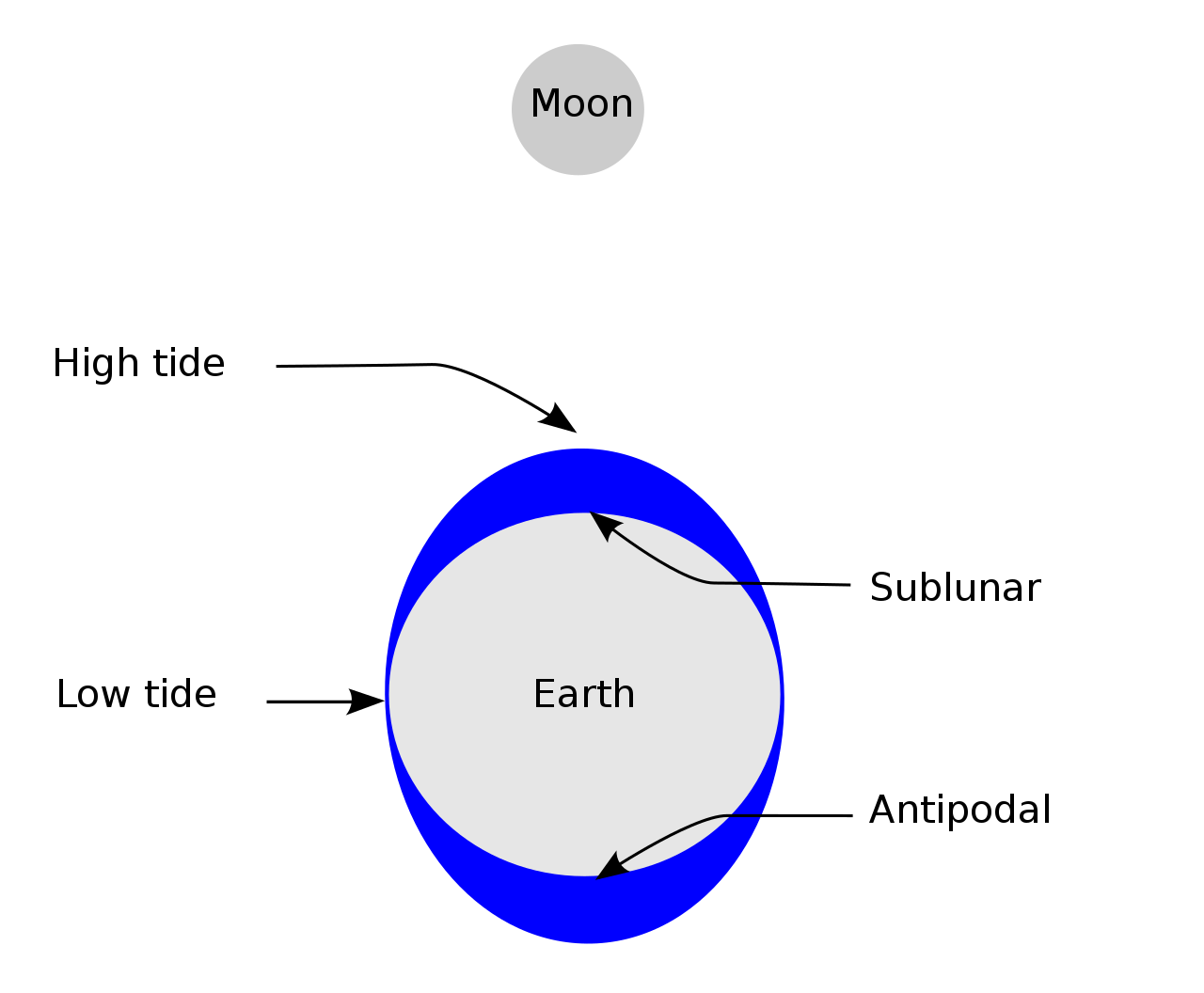
Fundamentally, tides occur due to uneven gravitational pull. The Moon, being the closest celestial body, exerts the strongest pull. This pull is stronger on the side of Earth facing the Moon than on the opposite side. This difference in force draws seawater to form bulges on both sides of Earth. The bulge facing the Moon is the direct high tide, while the bulge on the opposite side is the opposite high tide, caused by the inertia of the Earth-Moon system's rotation. The Sun also plays a role, albeit with a smaller influence. When Earth, Moon, and Sun align during full moons and new moons, their gravitational forces combine to produce higher and lower spring tides. Conversely, when the Moon and Sun are at right angles, their forces partially cancel each other, resulting in more moderate neap tides.
The Ocean as a Musician: Modifying the Cosmic Rhythm
If Earth were covered by a uniform ocean, tides would be easily predictable as water bulges moving around the world. However, reality is far more complex. The shape of ocean basins, seafloor depth, and indented coastlines modify the original tidal wave. In some places, high tide can rise over 15 meters, such as in the Bay of Fundy in Canada, because the bay's narrowing and shallowing shape acts like a funnel, forcing water to pile up. Elsewhere, like the Mediterranean Sea, tides are barely detectable due to its narrow connection to the Atlantic Ocean. The Coriolis effect, resulting from Earth's rotation, also deflects water movement, creating tidal gyres in ocean basins. Friction on the seafloor and shallow coastal waters dissipates tidal energy, slowing and altering wave shape. All these factors make each coastline have a unique tidal pattern.
The Rhythm of Life: Tidal Impact on Ecology and Humans
Tides are not just a physical phenomenon; they are the pulse of coastal ecosystems. The intertidal zone, the area exposed between tides, is the most dynamic habitat on Earth. Organisms like mangroves, crabs, and snails have adapted to constant water level changes. Tides bring nutrients, disperse larvae, and cleanse coastal areas. For humans, tides affect navigation and shipping; ships must wait for high tide to enter shallow ports. Knowledge of tides is critical for constructing ports, dikes, and dams. Indeed, tidal energy is being explored as a predictable renewable energy source, using turbines placed in areas with strong tidal currents. Culturally, many coastal communities have traditional tidal calendars that determine fishing times and daily activities.
Measuring and Predicting: The Science Behind Tide Tables
To accurately predict tides, scientists use instruments called tide gauges. These gauges, installed at ports and coastal stations, continuously measure sea level, ignoring short-term wave changes. Data is compared to a reference level known as mean sea level. Modern tide predictions use harmonic analysis, which decomposes water level records into different frequency components, each associated with astronomical movements of the Moon and Sun. By summing these components, scientists can predict tides years in advance. Although astronomy provides the basis, local factors like strong winds and barometric pressure can also cause storm surges, phenomena that often lead to coastal flooding during storms.
Conclusion: The Eternal Rhythm Connecting Us
Tides are a beautiful and powerful reminder that our planet is not an isolated entity. Every day, we witness the seemingly magical gravitational pull of the Moon and Sun, modified by the shapes of continents and seafloor, producing a rhythm that has sculpted coastlines for millions of years. From narrow bays to wide beaches, tides bring life, shape cultures, and offer future energy sources. The next time you stand by the shore and feel the water rise to touch your feet, take a moment to appreciate the cosmic dance occurring above and below the sea surface. It is the heartbeat of our planet, an eternal rhythm connecting us to the cosmos.
Tides: The Cosmic Rhythm That Shapes the World's Coastlines. Every day, Earth's oceans experience rising and falling tides due to the gravitational pull of the Moon and Sun, modified by the shapes of continents and the seafloor. This article delves into the science behind this phenomenon, its impact on coastal life, and how it serves as the pulse of our planet.. Introduction: The Ancient Pulse of the Ocean
Imagine the ocean breathing. Every twelve hours or so, seawater slowly rises, covering the shore, then recedes, leaving traces of foam and seaweed. This rhythm is no coincidence; it is the heartbeat of our planet, driven by forces from outer space. Tides, known as 'pasang surut' in Malay, are the most significant phenomenon connecting Earth with its cosmic neighbors. More than just a rise and fall of water levels, they are an engine that shapes coastal ecosystems, influences navigation, and since ancient times, have served as time markers for humans.
The Gravitational Dance: The True Cause of Tides
Fundamentally, tides occur due to uneven gravitational pull. The Moon, being the closest celestial body, exerts the strongest pull. This pull is stronger on the side of Earth facing the Moon than on the opposite side. This difference in force draws seawater to form bulges on both sides of Earth. The bulge facing the Moon is the direct high tide, while the bulge on the opposite side is the opposite high tide, caused by the inertia of the Earth-Moon system's rotation. The Sun also plays a role, albeit with a smaller influence. When Earth, Moon, and Sun align during full moons and new moons, their gravitational forces combine to produce higher and lower spring tides. Conversely, when the Moon and Sun are at right angles, their forces partially cancel each other, resulting in more moderate neap tides.
The Ocean as a Musician: Modifying the Cosmic Rhythm
If Earth were covered by a uniform ocean, tides would be easily predictable as water bulges moving around the world. However, reality is far more complex. The shape of ocean basins, seafloor depth, and indented coastlines modify the original tidal wave. In some places, high tide can rise over 15 meters, such as in the Bay of Fundy in Canada, because the bay's narrowing and shallowing shape acts like a funnel, forcing water to pile up. Elsewhere, like the Mediterranean Sea, tides are barely detectable due to its narrow connection to the Atlantic Ocean. The Coriolis effect, resulting from Earth's rotation, also deflects water movement, creating tidal gyres in ocean basins. Friction on the seafloor and shallow coastal waters dissipates tidal energy, slowing and altering wave shape. All these factors make each coastline have a unique tidal pattern.
The Rhythm of Life: Tidal Impact on Ecology and Humans
Tides are not just a physical phenomenon; they are the pulse of coastal ecosystems. The intertidal zone, the area exposed between tides, is the most dynamic habitat on Earth. Organisms like mangroves, crabs, and snails have adapted to constant water level changes. Tides bring nutrients, disperse larvae, and cleanse coastal areas. For humans, tides affect navigation and shipping; ships must wait for high tide to enter shallow ports. Knowledge of tides is critical for constructing ports, dikes, and dams. Indeed, tidal energy is being explored as a predictable renewable energy source, using turbines placed in areas with strong tidal currents. Culturally, many coastal communities have traditional tidal calendars that determine fishing times and daily activities.
Measuring and Predicting: The Science Behind Tide Tables
To accurately predict tides, scientists use instruments called tide gauges. These gauges, installed at ports and coastal stations, continuously measure sea level, ignoring short-term wave changes. Data is compared to a reference level known as mean sea level. Modern tide predictions use harmonic analysis, which decomposes water level records into different frequency components, each associated with astronomical movements of the Moon and Sun. By summing these components, scientists can predict tides years in advance. Although astronomy provides the basis, local factors like strong winds and barometric pressure can also cause storm surges, phenomena that often lead to coastal flooding during storms.
Conclusion: The Eternal Rhythm Connecting Us
Tides are a beautiful and powerful reminder that our planet is not an isolated entity. Every day, we witness the seemingly magical gravitational pull of the Moon and Sun, modified by the shapes of continents and seafloor, producing a rhythm that has sculpted coastlines for millions of years. From narrow bays to wide beaches, tides bring life, shape cultures, and offer future energy sources. The next time you stand by the shore and feel the water rise to touch your feet, take a moment to appreciate the cosmic dance occurring above and below the sea surface. It is the heartbeat of our planet, an eternal rhythm connecting us to the cosmos.
---
Reference: Tide — Wikipedia https://en.wikipedia.org/wiki/Tide