The Silent Corner in Campus
At 12:30 pm, male students at a university in China poured out of the lecture hall. The atmosphere was lively with laughter. Suddenly, a student named Wei was ambushed from behind. His four friends grabbed his arms and legs. In a split second, Wei was lifted into the air. His legs were spread apart. His eyes widened in fear.
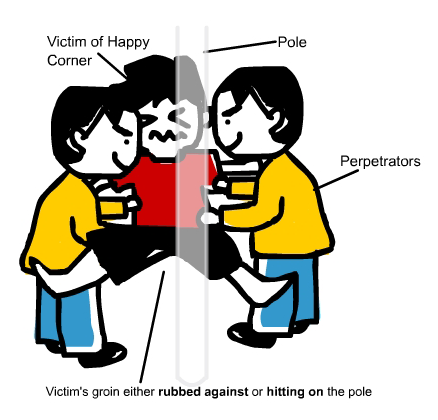
"Don't! Please don't!" he cried out half-laughing, but his voice trembled with panic. His friends ignored him. They ran towards a metal pole in the middle of the courtyard. The 10-centimeter-thick steel pole had witnessed dozens of 'victims' before. With one swift motion, Wei's sensitive area was dropped onto the pole – once, twice, three times. The sound of 'thud' echoed through the air. Laughter broke out. Wei winced in pain, his face twisted in a bitter smile.
This was no movie scene. It was reality behind the term 'Happy Corner' or 'Aluba'.
Origins: From Coarse Jokes to 'Tradition'
'Happy Corner' or 'Aluba' (阿鲁巴) originated among male students in Taiwan and China in the 1990s. No one knows who started it. However, it spread like wildfire to major universities in mainland China, Hong Kong, Macau, and Malaysia.
Initially, it was a form of 'play' or 'ritual' to celebrate something – like the end of exams, birthdays, or just to strengthen male friendships. The victim was usually lifted by a few friends, then his sensitive area was dropped onto a pole, door, or any upright object. The harder the drop, the 'happier' it was supposed to be.
However, from a psychological perspective, 'Happy Corner' was a manifestation of toxic masculinity and patriarchal culture among young men. It was a way to 'prove' bravery and physical endurance – that a man could withstand pain without complaining. A victim who smiled after being dropped was considered a 'true man'. A victim who cried or got angry was seen as weak and more likely to be targeted.
The Psychology Behind 'Happy Corner': Why They Enjoy It
Why could this clearly painful and hazardous activity become a 'tradition' that was defended? The answer lies in group psychology and the pressure to be accepted.
Firstly, it created a unique bond among the group of men. In anthropological studies, shared pain rituals often strengthened solidarity. When a victim went through 'Happy Corner', he was considered 'initiated' into the group. It was a brutal form of initiation, but seen as a 'price' to pay for acceptance.
Secondly, it was a release of pressure. Male students in China and Malaysia faced intense academic pressure. 'Happy Corner' became a way to vent frustration. When they dropped the victim, they symbolically 'dropped' their own pressure. The feeling of relief was misinterpreted as 'happiness'.
Thirdly, it was a game of power. In every group, there was a hierarchy. 'Happy Corner' often targeted quieter or less popular individuals. It was a way for the dominant group to assert their power. Although the victim smiled, there was an underlying element of coercion. They knew that if they refused, they would be ostracized.
The Unspoken Physical and Psychological Impact
Although considered a 'joke', 'Happy Corner' could have serious consequences. Physically, a strong drop onto the groin area could cause injuries to the testicles, bladder, or thigh. Broken pelvis bones, frozen blood in the scrotum, and erectile dysfunction have been reported in university clinics. In extreme cases, it could lead to temporary or permanent infertility.
Psychologically, the impact was more subtle but deeper. Victims who were frequently targeted might experience social anxiety, nightmares, and loss of self-confidence. They might avoid the area around the pole or feel scared every time they entered the campus. Ironically, many victims did not report the incidents because they feared being stigmatized. They preferred to suffer in silence rather than be seen as 'unsporting'.
A Malaysian student I met (whose name I've changed to Amir) shared his story: "When I was in form 4, I was subjected to 'Happy Corner' every time I finished an exam. At first, I laughed along. But later, I started to feel pain when I had to urinate. I was too ashamed to tell my teacher. I just hoped they would get bored soon." Amir is now 23 years old and still has a mild trauma whenever he sees a pole.
The Controversy: Between Tradition and Bullying
In recent years, 'Happy Corner' has gained serious attention from educational authorities. In China, several universities have issued clear bans on this practice. Cases of bullying involving 'Happy Corner' have been brought to disciplinary courts. In Malaysia, the Ministry of Education has warned all institutions to take stern action against any form of hazing.
However, many still defend it. They argue that it's just 'boys being silly' and not more harmful than 'kantoi' or 'military-style exercise'. They claim that as long as it's not excessive, it doesn't need to be banned. They also argue that it strengthens friendships and celebrates joy together.
But this argument is weak. When someone's joy is built on another person's pain, it's no longer a joke – it's bullying. All jokes require mutual consent. If a victim cannot refuse without fearing ostracism, it's coercion. Tradition cannot be used as an excuse to hurt others.
The Future: Ending the Culture of Silence
The first step to changing this culture is awareness. Many students are unaware that 'Happy Corner' can be classified as sexual bullying because it targets the intimate area. Schools and universities need to hold sessions on the physical boundaries and consent.
Secondly, teachers and parents need to be sensitive. If a child or student suddenly avoids the pole or frequently touches their groin area, don't dismiss it. Ask, talk, and offer support. Don't let them suffer in silence.
Thirdly, students themselves need to be brave. Saying 'no' is not a sign of weakness. It's a sign of maturity. True friendships are not built on pain. True joy does not require a metal pole.
In the end, culture only changes when each individual makes a conscious choice. A choice not to hurt. A choice not to be a victim. A choice to create a new, healthier tradition – one that celebrates with a smile, not pain.
We can be happy without making someone a 'Happy Corner'. That's true happiness.
Tradition of 'Happy Corner' or 'Aluba': A Hazing Ritual Among Male Students. Imagine walking through campus, suddenly being grabbed by a group of friends, lifted high, and having your sensitive area dropped onto a metal pole. This is 'Happy Corner' or 'Aluba', a hazing tradition that has sparked controversy: is it a harmless joke or a form of bullying?. The Silent Corner in Campus
At 12:30 pm, male students at a university in China poured out of the lecture hall. The atmosphere was lively with laughter. Suddenly, a student named Wei was ambushed from behind. His four friends grabbed his arms and legs. In a split second, Wei was lifted into the air. His legs were spread apart. His eyes widened in fear.
"Don't! Please don't!" he cried out half-laughing, but his voice trembled with panic. His friends ignored him. They ran towards a metal pole in the middle of the courtyard. The 10-centimeter-thick steel pole had witnessed dozens of 'victims' before. With one swift motion, Wei's sensitive area was dropped onto the pole – once, twice, three times. The sound of 'thud' echoed through the air. Laughter broke out. Wei winced in pain, his face twisted in a bitter smile.
This was no movie scene. It was reality behind the term 'Happy Corner' or 'Aluba'.
Origins: From Coarse Jokes to 'Tradition'
'Happy Corner' or 'Aluba' 阿鲁巴 originated among male students in Taiwan and China in the 1990s. No one knows who started it. However, it spread like wildfire to major universities in mainland China, Hong Kong, Macau, and Malaysia.
Initially, it was a form of 'play' or 'ritual' to celebrate something – like the end of exams, birthdays, or just to strengthen male friendships. The victim was usually lifted by a few friends, then his sensitive area was dropped onto a pole, door, or any upright object. The harder the drop, the 'happier' it was supposed to be.
However, from a psychological perspective, 'Happy Corner' was a manifestation of toxic masculinity and patriarchal culture among young men. It was a way to 'prove' bravery and physical endurance – that a man could withstand pain without complaining. A victim who smiled after being dropped was considered a 'true man'. A victim who cried or got angry was seen as weak and more likely to be targeted.
The Psychology Behind 'Happy Corner': Why They Enjoy It
Why could this clearly painful and hazardous activity become a 'tradition' that was defended? The answer lies in group psychology and the pressure to be accepted.
Firstly, it created a unique bond among the group of men. In anthropological studies, shared pain rituals often strengthened solidarity. When a victim went through 'Happy Corner', he was considered 'initiated' into the group. It was a brutal form of initiation, but seen as a 'price' to pay for acceptance.
Secondly, it was a release of pressure. Male students in China and Malaysia faced intense academic pressure. 'Happy Corner' became a way to vent frustration. When they dropped the victim, they symbolically 'dropped' their own pressure. The feeling of relief was misinterpreted as 'happiness'.
Thirdly, it was a game of power. In every group, there was a hierarchy. 'Happy Corner' often targeted quieter or less popular individuals. It was a way for the dominant group to assert their power. Although the victim smiled, there was an underlying element of coercion. They knew that if they refused, they would be ostracized.
The Unspoken Physical and Psychological Impact
Although considered a 'joke', 'Happy Corner' could have serious consequences. Physically, a strong drop onto the groin area could cause injuries to the testicles, bladder, or thigh. Broken pelvis bones, frozen blood in the scrotum, and erectile dysfunction have been reported in university clinics. In extreme cases, it could lead to temporary or permanent infertility.
Psychologically, the impact was more subtle but deeper. Victims who were frequently targeted might experience social anxiety, nightmares, and loss of self-confidence. They might avoid the area around the pole or feel scared every time they entered the campus. Ironically, many victims did not report the incidents because they feared being stigmatized. They preferred to suffer in silence rather than be seen as 'unsporting'.
A Malaysian student I met whose name I've changed to Amir shared his story: "When I was in form 4, I was subjected to 'Happy Corner' every time I finished an exam. At first, I laughed along. But later, I started to feel pain when I had to urinate. I was too ashamed to tell my teacher. I just hoped they would get bored soon." Amir is now 23 years old and still has a mild trauma whenever he sees a pole.
The Controversy: Between Tradition and Bullying
In recent years, 'Happy Corner' has gained serious attention from educational authorities. In China, several universities have issued clear bans on this practice. Cases of bullying involving 'Happy Corner' have been brought to disciplinary courts. In Malaysia, the Ministry of Education has warned all institutions to take stern action against any form of hazing.
However, many still defend it. They argue that it's just 'boys being silly' and not more harmful than 'kantoi' or 'military-style exercise'. They claim that as long as it's not excessive, it doesn't need to be banned. They also argue that it strengthens friendships and celebrates joy together.
But this argument is weak. When someone's joy is built on another person's pain, it's no longer a joke – it's bullying. All jokes require mutual consent. If a victim cannot refuse without fearing ostracism, it's coercion. Tradition cannot be used as an excuse to hurt others.
The Future: Ending the Culture of Silence
The first step to changing this culture is awareness. Many students are unaware that 'Happy Corner' can be classified as sexual bullying because it targets the intimate area. Schools and universities need to hold sessions on the physical boundaries and consent.
Secondly, teachers and parents need to be sensitive. If a child or student suddenly avoids the pole or frequently touches their groin area, don't dismiss it. Ask, talk, and offer support. Don't let them suffer in silence.
Thirdly, students themselves need to be brave. Saying 'no' is not a sign of weakness. It's a sign of maturity. True friendships are not built on pain. True joy does not require a metal pole.
In the end, culture only changes when each individual makes a conscious choice. A choice not to hurt. A choice not to be a victim. A choice to create a new, healthier tradition – one that celebrates with a smile, not pain.
We can be happy without making someone a 'Happy Corner'. That's true happiness.