Threat from the Sky: Why We Should Worry
Every day, Earth is bombarded by more than 100 tons of space debris — mostly dust particles that burn up in the atmosphere. However, among the millions of near-Earth objects (NEOs) orbiting the sun, there are a few large enough to cause a global catastrophe. The collision 66 million years ago by an object 10 kilometers wide is believed to have ended the dinosaur age through a chain reaction: massive tsunamis, widespread fires, and a long-lasting impact winter caused by dust from the shattered rock blocking sunlight for years. Scientists estimate objects larger than 1 kilometer can cause a major extinction event — and although the short-term risk is low, statistically such collisions will definitely happen one day unless we take defensive measures.
When the Shoemaker-Levy 9 comet crashed into Jupiter in 1994, it reminded us how powerful nature can be. The Chelyabinsk event in 2013 shocked the world when a 17-meter meteor exploded in the atmosphere over Russia, injuring more than 1,400 people. Without an early warning system and effective deflection techniques, humans may face the same fate as the dinosaurs.
Kinetic Impact: Pushing Asteroids with Giant Bullets
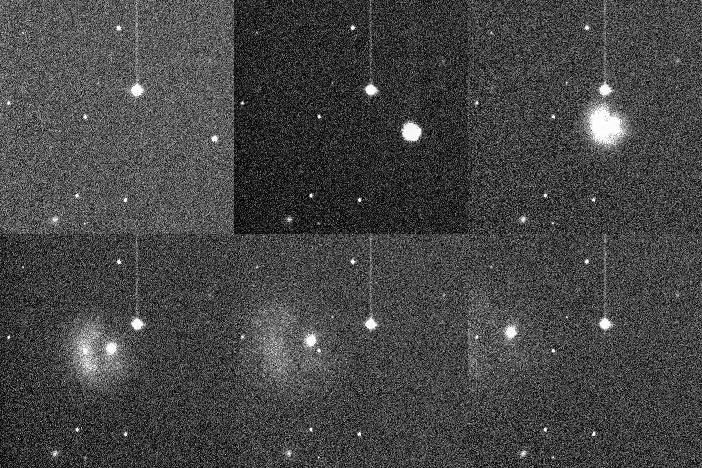
The easiest to understand method is the concept of "guided bullet chasing bullet": colliding with an asteroid using a high-speed spacecraft to slightly change its orbit. This was demonstrated by NASA's DART (Double Asteroid Redirection Test) mission in September 2022. A 570-kilogram spacecraft collided with the 160-meter-diameter asteroid Dimorphos at a speed of 6.6 kilometers per second. The result was that the orbital period of Dimorphos around its parent asteroid was successfully shortened by 32 minutes — far exceeding the initial target of 73 seconds. This success proved that the kinetic impact concept is indeed effective.
The principle is simple: by gradually changing the momentum of the asteroid, its trajectory will change enough to miss Earth — provided the impact is done years before the collision. However, this technique requires precise knowledge about the mass, composition, and structure of the asteroid. If the asteroid is a loose rubble pile, the impact might be less effective. Therefore, scientists are now planning follow-up missions like the European Space Agency's Hera to study the DART impact in more detail.
Nuclear Weapons: The Controversial Last Resort
If a large asteroid is detected at the last minute — within a few months or weeks — slower methods like kinetic impact might not be sufficient. This is where nuclear weapons come into play as a drastic option. Unlike the Hollywood movie depiction of blowing the asteroid into small fragments (which could still be dangerous to Earth), the actual strategy is to use a nuclear explosion on the surface of the asteroid to vaporize part of its mass. The resulting steam jet will act like a rocket, pushing the asteroid in the opposite direction with greater force.
Simulations by Lawrence Livermore National Laboratory show that a 1-megaton nuclear bomb detonated 100 meters away from a 500-meter-wide asteroid could change its trajectory enough to avoid a collision. However, its use is limited by international agreements such as the 1967 Outer Space Treaty, which prohibits the use of large-scale weapons in space. Scientists are also concerned that an inaccurate explosion might break the asteroid into several large pieces still heading toward Earth — resulting in a "cassette bomb"-like cosmic effect. Therefore, the nuclear option will only be used as a last resort and must be strictly controlled by international bodies.
Gravity Tractor: Pulling Asteroids Without Touching
Imagine a large spacecraft flying alongside an asteroid, using the faint gravitational pull between the two to slowly pull the asteroid out of its dangerous path. This is the concept of the "gravity tractor" — the softest and most controlled method. Since gravity is a universal force, this technique works regardless of the asteroid's composition or rotation. The spacecraft simply needs to be placed at a certain distance (usually within a range of 1 kilometer) and use its thrusters to continuously counteract the asteroid's gravitational pull — effectively "delaying" the asteroid slowly.
The main weakness: it is very slow. To move a 200-meter-wide asteroid by 1 Earth radius within 10 years, a 50-ton spacecraft would need a lot of fuel and highly efficient electric or ion thrusters. However, its advantages are that it produces no debris, does not require physical contact, and can be canceled at any time. This method is suitable for asteroids detected early — 10 to 20 years before impact — and requires high-precision engineering that is still in development.
Solar Lasers: Vaporizing Asteroids From a Distance
This idea is like using a magnifying glass to burn an ant — but on a planetary scale. Large mirrors or lasers orbiting in space can focus sunlight onto a hot spot on the asteroid's surface. Excessive heat will vaporize the rock, producing gas jets that push the asteroid slowly but steadily. This concept is called "laser ablation" and is suitable for slowly rotating or stable asteroids.
Studies show that a 20-megawatt laser operating for a year could change the trajectory of a 500-meter-wide asteroid by 1,000 kilometers — enough to avoid Earth. The main challenge is the need for a huge power source and the precision required to direct the laser beam over millions of kilometers. However, with advances in photovoltaic and adaptive optics technology, this concept is becoming increasingly realistic. In addition, lasers can also be used to slowly heat the asteroid without the risk of uncontrolled nuclear explosions.
Future: Becoming Guardians of the Planet
No single method is perfect for all situations — each asteroid has different size, composition, orbit, and warning time. Therefore, the best strategy is to combine several techniques: use kinetic impact for medium-sized asteroids, gravity tractors for objects detected early, and nuclear weapons as a last resort. Early warning systems like NASA's Sentry Risk Table and ESA's NeOShield-2 need to be enhanced to detect dangerous asteroids decades earlier.
Most importantly, humans need to stop being indifferent. Funding planetary defense missions is not a waste — it is an insurance for the survival of our species. Every day without preparation increases the risk that one day, we will witness a preventable collision. As one astronomer said, "We cannot change our fate — but we can change our orbit."
---
Reference: Asteroid impact avoidance — Wikipedia
How Humans Can Save Earth From a World-Ending Asteroid — 5 Crazy Techniques That Might Work. Are we ready if a giant asteroid like the one that killed the dinosaurs comes again? Scientists are now actively developing various methods to avoid a deadly collision. From shooting nuclear bullets into space to pushing asteroids with gravity — here are 5 most promising techniques that could save human civilization.. Threat from the Sky: Why We Should Worry
Every day, Earth is bombarded by more than 100 tons of space debris — mostly dust particles that burn up in the atmosphere. However, among the millions of near-Earth objects NEOs orbiting the sun, there are a few large enough to cause a global catastrophe. The collision 66 million years ago by an object 10 kilometers wide is believed to have ended the dinosaur age through a chain reaction: massive tsunamis, widespread fires, and a long-lasting impact winter caused by dust from the shattered rock blocking sunlight for years. Scientists estimate objects larger than 1 kilometer can cause a major extinction event — and although the short-term risk is low, statistically such collisions will definitely happen one day unless we take defensive measures.
When the Shoemaker-Levy 9 comet crashed into Jupiter in 1994, it reminded us how powerful nature can be. The Chelyabinsk event in 2013 shocked the world when a 17-meter meteor exploded in the atmosphere over Russia, injuring more than 1,400 people. Without an early warning system and effective deflection techniques, humans may face the same fate as the dinosaurs.
Kinetic Impact: Pushing Asteroids with Giant Bullets
The easiest to understand method is the concept of "guided bullet chasing bullet": colliding with an asteroid using a high-speed spacecraft to slightly change its orbit. This was demonstrated by NASA's DART Double Asteroid Redirection Test mission in September 2022. A 570-kilogram spacecraft collided with the 160-meter-diameter asteroid Dimorphos at a speed of 6.6 kilometers per second. The result was that the orbital period of Dimorphos around its parent asteroid was successfully shortened by 32 minutes — far exceeding the initial target of 73 seconds. This success proved that the kinetic impact concept is indeed effective.
The principle is simple: by gradually changing the momentum of the asteroid, its trajectory will change enough to miss Earth — provided the impact is done years before the collision. However, this technique requires precise knowledge about the mass, composition, and structure of the asteroid. If the asteroid is a loose rubble pile, the impact might be less effective. Therefore, scientists are now planning follow-up missions like the European Space Agency's Hera to study the DART impact in more detail.
Nuclear Weapons: The Controversial Last Resort
If a large asteroid is detected at the last minute — within a few months or weeks — slower methods like kinetic impact might not be sufficient. This is where nuclear weapons come into play as a drastic option. Unlike the Hollywood movie depiction of blowing the asteroid into small fragments which could still be dangerous to Earth , the actual strategy is to use a nuclear explosion on the surface of the asteroid to vaporize part of its mass. The resulting steam jet will act like a rocket, pushing the asteroid in the opposite direction with greater force.
Simulations by Lawrence Livermore National Laboratory show that a 1-megaton nuclear bomb detonated 100 meters away from a 500-meter-wide asteroid could change its trajectory enough to avoid a collision. However, its use is limited by international agreements such as the 1967 Outer Space Treaty, which prohibits the use of large-scale weapons in space. Scientists are also concerned that an inaccurate explosion might break the asteroid into several large pieces still heading toward Earth — resulting in a "cassette bomb"-like cosmic effect. Therefore, the nuclear option will only be used as a last resort and must be strictly controlled by international bodies.
Gravity Tractor: Pulling Asteroids Without Touching
Imagine a large spacecraft flying alongside an asteroid, using the faint gravitational pull between the two to slowly pull the asteroid out of its dangerous path. This is the concept of the "gravity tractor" — the softest and most controlled method. Since gravity is a universal force, this technique works regardless of the asteroid's composition or rotation. The spacecraft simply needs to be placed at a certain distance usually within a range of 1 kilometer and use its thrusters to continuously counteract the asteroid's gravitational pull — effectively "delaying" the asteroid slowly.
The main weakness: it is very slow. To move a 200-meter-wide asteroid by 1 Earth radius within 10 years, a 50-ton spacecraft would need a lot of fuel and highly efficient electric or ion thrusters. However, its advantages are that it produces no debris, does not require physical contact, and can be canceled at any time. This method is suitable for asteroids detected early — 10 to 20 years before impact — and requires high-precision engineering that is still in development.
Solar Lasers: Vaporizing Asteroids From a Distance
This idea is like using a magnifying glass to burn an ant — but on a planetary scale. Large mirrors or lasers orbiting in space can focus sunlight onto a hot spot on the asteroid's surface. Excessive heat will vaporize the rock, producing gas jets that push the asteroid slowly but steadily. This concept is called "laser ablation" and is suitable for slowly rotating or stable asteroids.
Studies show that a 20-megawatt laser operating for a year could change the trajectory of a 500-meter-wide asteroid by 1,000 kilometers — enough to avoid Earth. The main challenge is the need for a huge power source and the precision required to direct the laser beam over millions of kilometers. However, with advances in photovoltaic and adaptive optics technology, this concept is becoming increasingly realistic. In addition, lasers can also be used to slowly heat the asteroid without the risk of uncontrolled nuclear explosions.
Future: Becoming Guardians of the Planet
No single method is perfect for all situations — each asteroid has different size, composition, orbit, and warning time. Therefore, the best strategy is to combine several techniques: use kinetic impact for medium-sized asteroids, gravity tractors for objects detected early, and nuclear weapons as a last resort. Early warning systems like NASA's Sentry Risk Table and ESA's NeOShield-2 need to be enhanced to detect dangerous asteroids decades earlier.
Most importantly, humans need to stop being indifferent. Funding planetary defense missions is not a waste — it is an insurance for the survival of our species. Every day without preparation increases the risk that one day, we will witness a preventable collision. As one astronomer said, "We cannot change our fate — but we can change our orbit."
---
Reference: Asteroid impact avoidance — Wikipedia https://en.wikipedia.org/wiki/Asteroid impact avoidance