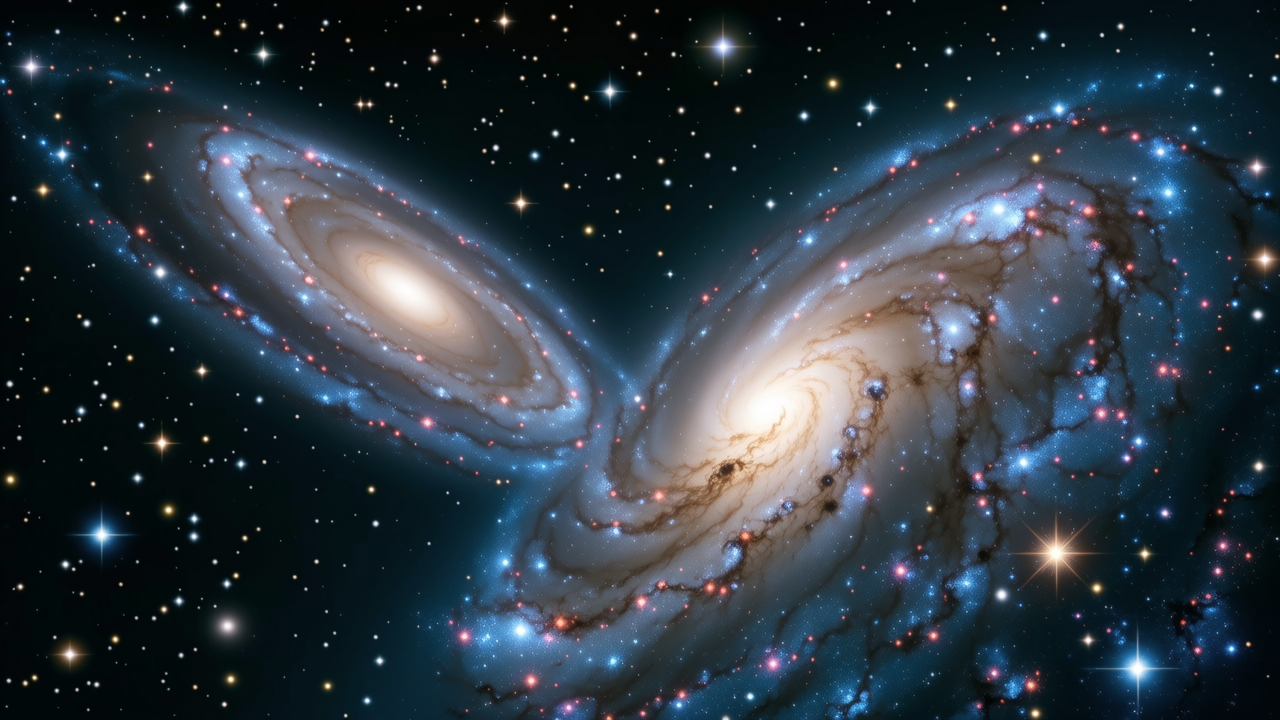
Far beyond the edges of our galaxy, a cosmic collision is already set in motion. The Andromeda galaxy (M31) — the largest spiral galaxy neighboring the Milky Way and visible to the naked eye on a dark night as a faint patch of light — is moving toward our galaxy at an astonishing speed of about 110 kilometers per second.
In approximately 4.5 billion years from now, Andromeda and the Milky Way will meet in a dramatic cosmic event called a galactic collision. However, this 'collision' will feel very different from what the word implies. Because galaxies are mainly composed of empty space between stars, the chance of stars from Andromeda directly colliding with any stars in the Milky Way is extremely low — roughly equivalent to the chance of two cars from different cities colliding if they were released from a distance of 1,000 kilometers.
What will happen is that these galaxies will gravitationally pull each other, stretch, distort, and eventually merge in a process that will take billions of years. Stars will be thrown into new, different orbits, and powerful waves of star formation may occur when gas clouds combine and compress.
The end result, in about 7 billion years from now, will be a large elliptical galaxy that scientists have informally named 'Milkomeda' — a combination of the Milky Way and Andromeda. Our Sun may still exist at that time, although perhaps in a very different orbit within the new combined galaxy.
🔬 Science Facts #26: The Andromeda Galaxy Is Moving Toward the Milky Way at 110km/s. Our neighboring galaxy, Andromeda, is moving toward the Milky Way at a speed of 110 kilometers per second and is expected to collide in 4.5 billion years — however, the chance of stars colliding is very low.. Far beyond the edges of our galaxy, a cosmic collision is already set in motion. The Andromeda galaxy M31 — the largest spiral galaxy neighboring the Milky Way and visible to the naked eye on a dark night as a faint patch of light — is moving toward our galaxy at an astonishing speed of about 110 kilometers per second.
In approximately 4.5 billion years from now, Andromeda and the Milky Way will meet in a dramatic cosmic event called a galactic collision. However, this 'collision' will feel very different from what the word implies. Because galaxies are mainly composed of empty space between stars, the chance of stars from Andromeda directly colliding with any stars in the Milky Way is extremely low — roughly equivalent to the chance of two cars from different cities colliding if they were released from a distance of 1,000 kilometers.
What will happen is that these galaxies will gravitationally pull each other, stretch, distort, and eventually merge in a process that will take billions of years. Stars will be thrown into new, different orbits, and powerful waves of star formation may occur when gas clouds combine and compress.
The end result, in about 7 billion years from now, will be a large elliptical galaxy that scientists have informally named 'Milkomeda' — a combination of the Milky Way and Andromeda. Our Sun may still exist at that time, although perhaps in a very different orbit within the new combined galaxy.