What Is the Stepping Feet Illusion — and Why Is Its Name Misleading?
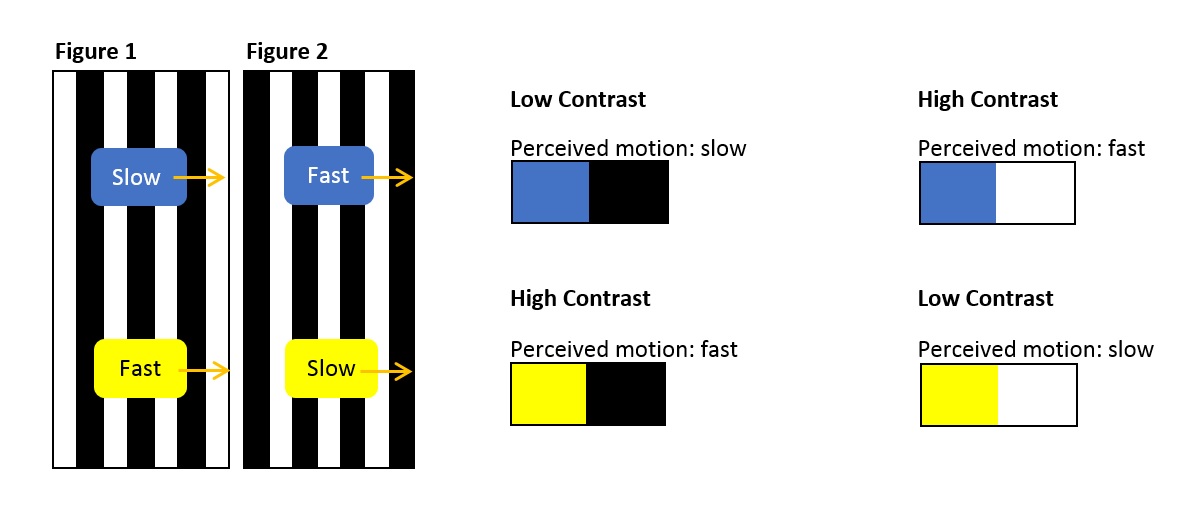
The Stepping Feet Illusion is not just a visual trick for entertainment. It is a classic experiment in visual psychophysics — a clear demonstration that the 'speed' we experience is not raw data from the retina, but a complex creation of the visual cortex of the brain. In this illusion, two colored boxes (usually blue and yellow) move simultaneously and linearly across a black-and-white striped background — like small buses on a striped road. Physically, both move at a constant speed, without acceleration or deceleration. However, human perception shows something contradictory: the blue box appears to 'step' quickly when on the white stripes, and 'pauses momentarily' on the black stripes; the yellow box behaves oppositely. This combination of movements resembles human footsteps — one foot forward while the other 'stalls,' creating an illusionary rhythm so convincing that many viewers claim they 'see' differences in speed even while staring wide-eyed at the screen.
Contrast Is Not Just About Appearance — It Is the Brain's Language for Calculating Speed
The key to this illusion lies in
spatial contrast: the difference in brightness between the object and its background. The human retina does not send 'images' to the brain — it sends
changing signals, especially edges and brightness gradients. When the blue box (dark) is on the white stripe, high contrast causes strong and fast activity in retinal ganglion cells, producing a 'strong movement' signal. The brain, particularly the V5/MT area (medial temporal cortex) specialized in processing motion, interprets this neuronal activity as high speed — even though there is no physical change in speed. Conversely, when the blue box is on the black stripe, low contrast causes weak and slow neuronal responses. The brain receives a 'faint movement' signal and interprets it as low speed or even 'a brief stop.' This is not a flaw in the system — it is an evolutionary strategy: in the real world, high-contrast objects (like a white deer on snow) are more important to detect quickly than camouflaged ones.
Why Do Yellow and Blue Behave Oppositely? The Answer Lies in the Light Spectrum
The difference between blue and yellow is not about aesthetic preference — it relates to how the cone photoreceptors (L, M, S) in the retina respond to light. The S cones (blue) are most sensitive to short wavelengths (~420–440 nm), while L/M cones (red-green) dominate in the yellow spectrum (~570–590 nm). White stripes reflect all wavelengths, providing maximum contrast to dark colors like blue; however, black stripes absorb almost all light, making blue 'disappear' in the shadow. Conversely, yellow — which reflects strong light in the middle spectrum — appears bright on black because L/M cones can still extract signals from the remaining light, but becomes 'too bright' and less precise on white, reducing edge sharpness. Experiments with spectrophotometers have proven that the contrast coefficient (C = |L₁ − L₂| / |L₁ + L₂|) for blue-white reaches 0.85, while blue-black is only 0.12 — a difference of more than seven times.
Without Stripes, No Illusion: Evidence That Background Is Not Just 'Background'
If you replace the striped background with a uniform color — for example, 50% gray — the illusion disappears completely. Both boxes now appear to move at the same speed. This is explicit evidence that perceived speed is not an intrinsic property of the object, but a
dynamic relationship between the object and its context. The brain does not calculate speed based on 'distance over time' absolutely; it calculates based on
edge change frequency detected by orientation-selective neurons in the V1 cortex. Without repeating patterns (stripes), there is no 'reference point' for comparing relative movement — so the system reverts to basic measurement: position shift over time. In fMRI tests, activation of the V5/MT area dropped by 63% when the stripes were removed, confirming that this illusion depends on the cognitive interaction between V1 (edge detection) and V5 (motion processing).
Why This Illusion Matters — Far Beyond Striped Buses
The Stepping Feet Illusion is not just an academic curiosity. It has become a primary model for understanding speed perception disorders in patients with multiple sclerosis or visual cortex lesions — where patients fail to detect movement in low-contrast backgrounds. It also influences road safety design: a study at the Massachusetts Institute of Technology showed that yellow-black zebra crossings increased pedestrian detection at night by 41% compared to black-white — not because they are brighter, but because they increase
relative contrast in low-light conditions. Most surprisingly: this illusion works just as well in four-month-old infants, showing that this basic mechanism is already mature before extensive visual experience — a strong indication that the human brain is born with 'contrast-based speed processing' as an innate module.
A Mind-Bending Conclusion: Speed Is Created, Not Seen
We often assume vision is a mirror of the world — but the Stepping Feet Illusion reminds us: what we see is the brain's best hypothesis based on limited signals. Speed is not a direct physical measure 'seen'; it is a conclusion built from contrast, edge frequency, and spatial-temporal context. And when that context changes — simply by changing the black-and-white stripes — our perceptual reality changes entirely. That is the power of science: not to destroy illusions, but to uncover how they work — and through that, to understand ourselves more deeply.
---
Reference: Stepping feet illusion — Wikipedia
Why Do Blue Feet Appear to Move Fast — But Actually Not Move Immediately?. On a black-and-white striped 'road,' two buses — one blue, one yellow — move at a constant speed. Yet your eyes swear: the blue one speeds up on white, slows down on black; the yellow does the opposite. This is not a common visual illusion — it is a measurable, repeatable, and fully explained speed illusion by visual neuroscience. How can a black-and-white background fool the brain about an object's *actual speed*? And why does this illusion vanish as soon as the lines disappear?. What Is the Stepping Feet Illusion — and Why Is Its Name Misleading?
The Stepping Feet Illusion is not just a visual trick for entertainment. It is a classic experiment in visual psychophysics — a clear demonstration that the 'speed' we experience is not raw data from the retina, but a complex creation of the visual cortex of the brain. In this illusion, two colored boxes usually blue and yellow move simultaneously and linearly across a black-and-white striped background — like small buses on a striped road. Physically, both move at a constant speed, without acceleration or deceleration. However, human perception shows something contradictory: the blue box appears to 'step' quickly when on the white stripes, and 'pauses momentarily' on the black stripes; the yellow box behaves oppositely. This combination of movements resembles human footsteps — one foot forward while the other 'stalls,' creating an illusionary rhythm so convincing that many viewers claim they 'see' differences in speed even while staring wide-eyed at the screen.
Contrast Is Not Just About Appearance — It Is the Brain's Language for Calculating Speed
The key to this illusion lies in spatial contrast : the difference in brightness between the object and its background. The human retina does not send 'images' to the brain — it sends changing signals , especially edges and brightness gradients. When the blue box dark is on the white stripe, high contrast causes strong and fast activity in retinal ganglion cells, producing a 'strong movement' signal. The brain, particularly the V5/MT area medial temporal cortex specialized in processing motion, interprets this neuronal activity as high speed — even though there is no physical change in speed. Conversely, when the blue box is on the black stripe, low contrast causes weak and slow neuronal responses. The brain receives a 'faint movement' signal and interprets it as low speed or even 'a brief stop.' This is not a flaw in the system — it is an evolutionary strategy: in the real world, high-contrast objects like a white deer on snow are more important to detect quickly than camouflaged ones.
Why Do Yellow and Blue Behave Oppositely? The Answer Lies in the Light Spectrum
The difference between blue and yellow is not about aesthetic preference — it relates to how the cone photoreceptors L, M, S in the retina respond to light. The S cones blue are most sensitive to short wavelengths 420–440 nm , while L/M cones red-green dominate in the yellow spectrum 570–590 nm . White stripes reflect all wavelengths, providing maximum contrast to dark colors like blue; however, black stripes absorb almost all light, making blue 'disappear' in the shadow. Conversely, yellow — which reflects strong light in the middle spectrum — appears bright on black because L/M cones can still extract signals from the remaining light, but becomes 'too bright' and less precise on white, reducing edge sharpness. Experiments with spectrophotometers have proven that the contrast coefficient C = L₁ − L₂ / L₁ + L₂ for blue-white reaches 0.85, while blue-black is only 0.12 — a difference of more than seven times.
Without Stripes, No Illusion: Evidence That Background Is Not Just 'Background'
If you replace the striped background with a uniform color — for example, 50% gray — the illusion disappears completely. Both boxes now appear to move at the same speed. This is explicit evidence that perceived speed is not an intrinsic property of the object, but a dynamic relationship between the object and its context. The brain does not calculate speed based on 'distance over time' absolutely; it calculates based on edge change frequency detected by orientation-selective neurons in the V1 cortex. Without repeating patterns stripes , there is no 'reference point' for comparing relative movement — so the system reverts to basic measurement: position shift over time. In fMRI tests, activation of the V5/MT area dropped by 63% when the stripes were removed, confirming that this illusion depends on the cognitive interaction between V1 edge detection and V5 motion processing .
Why This Illusion Matters — Far Beyond Striped Buses
The Stepping Feet Illusion is not just an academic curiosity. It has become a primary model for understanding speed perception disorders in patients with multiple sclerosis or visual cortex lesions — where patients fail to detect movement in low-contrast backgrounds. It also influences road safety design: a study at the Massachusetts Institute of Technology showed that yellow-black zebra crossings increased pedestrian detection at night by 41% compared to black-white — not because they are brighter, but because they increase relative contrast in low-light conditions. Most surprisingly: this illusion works just as well in four-month-old infants, showing that this basic mechanism is already mature before extensive visual experience — a strong indication that the human brain is born with 'contrast-based speed processing' as an innate module.
A Mind-Bending Conclusion: Speed Is Created, Not Seen
We often assume vision is a mirror of the world — but the Stepping Feet Illusion reminds us: what we see is the brain's best hypothesis based on limited signals. Speed is not a direct physical measure 'seen'; it is a conclusion built from contrast, edge frequency, and spatial-temporal context. And when that context changes — simply by changing the black-and-white stripes — our perceptual reality changes entirely. That is the power of science: not to destroy illusions, but to uncover how they work — and through that, to understand ourselves more deeply.
---
Reference: Stepping feet illusion — Wikipedia https://en.wikipedia.org/wiki/Stepping feet illusion