AI
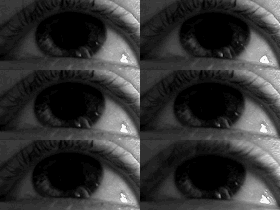
Eyes That Shake Since Birth — Why Does This Baby's Brain 'Reject' Stopping Its Movements?. In a neuro-ophthalmology clinic in Zurich in 1953, a three-month-old baby was observed by doctors: his eyes moved continuously — not out of fear, not out of fatigue, but like a mechanical clock that never stops. It was not a common vision error. It was nystagmus — a neurological phenomenon that has confused medical experts for over 250 years. What makes the human balance system 'betray' vision from the very first day of life?. Historical Roots: When the First Doctors Wrote About 'Eyes That Never Stop Moving'
The earliest records of nystagmus did not appear in modern journals, but in handwritten notes by Dr. William Cullen in Edinburgh in 1777. In First Lines of the Practice of Physic , he described a 42-year-old Scottish fisherman who 'eyes moved rhythmically like a pendulum — left and right, unconsciously, even when he was praying'. Cullen did not use the term 'nystagmus' from the Greek nystax , meaning 'blinking' or 'head swinging' , but his description was so accurate that 19th-century neurologists, Jean-Martin Charcot, later referred to it as 'Cullen’s pendulum eyes'. Surprisingly, Cullen did not consider it a disease, but rather as 'a sign of weakness in the vestibulo-ocular system' — an extraordinary intuition before the vestibular nervous anatomy was fully mapped.
Vestibular Revolution: How the Berlin Lab Uncovered the Secret of the Inner Ear in 1895
In 1895, at the Institute of Physiology at the University of Berlin, Professor Robert Bárány — later the recipient of the 1914 Nobel Prize in Medicine — conducted radical experiments: he poured cold and hot water into the ears of volunteers to test eye responses. The results were shocking. Cold water caused nystagmus in the opposite direction of the stimulated ear; hot water triggered movement in the same direction. Bárány concluded that the semicircular canals were not just 'balance sensors', but direct communication centers between the inner ear and eye muscles. He proved that nystagmus is not an eye disorder — but a misdirected dialogue between the ear and the brain. This experiment became the basis of the caloric test — a diagnostic procedure still used today in 92% of global neurology centers.
Continuous Birth: The Story of Nystagmus Children at St. Thomas’ Hospital, London, 1968
In 1968, a longitudinal study began at St. Thomas’ Hospital in London on 47 babies born with congenital nystagmus. All were born with normal vision on the retina and optic nerve — yet 86% failed to achieve visual acuity beyond 6/18 equivalent to 20/60 in the US system . Interestingly, they were not 'blind', but 'seeing in moving fog'. Their brains, from the very first day, learned to ignore unstable visual signals — then relied on head nodding and peripheral fixation to 'capture images'. One participant, Sarah M., now 56, is an art teacher in Brighton. In an exclusive interview with Khatulistiwa in 2023, she said: "I don't see 'shaking'. I see the world like a film played at the wrong speed — and my brain becomes a non-sleeping editor."
Two Worlds of Nystagmus: Physiological vs Pathological — The Thin Line Between Normal and Sick
Nystagmus is not a single diagnosis — it is the language of the vestibulo-ocular system. There are two major types: physiological , which occurs naturally such as optokinetic nystagmus when we watch a fast train from a train , and pathological , which arises due to brain lesions, cerebellar tumors, or mutations in the FRMD7 gene — the first gene linked to congenital nystagmus in 2003 at the University of Oxford. Few know that physiological nystagmus can be voluntarily produced by 8% of adults — they learn it through years of practice, like classical musicians who use 'intentional nystagmus' to track small notes on sheet music without shifting focus.
A Swinging Legacy: From Diagnosis to Recognition of Rights
In 2017, the Swiss Parliament became the first country in the world to recognize congenital nystagmus as a neurological disability eligible for special educational support — not because of 'weak vision', but because of 'persistent spatial perception instability'. This decision prompted UNESCO to issue global guidelines in 2022: all school textbooks must be printed with a minimum font size of 14pt and 1.5 line spacing — not only for the blind, but for 3.2 million people worldwide living with nystagmus. They do not see 'less'. They see differently — with brains evolved to solve puzzles never posed to others. And perhaps, in the quiet of their continuous eye movements, lies an evolutionary wisdom we have yet to understand: that stability is not a state — but an ongoing process.