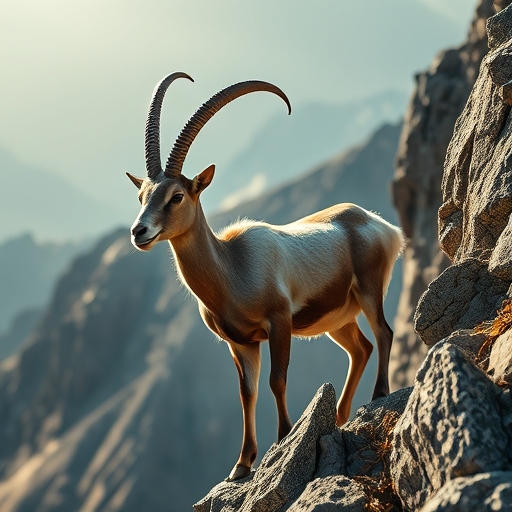
Imagine an animal that moves nimbly on almost vertical rock faces, as if gravity has no effect. With strong muscles and gripping hooves, this animal can leap between rock crevices and climb challenging peaks. This is a brief description of the desert goat, or more commonly known as the ibex, a wild goat species that has long captured the attention of scientists and wildlife enthusiasts worldwide. Its presence not only marks a healthy mountain ecosystem but also symbolizes nature's resilience and adaptive efficiency. As a Science & Technology Desk reporter, I, Nurul Izzati, invite you to delve into the unique world of this animal.
What is a Desert Goat and Its Unique Physical Characteristics?
The desert goat refers to several wild goat species in the genus
Capra, most notably distinguished by the physical characteristics of their males. Male desert goats possess
large, curved horns that arch horizontally at the front, forming an impressive curve backward. These horns can reach lengths of up to a meter or more, serving not only as an attraction during mating season but also as a defensive weapon against predators and in dominance fights among males. Females, on the other hand, have smaller, more slender horns.
The desert goat's coat is typically yellowish-brown to grayish-brown, and can become darker in winter. Their short, stocky, and muscular legs are equipped with cloven hooves, hard on the outside and soft on the inside, providing exceptional grip on rocky and uneven surfaces. This feature is a key to their unparalleled cliff-climbing prowess.
Where Can We Find Desert Goats?
Desert goats are widely distributed across several geographical regions. According to reports and studies, these species are generally
found in Eurasia, North Africa, and East Africa. This includes mountain ranges in Europe such as the Alps (the native habitat of the Alpine ibex), the Caucasus, and the Pyrenees. In Asia, they inhabit areas like the Himalayas, Central Asia, and parts of the Middle East. In Africa, their habitats include mountain ranges in North Africa (such as the Nubian ibex) and also in East Africa. Each population has often adapted to the specific climate and topography of its region, resulting in distinct subspecies with slight variations in appearance and behavior.
How Do Desert Goats Survive in Extreme Habitats?
The ability of desert goats to live and thrive in harsh mountain habitats is a testament to amazing evolution. Several key adaptations enable them to face these challenges:
- Specialized Hooves: As mentioned, their hooves provide exceptional grip, allowing them to climb steep slopes and stand on narrow ledges. The structure of these hooves is like a flexible rubber pad, highly effective on rock.
- Sharp Hearing and Vision: These help them detect predators such as wolves, snow leopards, or eagles from a distance in open environments.
- Flexible Diet: They are herbivores that feed on a variety of mountain vegetation, including grasses, mosses, shrubs, and tree leaves. They can spend hours grazing on slopes, even during harsh winters when food is scarce.
- Adaptive Physiology: Their bodies can withstand extreme temperatures, from the scorching heat of the desert to the freezing cold of mountain peaks. They are also efficient in water usage, which is crucial in arid environments.
Are There Different Types of Desert Goats?
Yes, there are several different species of desert goats, each with its unique characteristics and habitat. Among the most well-known are:
- **Alpine Ibex (Capra ibex)**: Found in the European Alps, it is the most recognized species and has been successfully recovered from the brink of extinction.
- **Nubian Ibex (Capra nubiana)**: Inhabits desert and semi-desert areas in the Middle East and North Africa, known for its very long and slender horns.
- **Siberian Ibex (Capra sibirica)**: A large species living in the mountain ranges of Central Asia, possessing very large and heavy horns.
- **Spanish Ibex (Capra pyrenaica)**: Found in the Pyrenees and other mountain ranges on the Iberian Peninsula, with various subspecies.
Each of these species has adapted to the nuances of their environment, yet all share an extraordinary ability to navigate challenging mountainous landscapes.
What is the Conservation Status of Desert Goats?
While desert goats are generally not considered globally endangered species, some of their species or subspecies face serious conservation challenges. The main threats include habitat loss due to human development, poaching, competition with domestic livestock for food, and climate change affecting the availability of their resources and habitats. For example, the Pyrenean Ibex went extinct in the early 21st century, despite intensive conservation efforts.
Conservation efforts are underway in many areas, involving the establishment of protected areas, captive breeding programs, and stricter anti-poaching laws. Public education also plays a vital role in raising awareness about the importance of protecting these iconic animals and their natural habitats. Understanding the ecology of desert goats is the first step to ensuring their survival for future generations, especially in the context of rapidly accelerating global climate change.
Mystery of the Desert Goat: Steep Cliff Rulers from Eurasia to Africa. The desert goat, or ibex, is no ordinary goat; it is an extraordinary wild species with magnificent curved horns and amazing adaptability that allows it to conquer the most extreme mountainous landscapes across three continents.. Imagine an animal that moves nimbly on almost vertical rock faces, as if gravity has no effect. With strong muscles and gripping hooves, this animal can leap between rock crevices and climb challenging peaks. This is a brief description of the desert goat, or more commonly known as the ibex, a wild goat species that has long captured the attention of scientists and wildlife enthusiasts worldwide. Its presence not only marks a healthy mountain ecosystem but also symbolizes nature's resilience and adaptive efficiency. As a Science & Technology Desk reporter, I, Nurul Izzati, invite you to delve into the unique world of this animal.
What is a Desert Goat and Its Unique Physical Characteristics?
The desert goat refers to several wild goat species in the genus Capra , most notably distinguished by the physical characteristics of their males. Male desert goats possess large, curved horns that arch horizontally at the front, forming an impressive curve backward. These horns can reach lengths of up to a meter or more, serving not only as an attraction during mating season but also as a defensive weapon against predators and in dominance fights among males. Females, on the other hand, have smaller, more slender horns.
The desert goat's coat is typically yellowish-brown to grayish-brown, and can become darker in winter. Their short, stocky, and muscular legs are equipped with cloven hooves, hard on the outside and soft on the inside, providing exceptional grip on rocky and uneven surfaces. This feature is a key to their unparalleled cliff-climbing prowess.
Where Can We Find Desert Goats?
Desert goats are widely distributed across several geographical regions. According to reports and studies, these species are generally found in Eurasia, North Africa, and East Africa . This includes mountain ranges in Europe such as the Alps the native habitat of the Alpine ibex , the Caucasus, and the Pyrenees. In Asia, they inhabit areas like the Himalayas, Central Asia, and parts of the Middle East. In Africa, their habitats include mountain ranges in North Africa such as the Nubian ibex and also in East Africa. Each population has often adapted to the specific climate and topography of its region, resulting in distinct subspecies with slight variations in appearance and behavior.
How Do Desert Goats Survive in Extreme Habitats?
The ability of desert goats to live and thrive in harsh mountain habitats is a testament to amazing evolution. Several key adaptations enable them to face these challenges:
Specialized Hooves : As mentioned, their hooves provide exceptional grip, allowing them to climb steep slopes and stand on narrow ledges. The structure of these hooves is like a flexible rubber pad, highly effective on rock.
Sharp Hearing and Vision : These help them detect predators such as wolves, snow leopards, or eagles from a distance in open environments.
Flexible Diet : They are herbivores that feed on a variety of mountain vegetation, including grasses, mosses, shrubs, and tree leaves. They can spend hours grazing on slopes, even during harsh winters when food is scarce.
Adaptive Physiology : Their bodies can withstand extreme temperatures, from the scorching heat of the desert to the freezing cold of mountain peaks. They are also efficient in water usage, which is crucial in arid environments.
Are There Different Types of Desert Goats?
Yes, there are several different species of desert goats, each with its unique characteristics and habitat. Among the most well-known are:
Alpine Ibex Capra ibex : Found in the European Alps, it is the most recognized species and has been successfully recovered from the brink of extinction.
Nubian Ibex Capra nubiana : Inhabits desert and semi-desert areas in the Middle East and North Africa, known for its very long and slender horns.
Siberian Ibex Capra sibirica : A large species living in the mountain ranges of Central Asia, possessing very large and heavy horns.
Spanish Ibex Capra pyrenaica : Found in the Pyrenees and other mountain ranges on the Iberian Peninsula, with various subspecies.
Each of these species has adapted to the nuances of their environment, yet all share an extraordinary ability to navigate challenging mountainous landscapes.
What is the Conservation Status of Desert Goats?
While desert goats are generally not considered globally endangered species, some of their species or subspecies face serious conservation challenges. The main threats include habitat loss due to human development, poaching, competition with domestic livestock for food, and climate change affecting the availability of their resources and habitats. For example, the Pyrenean Ibex went extinct in the early 21st century, despite intensive conservation efforts.
Conservation efforts are underway in many areas, involving the establishment of protected areas, captive breeding programs, and stricter anti-poaching laws. Public education also plays a vital role in raising awareness about the importance of protecting these iconic animals and their natural habitats. Understanding the ecology of desert goats is the first step to ensuring their survival for future generations, especially in the context of rapidly accelerating global climate change.