🌍 Global coverage 24/7 • 🏯 East Asia: China, Japan, Korea • 🛕 South Asia: India • 🏰 Europe • 🗽 Americas • 🌍 Africa • 🕌 Middle East • 🇵🇸 Palestine Solidarity •
This article is a translation from the original language.
🧠 Did You Know
Millions of Dollars Not Enough for a Loaf of Bread: The Horrifying Story of German Hyperinflation in 1923
Imagine paper money worth RM1 million being enough to buy just one loaf of bread. That was the reality faced by the people of Germany in 1923 when hyperinflation hit the Weimar Republic. Within a few months, the value of the currency collapsed so much that one US dollar was worth 4.2 trillion marks. This article reveals the causes, the experiences of the people, and the devastating end of the worst economic crisis in modern history.
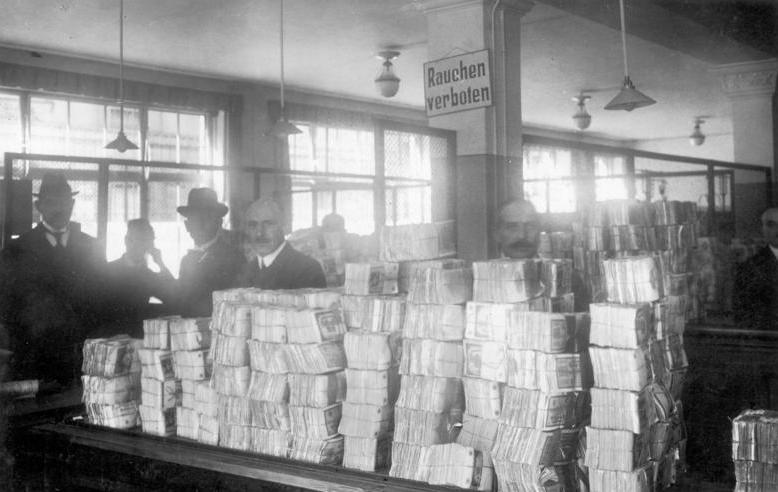
Image: Foto: Wikipedia — Hyperinflation in the Weimar Republic (CC BY-SA 4.0)
AI
Paper Money as Wall Paper
In a small apartment in Berlin during the winter of 1923, Frau Schmidt gazed at a pile of paper money that filled the living room. Not for spending, but for burning in the kitchen. Firewood was too expensive, while the paper money, whose value dropped every hour, was more useful as fuel. Across Germany, children played with piles of worthless paper money — building paper castles, and even folding them into kites. This was not a story of luxury, but of an economic tragedy known as the Weimar hyperinflation, which peaked in 1923. Within a few years, the German currency — the Papiermark — fell from 4.2 marks per US dollar in 1914 to 4,210,500,000,000 marks per dollar in November 1923. How could a developed country reach such a point?
War Debt and Reparation Burden
The problem began during World War I. The German government, under Kaiser Wilhelm II, chose to finance the war not through taxes, but through loans. This caused the national debt to skyrocket to 156 billion marks by 1918. When the war ended, the 1919 Treaty of Versailles imposed heavy conditions on Germany — including paying reparations of 50 billion marks in cash and goods such as coal and timber. The London Schedule of May 1921 set this amount to be paid in hard currencies like gold or dollars. To meet these demands, the Weimar government started printing money uncontrollably. In August 1921, the German Central Bank (Reichsbank) began buying hard currencies with Papiermark at any price, under the pretext of paying reparations — although actual cash payments were minimal until 1924. This started a vicious cycle: the more money printed, the lower its value; the lower its value, the more money had to be printed.
Moments of Value Destruction
In early 1922, the mark seemed stable at around 320 marks per dollar. However, inflation then exploded. By December 1922, one US dollar was worth 7,400 marks. In January 1923, France and Belgium occupied the Ruhr — Germany's main industrial region — as pressure for reparations. The German government responded by encouraging passive resistance and printing more money to pay the wages of striking workers. The result? By July 1923, one dollar was worth 353,000 marks; in August, 4.6 million marks; in September, 98.9 million marks; in October, 25.3 billion marks. The peak came in November 1923: one US dollar equaled 4,210,500,000,000 marks. Paper money worth trillions of marks was printed, but almost not enough to buy daily goods. The price of bread, which was 250 marks in January 1923, jumped to 200,000 billion marks in November. People had to carry money in bags or wheelbarrows just to buy food. Wages were paid daily — and sometimes hourly — because their value dropped so quickly.
Daily Life During the Crisis
For ordinary people like Frau Schmidt, hyperinflation meant losing their life savings. Workers and middle-class retirees who saved money in banks found their savings instantly worthless. A teacher named Friedrich wrote in his diary: 'I received my salary at 10 am. By noon, half of its value was gone. I ran to the bakery, but prices had already risen.' Barter systems became popular again — exchanging goods for goods. A farmer might refuse to sell his produce for paper money, instead asking for items like watches or furniture. Small businesses went bankrupt, while foreign speculators bought German real estate at low prices. This instability also sparked social and political tensions. Extreme parties like the Nazi Party began gaining support by promising to restore dignity and stability. Hyperinflation not only destroyed the economy, but also the spirit of the nation.
End of the Crisis and an Eternal Lesson
In November 1923, the German government under Chancellor Gustav Stresemann took drastic measures. The Rentenmark was introduced as a new currency, backed by land and industrial assets. The exchange rate was set: 1 Rentenmark = 1 trillion Papiermark. The central bank was given independence, and money printing was halted. This measure successfully restored confidence; within weeks, prices stabilized. However, the damage had already been done. People's savings were destroyed, the middle class was ruined, and psychological wounds lasted until World War II. The Weimar hyperinflation became a warning to the modern world about the dangers of uncontrolled money printing, unchecked national debt, and loss of trust in institutions. It also reminds us that economic stability is not just numbers, but the lives and dignity of people. Until today, Germany is known for its cautious attitude towards inflation — a direct legacy from the 1923 tragedy.
Millions of Dollars Not Enough for a Loaf of Bread: The Horrifying Story of German Hyperinflation in 1923. Imagine paper money worth RM1 million being enough to buy just one loaf of bread. That was the reality faced by the people of Germany in 1923 when hyperinflation hit the Weimar Republic. Within a few months, the value of the currency collapsed so much that one US dollar was worth 4.2 trillion marks. This article reveals the causes, the experiences of the people, and the devastating end of the worst economic crisis in modern history.. Paper Money as Wall Paper
In a small apartment in Berlin during the winter of 1923, Frau Schmidt gazed at a pile of paper money that filled the living room. Not for spending, but for burning in the kitchen. Firewood was too expensive, while the paper money, whose value dropped every hour, was more useful as fuel. Across Germany, children played with piles of worthless paper money — building paper castles, and even folding them into kites. This was not a story of luxury, but of an economic tragedy known as the Weimar hyperinflation, which peaked in 1923. Within a few years, the German currency — the Papiermark — fell from 4.2 marks per US dollar in 1914 to 4,210,500,000,000 marks per dollar in November 1923. How could a developed country reach such a point?
War Debt and Reparation Burden
The problem began during World War I. The German government, under Kaiser Wilhelm II, chose to finance the war not through taxes, but through loans. This caused the national debt to skyrocket to 156 billion marks by 1918. When the war ended, the 1919 Treaty of Versailles imposed heavy conditions on Germany — including paying reparations of 50 billion marks in cash and goods such as coal and timber. The London Schedule of May 1921 set this amount to be paid in hard currencies like gold or dollars. To meet these demands, the Weimar government started printing money uncontrollably. In August 1921, the German Central Bank Reichsbank began buying hard currencies with Papiermark at any price, under the pretext of paying reparations — although actual cash payments were minimal until 1924. This started a vicious cycle: the more money printed, the lower its value; the lower its value, the more money had to be printed.
Moments of Value Destruction
In early 1922, the mark seemed stable at around 320 marks per dollar. However, inflation then exploded. By December 1922, one US dollar was worth 7,400 marks. In January 1923, France and Belgium occupied the Ruhr — Germany's main industrial region — as pressure for reparations. The German government responded by encouraging passive resistance and printing more money to pay the wages of striking workers. The result? By July 1923, one dollar was worth 353,000 marks; in August, 4.6 million marks; in September, 98.9 million marks; in October, 25.3 billion marks. The peak came in November 1923: one US dollar equaled 4,210,500,000,000 marks. Paper money worth trillions of marks was printed, but almost not enough to buy daily goods. The price of bread, which was 250 marks in January 1923, jumped to 200,000 billion marks in November. People had to carry money in bags or wheelbarrows just to buy food. Wages were paid daily — and sometimes hourly — because their value dropped so quickly.
Daily Life During the Crisis
For ordinary people like Frau Schmidt, hyperinflation meant losing their life savings. Workers and middle-class retirees who saved money in banks found their savings instantly worthless. A teacher named Friedrich wrote in his diary: 'I received my salary at 10 am. By noon, half of its value was gone. I ran to the bakery, but prices had already risen.' Barter systems became popular again — exchanging goods for goods. A farmer might refuse to sell his produce for paper money, instead asking for items like watches or furniture. Small businesses went bankrupt, while foreign speculators bought German real estate at low prices. This instability also sparked social and political tensions. Extreme parties like the Nazi Party began gaining support by promising to restore dignity and stability. Hyperinflation not only destroyed the economy, but also the spirit of the nation.
End of the Crisis and an Eternal Lesson
In November 1923, the German government under Chancellor Gustav Stresemann took drastic measures. The Rentenmark was introduced as a new currency, backed by land and industrial assets. The exchange rate was set: 1 Rentenmark = 1 trillion Papiermark. The central bank was given independence, and money printing was halted. This measure successfully restored confidence; within weeks, prices stabilized. However, the damage had already been done. People's savings were destroyed, the middle class was ruined, and psychological wounds lasted until World War II. The Weimar hyperinflation became a warning to the modern world about the dangers of uncontrolled money printing, unchecked national debt, and loss of trust in institutions. It also reminds us that economic stability is not just numbers, but the lives and dignity of people. Until today, Germany is known for its cautious attitude towards inflation — a direct legacy from the 1923 tragedy.
---
Reference: Hyperinflation in the Weimar Republic — Wikipedia https://en.wikipedia.org/wiki/Hyperinflation in the Weimar Republic
World War I, Weimar Republic, 1923, Berlin, Kaiser Wilhelm II, paper money, financial collapse, currency collapse, German history, hyperinflation, Papiermark, economic disaster, Germany, economic crisis, reparation burden