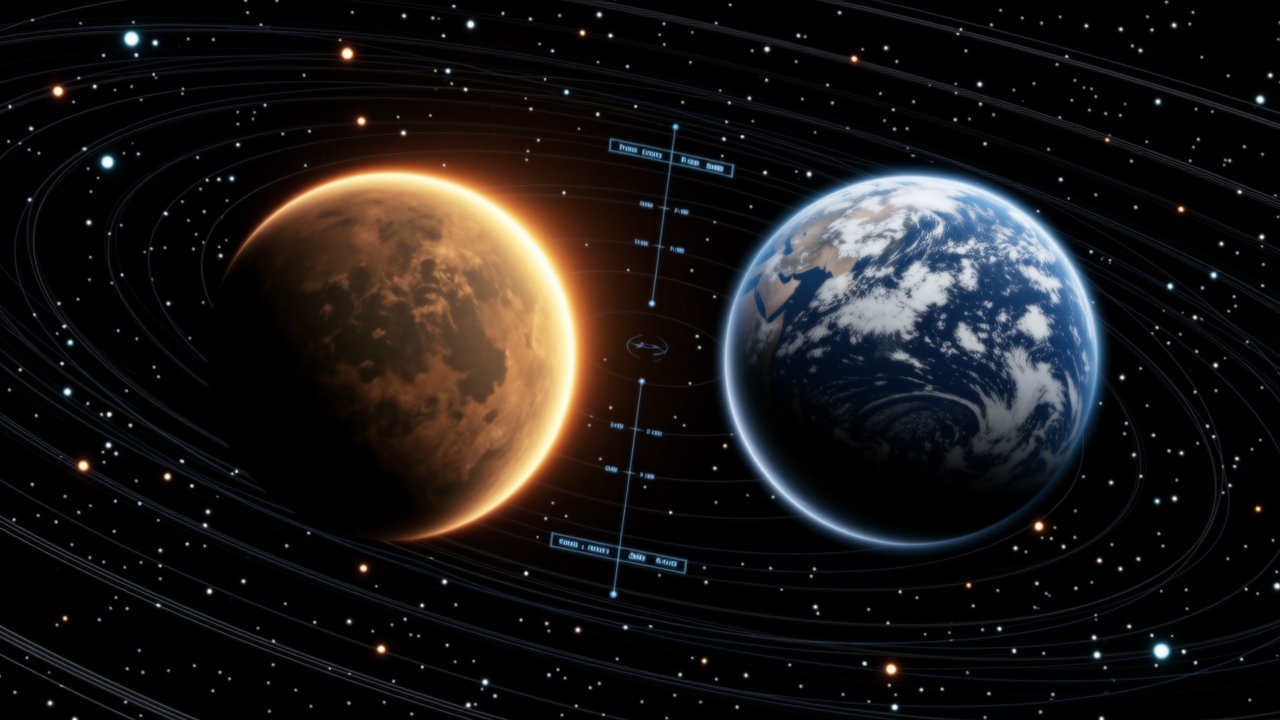
In our solar system, most planets rotate on their axes in the same direction — counterclockwise when viewed from the north pole of the solar system. This rotation is a legacy of the protoplanetary disk that spun as the solar system formed from a cloud of gas and dust. However, there are two notable exceptions: Venus and Uranus.
Venus rotates in the opposite (retrograde) direction compared to Earth, meaning if you were standing on the surface of Venus and could see the sun through the thick sulfuric clouds that envelop it, the sun would rise in the west and set in the east. This is completely opposite to the experience on Earth.
Adding to this peculiarity, a day on Venus (the time for one full rotation on its axis) is longer than a year on Venus (the time for one orbit around the Sun). A day on Venus takes 243 Earth days, while a year on Venus is only 225 Earth days. This means on Venus, you would celebrate more "years" than "days"!
Why does Venus rotate backwards? The most accepted answer is that in the early days of the solar system, Venus experienced a major collision with another object that reversed its rotation. Another theory suggests that the very strong tidal effects from the Sun and Venus's dense atmosphere could have slowly reversed the planet's rotation over time. Uranus, on the other hand, rotates on its nearly flat axis, possibly due to a major collision during its formation.
🔬 Science Facts #22: Venus Rotates in the Opposite Direction Compared to Most Planets. Venus rotates on its axis in the opposite direction of Earth and most other planets — meaning on Venus, the Sun rises in the west and sets in the east.. In our solar system, most planets rotate on their axes in the same direction — counterclockwise when viewed from the north pole of the solar system. This rotation is a legacy of the protoplanetary disk that spun as the solar system formed from a cloud of gas and dust. However, there are two notable exceptions: Venus and Uranus.
Venus rotates in the opposite retrograde direction compared to Earth, meaning if you were standing on the surface of Venus and could see the sun through the thick sulfuric clouds that envelop it, the sun would rise in the west and set in the east. This is completely opposite to the experience on Earth.
Adding to this peculiarity, a day on Venus the time for one full rotation on its axis is longer than a year on Venus the time for one orbit around the Sun . A day on Venus takes 243 Earth days, while a year on Venus is only 225 Earth days. This means on Venus, you would celebrate more "years" than "days"!
Why does Venus rotate backwards? The most accepted answer is that in the early days of the solar system, Venus experienced a major collision with another object that reversed its rotation. Another theory suggests that the very strong tidal effects from the Sun and Venus's dense atmosphere could have slowly reversed the planet's rotation over time. Uranus, on the other hand, rotates on its nearly flat axis, possibly due to a major collision during its formation.