Quasars — short for quasi-stellar radio sources — are among the brightest and most violent objects known in the universe. A quasar can produce light that exceeds the entire Milky Way galaxy, which contains 200-400 billion stars, with some of the brightest quasars producing light equivalent to 100 trillion stars like our Sun.
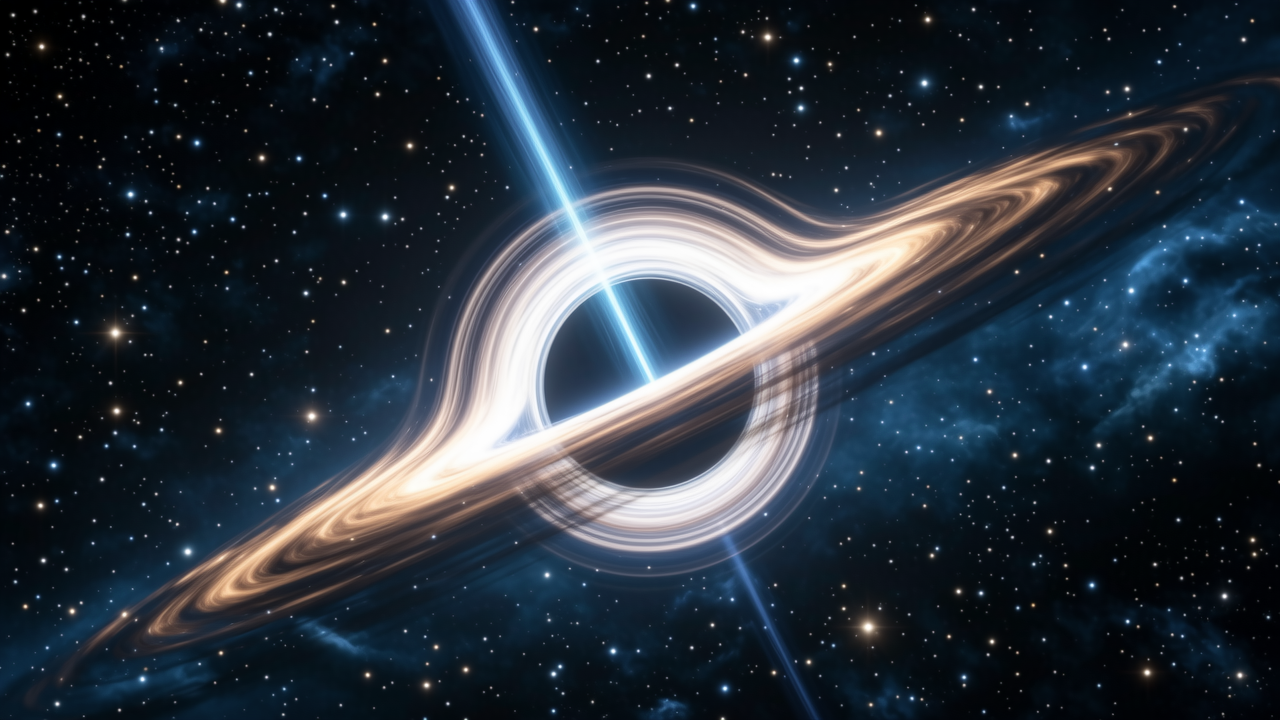
Quasars are essentially active galactic nuclei — supermassive black holes at the center of galaxies that are actively accreting mass. As gas, dust, and stars fall toward the black hole, they form a rapidly spinning accretion disk. Friction within this disk generates extreme heat — millions of degrees — and releases enormous amounts of energy in the form of light, X-rays, and other radiation.
The most astonishing aspect of quasars is their distance. Most quasars we know are located billions of light-years away from Earth — meaning the light we receive from them left the quasars billions of years ago, giving us a view into the very young early universe. The farthest quasar ever discovered is more than 13 billion light-years away — showing us galaxies that formed only a few hundred million years after the Big Bang.
Although quasars produce immense amounts of energy, the black holes generating this energy are extremely compact — the entire power of a quasar is produced in an area no larger than our solar system.
🔬 Science Facts #7: Quasars Produce More Light Than 100 Trillion Stars Combined. Quasars are the brightest objects in the universe — some quasars produce light that exceeds the combination of entire galaxies containing hundreds of billions of stars.. Quasars — short for quasi-stellar radio sources — are among the brightest and most violent objects known in the universe. A quasar can produce light that exceeds the entire Milky Way galaxy, which contains 200-400 billion stars, with some of the brightest quasars producing light equivalent to 100 trillion stars like our Sun.
Quasars are essentially active galactic nuclei — supermassive black holes at the center of galaxies that are actively accreting mass. As gas, dust, and stars fall toward the black hole, they form a rapidly spinning accretion disk. Friction within this disk generates extreme heat — millions of degrees — and releases enormous amounts of energy in the form of light, X-rays, and other radiation.
The most astonishing aspect of quasars is their distance. Most quasars we know are located billions of light-years away from Earth — meaning the light we receive from them left the quasars billions of years ago, giving us a view into the very young early universe. The farthest quasar ever discovered is more than 13 billion light-years away — showing us galaxies that formed only a few hundred million years after the Big Bang.
Although quasars produce immense amounts of energy, the black holes generating this energy are extremely compact — the entire power of a quasar is produced in an area no larger than our solar system.